Electric vehicles are no longer a distant dream for Kenyan drivers — they are pulling up right outside your gate. With fuel prices refusing to behave and the government pushing hard for cleaner roads, the question for many Kenyans is no longer whether to go electric, but how to pay for it. That is exactly where NCBA Bank has stepped in with a bold move.
In February 2026, NCBA Bank launched a specialized EV loan product that offers interest rates 2% lower than its traditional vehicle financing. It is the kind of deal that makes you put down your cup of chai and pay attention. Whether you are a first-time car buyer, a fleet owner, or simply a Nairobi commuter tired of the pump, this loan could be your ticket to affordable, sustainable mobility.
In this guide, we break down everything you need to know about the NCBA EV loan — what it covers, who qualifies, how to apply, and why now is genuinely the best time to make the switch to electric. For the latest automotive news, car reviews, and driving guides tailored for Kenyan roads, be sure to check out automag.co.ke.
Why NCBA Is Betting Big on Electric Vehicles in Kenya
NCBA Bank has actually been in the EV financing game for a few years. Back in 2022, the bank set aside a dedicated KES 2 billion kitty for electric vehicle funding — a bold statement at a time when most Kenyans had never seen an EV on their street. That original scheme offered up to 80% financing for personal and public service vehicles over five years, targeting the then-growing but still fragile EV market.
Fast forward to 2026, and the landscape has changed dramatically. Kenya’s EV registrations surged by an incredible 2,700% between 2022 and 2025, with projections reaching 39,324 registered EVs by 2025 — putting Kenya well ahead of regional neighbours like Uganda, Tanzania, and Rwanda. Electric two-wheelers have led the charge, but private car adoption is rapidly catching up.
The timing of NCBA’s February 2026 product launch is no coincidence. Kenya’s National Electric Mobility Policy, launched in February 2026, provides a formal framework to accelerate EV adoption, expand charging infrastructure, and stimulate investment in sustainable mobility. With the government rolling out the welcome mat, NCBA moved to match the moment with a product that goes beyond its original kitty — a dedicated, lower-rate loan designed specifically for the next generation of Kenyan EV buyers.
At autoskenya.com, you can keep up with the latest developments in Kenya’s fast-moving automotive sector, including EV news, road tests, and buyer guides.
What Is the NCBA EV Loan and How Is It Different?
The NCBA EV loan launched in February 2026 is a specialized asset finance product built from the ground up for electric vehicle purchases. Here is what makes it stand apart from the standard NCBA car loan:
Lower Interest Rate — The Headline Deal
The most compelling feature is the interest rate. NCBA’s new EV loan comes with a rate that is 2 percentage points lower than what the bank charges on conventional petrol or diesel vehicle loans. For context, NCBA Bank’s average lending rate in January 2026 stood at 15.60% according to the Central Bank of Kenya’s latest commercial banking report. Under the new EV loan structure, qualified buyers could access financing at rates significantly below this, making electric vehicle ownership considerably more affordable over the loan’s lifetime.
To put this in real numbers: on a KES 3 million loan repaid over 60 months, a 2% rate reduction can save a borrower well over KES 150,000 in total interest — money that stays in your pocket rather than going to the bank.
Up to 80% Financing
Like NCBA’s earlier EV programme, the new product offers up to 80% financing of the total vehicle cost. This means that for a KES 3 million electric car, you would need a deposit of around KES 600,000, with the bank covering the remaining KES 2.4 million.
Repayment Period of Up to 60 Months
The loan offers repayment terms of up to five years (60 months), giving buyers the flexibility to spread out costs into manageable monthly instalments. This is especially important when you consider that while EVs have higher upfront costs, their running and maintenance costs are substantially lower over time.
Covers Private and Public Service Vehicles
One of the most inclusive aspects of the NCBA EV loan is its breadth. The product covers:
- Private passenger cars (sedans, SUVs, hatchbacks)
- Electric motorcycles (boda bodas)
- Electric tuk-tuks
- Public Service Vehicles (PSVs) — matatus, buses, and shuttle vans
This makes the loan particularly attractive to SMEs and transport operators looking to reduce fuel costs and future-proof their fleets.
Fast Turnaround — Approval in 24 Hours
For a bank loan, the process is refreshingly quick. NCBA approves car loans within 12 hours if the applicant qualifies, with no hidden costs and additional Insurance Premium Financing available if needed. For the EV product, approval timelines are expected to be similar, making it practical for buyers who have already identified a vehicle and are ready to move.
Who Qualifies for the NCBA EV Loan?
Eligibility for the NCBA EV loan follows the bank’s standard asset finance criteria, with a few additional considerations for the EV product:
Basic requirements include:
- Kenyan citizen or resident with a valid national ID or passport
- Must be at least 21 years of age
- Regular, verifiable income (salaried employees, business owners, or self-employed individuals)
- Active NCBA bank account (or willingness to open one)
- Good credit history — a clean record at CRB (Credit Reference Bureau) significantly improves your chances
- Proof of income: recent payslips, bank statements (typically last 3–6 months), or audited accounts for business owners
For PSV and fleet operators, additional requirements may include vehicle operating licences, route permits, and proof of business operation.
The bank also retains the right to require comprehensive insurance on the financed vehicle, which is standard practice for asset finance products in Kenya.
How to Apply for the NCBA EV Loan
Applying is designed to be simple, with multiple channels available:
1. Online Application — Visit ke.ncbagroup.com and navigate to the car loans section. Fill in your details and submit your documents digitally. This is the fastest and most convenient route.
2. NCBA Branch — Walk into any of NCBA’s growing branch network (the bank recently opened its 99th branch in Kawangware) and speak to a relationship manager who will guide you through the process.
3. NCBA NOW App — The bank’s mobile banking app allows customers to initiate loan applications directly from their phones. This is especially convenient for applicants who prefer to handle financial matters from their smartphones.
Documents to have ready:
- National ID or passport (both sides)
- KRA PIN certificate
- Last 3–6 months’ bank statements
- Recent payslips or proof of income
- Proforma invoice or quotation for the vehicle you intend to purchase
- Filled NCBA loan application form
What EVs Can You Buy With the NCBA EV Loan?
This is where things get exciting. The Kenyan EV market in 2026 offers far more choices than it did just three years ago. Several EV models are now available under KES 3 million and are eligible for reduced import duty and registration charges in 2025.
Here are some popular EV categories and models available in Kenya that are eligible for NCBA EV financing:
Affordable Electric Cars (Under KES 3 Million)
- Nissan Leaf — One of the most widely available EVs in Kenya, now accessible as a used import. A reliable entry point for urban drivers.
- BYD e2 / BYD Dolphin — Chinese-made EVs that have gained traction in the Kenyan market for their competitive pricing and solid range.
- MG ZS EV — A compact SUV that combines practicality with electric efficiency, popular among Nairobi’s middle-class buyers.
Mid-Range Electric Cars (KES 3–6 Million)
- Hyundai Ioniq 5 — A stylish, feature-rich EV with excellent range and fast charging capability.
- Kia EV6 — Another strong performer in the mid-range, well suited for both city driving and highway runs to Mombasa or Nakuru.
- BYD Atto 3 — A practical crossover with impressive technology and a competitive price point.
If you are looking for second-hand EV options, auto24.co.ke is a trusted platform for buying pre-owned cars in Kenya. At the time of writing, auto24.co.ke lists several quality second-hand vehicles across all segments — from fuel-efficient hybrids to fully electric models — making it a smart starting point for buyers who want to explore their options before approaching NCBA for financing.
For drivers who want to go a step further and explore importing an electric vehicle directly, EV24.africa offers import options for electric cars, expanding choices beyond what is readily available on local dealership floors. Whether you are eyeing a specific model from Japan, China, or Europe, EV24.africa is a useful resource for navigating the import process.
Breaking Down the Numbers: Is the NCBA EV Loan Worth It?
Let us run through a quick comparison to show how the EV loan stacks up against a standard car loan.
Scenario: Purchasing a BYD Dolphin at KES 2,800,000
| Feature | Standard Car Loan | NCBA EV Loan |
| Vehicle Price | KES 2,800,000 | KES 2,800,000 |
| Deposit (20%) | KES 560,000 | KES 560,000 |
| Loan Amount | KES 2,240,000 | KES 2,240,000 |
| Interest Rate | ~15.6% p.a. | ~13.6% p.a. |
| Loan Tenure | 60 months | 60 months |
| Approx. Monthly Repayment | KES 54,000 | KES 51,200 |
| Total Interest Paid | ~KES 1,000,000 | ~KES 832,000 |
| Savings | — | ~KES 168,000 |
Note: These are illustrative figures for comparison purposes. Actual rates and repayments may vary based on individual credit profiles and prevailing bank rates.
Over five years, a buyer financing a KES 2.8 million EV through the NCBA EV loan saves approximately KES 168,000 compared to a standard car loan — a significant sum that more than covers several months of electricity charging costs.
The Government Is Backing You Up: Kenya’s EV Tax Incentives
The NCBA EV loan does not exist in a vacuum. It is supported by one of the most ambitious government EV policies Kenya has ever seen. Kenya has unveiled a comprehensive package of tax incentives designed to accelerate electric vehicle adoption as part of its National Electric Mobility Policy, including exemptions for value-added taxes and excise duties on electric vehicle components and charging infrastructure beginning in July.
What does this mean for buyers? Cheaper vehicles at the point of import, lower registration costs, and a growing network of charging infrastructure — all of which reduce the total cost of EV ownership over time.
The government is backing EV adoption with tax relief through zero-rated VAT on electric buses, electric motorcycles, electric bicycles, and lithium-ion batteries, as well as 0% excise duty on electric motorcycles and electric bicycles.
Additionally, Kenya has introduced a special electricity tariff for EVs offering off-peak rates of $0.06 per unit and $0.12 during peak hours, encouraging nighttime charging to ease grid demand. For a daily commuter, this translates to monthly charging costs that are a fraction of what a comparable petrol vehicle would consume.
Charging Your EV in Kenya: What You Need to Know
One of the most common concerns for prospective EV buyers is charging infrastructure. Where do you charge? How long does it take? What happens if you are stuck on the Nairobi–Mombasa highway?
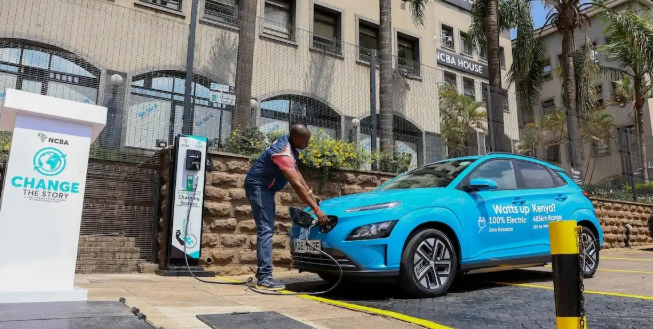
The good news is that the situation is improving faster than most people realise. NCBA Group itself has installed six electric vehicle charging stations across Nairobi, Kigali, and Kampala as part of its sustainability commitments — meaning the bank is not just financing your EV, it is actively building the infrastructure you need to run it.
Kenya Power has also been expanding its EV charging network, with stations deployed across strategic corridors in Nairobi and plans for locations in Nakuru, Mombasa, Kisumu, and Eldoret.
Practical charging tips for Kenyan EV owners:
- Charge overnight at home — Most EV owners do 80–90% of their charging at home, typically overnight. A standard home socket works for a slow overnight charge, while a dedicated home wall charger is faster and more efficient.
- Use off-peak electricity tariffs — With Kenya’s special EV electricity tariff, charging between 11 PM and 6 AM is significantly cheaper.
- Plan long-distance trips ahead — Before heading to Mombasa or Kisumu, map out available charging stops along the route. Apps and EV community groups on WhatsApp are a useful resource for updated station information.
- Keep a 20% battery buffer — Avoid running your battery below 20%, especially on longer trips. This preserves battery health and keeps you from range anxiety.
- Know your EV’s real-world range — Manufacturer range figures are often measured under ideal conditions. In Kenya’s mixed terrain and traffic, expect real-world range to be 10–20% lower than the stated figure.
NCBA EV Loan vs. Other Bank EV Financing Options in Kenya
NCBA is not the only bank offering EV financing in Kenya, but its February 2026 product positions it as the most aggressive in terms of rate reduction. Here is a brief comparison of what is available across the market:
NCBA Bank — Specialized EV loan with 2% rate reduction below standard vehicle lending. Strong brand recognition and wide branch network. EV-specific expertise built since 2022.
KCB Bank — Offers general asset finance for vehicle purchases with competitive rates, though no publicly announced EV-specific rate reduction as of early 2026.
Equity Bank — Has been expanding its green finance products. Their vehicle financing arm covers EVs, but without a dedicated discounted EV product matching NCBA’s offer.
Stanbic Bank Kenya — Stanbic was among the banks with the lowest average lending rates in Kenya in January 2026 at 12.35%, making it competitive for general vehicle finance, though NCBA’s specialized EV product still closes much of this gap for electric vehicle buyers specifically.
The 2% reduction from NCBA may seem modest on paper, but when applied to loan amounts in the millions of shillings over five years, the savings are real and tangible.
Electric Vehicles and the Long-Term Savings Picture
Beyond the loan itself, it is worth understanding the full picture of what owning an EV means for your wallet over time.
Fuel costs: A typical Kenyan petrol car consuming 8–10 litres per 100km at current pump prices costs roughly KES 12,000–18,000 per month for a daily commuter covering 50km each way. An equivalent EV charged at Kenya’s off-peak electricity rate costs KES 2,000–4,000 per month for the same distance — a saving of KES 8,000–14,000 every single month.
Maintenance: EVs have far fewer moving parts than internal combustion engines — no engine oil changes, no exhaust systems, no timing belts, no spark plugs. Over five years, EVs are 30–40% cheaper to maintain in Kenya compared to petrol equivalents. For high-mileage drivers and fleet operators, this is a transformative difference.
Resale value: As EVs become more mainstream in Kenya, resale values are expected to improve. Early adopters who buy well-regarded brands such as Nissan, Hyundai, Kia, and BYD are likely to benefit from healthy residuals as the market matures.
For more in-depth car buying guides, vehicle comparisons, and financing tips tailored to Kenyan buyers, visit automag.co.ke — your go-to resource for the Kenyan automotive landscape.
Tips for First-Time EV Buyers Applying for the NCBA EV Loan
If you are new to the world of electric vehicles and considering the NCBA EV loan, here are some practical tips to help you navigate the process smoothly:
1. Sort out your finances before you shop Before visiting a dealership, get a rough pre-assessment from NCBA to understand how much you qualify for. This prevents you from falling in love with a car you cannot finance.
2. Compare total cost of ownership, not just sticker price An EV at KES 3.5 million might seem expensive compared to a petrol car at KES 2.5 million, but when you factor in fuel savings, lower maintenance, and the reduced interest from NCBA’s EV loan, the EV often wins over a five-year ownership period.
3. Check the EV’s battery health (for used models) If buying a pre-owned EV, always request a battery health report. A battery at 80% or above is generally considered healthy for continued use. Most modern EVs have battery warranties of 8 years or 160,000km.
4. Plan your home charging setup Before taking delivery of your EV, arrange for a home charging point to be installed. A standard 240V socket works, but a dedicated wall charger charges your car faster and more safely. Factor this into your budget.
5. Join Kenya’s EV community There are several active EV owner groups on WhatsApp and Facebook in Kenya. These communities are invaluable for advice on charging spots, service centres, spare parts, and real-world range experiences on Kenyan roads.
The Bigger Picture: Kenya’s EV Revolution Is Here
NCBA’s February 2026 EV loan is not just a product announcement — it is a signal that Kenya’s electric vehicle revolution is shifting from early adoption to mainstream reality. Banks do not lower interest rates for niche markets; they do it for markets they believe in.
Kenya’s National Electric Mobility Policy, launched in early 2026, outlines adoption, infrastructure rollout, fiscal incentives, and industrial ambition — creating the most supportive environment Kenya’s EV market has ever seen. Combined with NCBA’s competitive financing, government tax breaks, expanding charging infrastructure, and a growing variety of affordable EV models, the barriers to entry have never been lower.
Whether you are a Nairobi professional tired of spending KES 15,000 on fuel every month, a boda boda operator looking to cut running costs, or a logistics company planning to electrify your fleet, the NCBA EV loan gives you a practical, affordable pathway into the future of mobility.
For the latest electric vehicle news, import options, and guidance on bringing EVs into Kenya, EV24.africa is an excellent resource for anyone serious about making the switch. And if you are still exploring which vehicles best suit your needs and budget — whether new or used — be sure to check out auto24.co.ke for a wide selection of quality second-hand vehicles across all categories.
Kenya’s roads are changing. The question is: will you be ahead of the curve, or chasing it?
Read more automotive insights, car reviews, and driving guides for Kenya on automag.co.keand autoskenya.com.