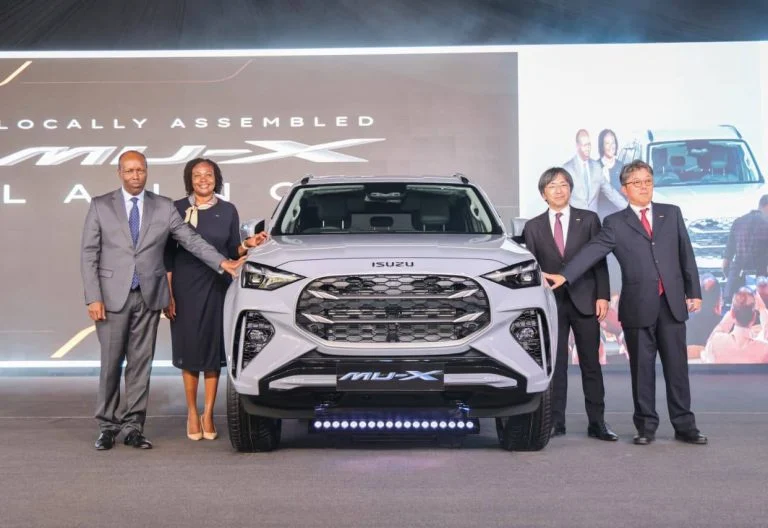
Locally assembled cars in Kenya are now undercutting imports on price for the first time. Here’s what’s driving the shift and what it means for buyers.
Locally Assembled Versus Imported Cars in Kenya
For decades, “new car” and “expensive” meant the same thing in Kenya — but that’s starting to change. On February 2, 2026, Trade and Industry Cabinet Secretary Lee Kinyanjui announced that the price of the locally assembled Isuzu MU-X would drop by 27%, from Ksh 13.5 million to Ksh 9.9 million, thanks to tax incentives tied to local assembly. That single announcement captures a shift that’s been building for years: locally assembled cars in Kenya are finally becoming price-competitive with imports, and the gap is closing fast.
Why Locally Assembled Cars Are Suddenly Cheaper
The numbers tell the story better than any press release. Completely knocked-down (CKD) local assembly’s share of new car sales in Kenya has jumped from 48.2% in 2015 to nearly 90% in 2025, while fully built-up (CBU) imports have fallen from 51.8% to just 10.4% over the same period. That’s a near-total reversal of the market in a decade.
The mechanism behind it is straightforward: government tax incentives. Kenya has been offering exemptions on imported vehicle parts used in local assembly for years, and the split between locally produced and imported vehicles has moved from roughly 50-50 in 2020 to about 80% local today. Manufacturers who source more components locally now qualify for enhanced tax incentives, pulling Kenyan suppliers deeper into the assembly value chain.
Isuzu itself put it plainly: with used cars dominating so much of the market, there was historically little justification for building a local industry — so the government has deliberately tightened the used-import market while sweetening the deal for assemblers.
The Used-Import Squeeze Is Doing Its Part Too
Since January 1, 2026, KEBS has enforced its eight-year age limit under standard KS 1515:2000, meaning only right-hand-drive vehicles first registered in 2019 or later can clear Mombasa port. That’s effectively banned the older, cheaper used imports that used to flood the market — pushing the floor price for something like a clean used Toyota Vitz from around Ksh 350,000 up to Ksh 500,000–700,000.
Add the pending National Automotive Bill 2025, which has completed public participation and is expected to be enacted before the next financial year, and you can see the direction of travel: government leasing programmes will require locally assembled vehicles with a set percentage of local content, tilting future demand further toward domestic assembly.
Who’s Actually Building Cars in Kenya?
Kenya’s main assembly plants are Isuzu East Africa in Nairobi, Associated Vehicle Assemblers (owned by Simba Corp) in Mombasa, and Kenya Vehicle Manufacturers in Thika (owned by the government, DT Dobie, and CMC Holdings). The Isuzu MU-X milestone is a big deal specifically because it made Kenya the first country outside Thailand to manufacture the model.
It’s not just petrol and diesel vehicles either. The government has intensified local assembly of electric vehicles too, part of a broader push to cut both emissions and dependence on imported fuel. That ties into February’s National E-Mobility Policy launch, though EV assembly still faces its own cost headwinds — worth reading up on separately if you’re EV-curious.
So, Which Should You Actually Buy?
If you need something now, a used import from a trusted dealer is still the fastest route — auto24.co.ke is a solid place to browse second-hand stock that meets the new-age requirements. But if you can wait, locally assembled options are worth watching closely; the MU-X case shows the price gap can close dramatically once incentives kick in. For ongoing coverage as more models get the local-assembly treatment, automag.co.ke and autoskenya.com are both good places to track pricing announcements as they land. And if sustainability factors into your decision at all, EV24.africa is worth a look for electric import options while Kenya’s local EV assembly scene keeps maturing.
The bottom line: the old assumption — “new is always pricier” — no longer holds automatically in Kenya. Do the math on both options before you commit.