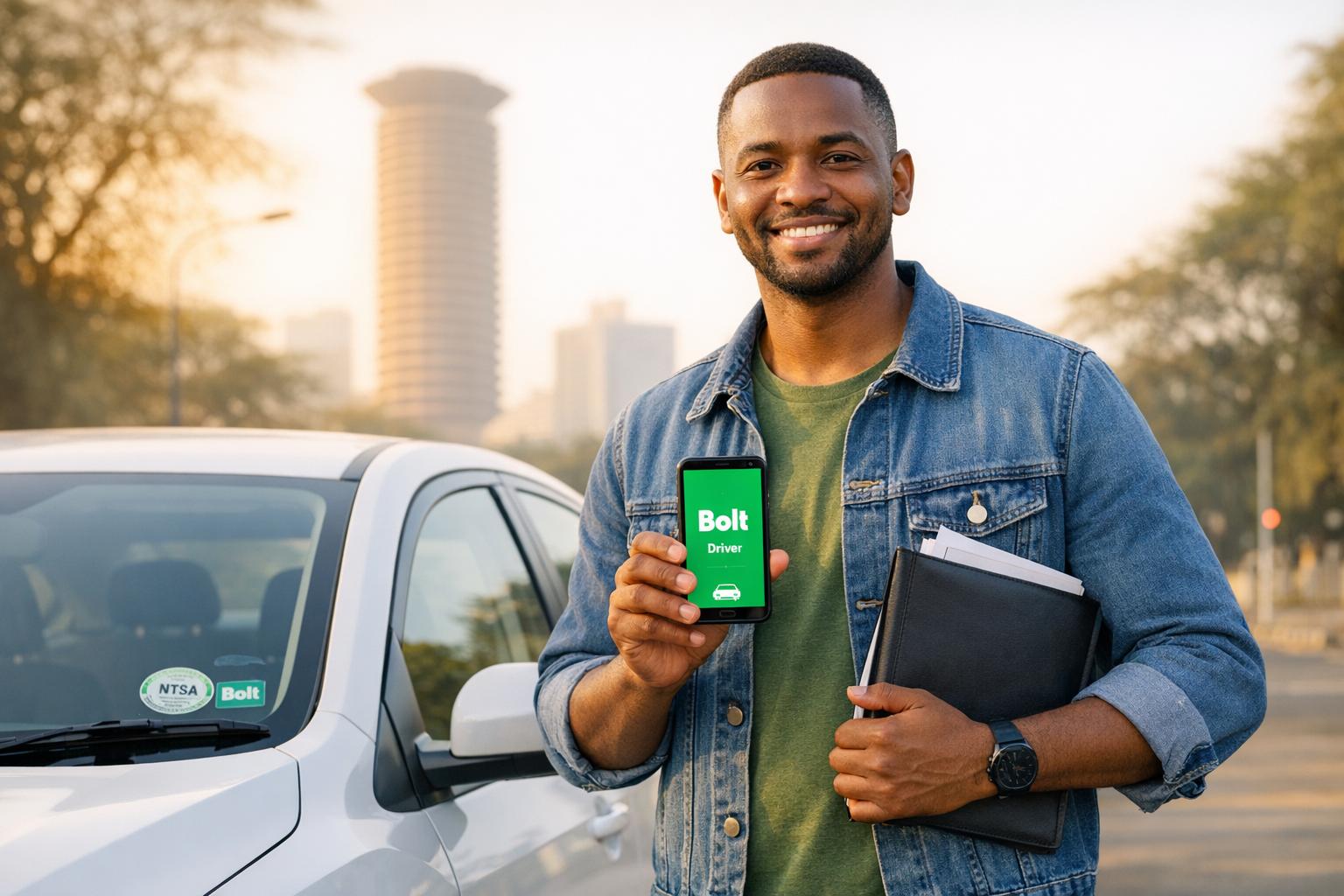
Becoming a Bolt driver in Nairobi is straightforward and offers flexible earning opportunities. Here’s a quick breakdown of what you need:
- Requirements: You must be at least 21 years old and have a valid Kenyan driver’s license, PSV badge, Certificate of Good Conduct, and a smartphone (Android 9.0+/iOS 14+).
- Vehicle Standards: Your car must meet specific criteria, such as being from 2011 or later (depending on the category), passing NTSA inspection, and having PSV insurance.
- Registration Process: Sign up online, upload required documents, and attend a 30-minute training session at Sarit Centre or Azure Towers. Account activation takes about 48 hours.
- Earnings: Drivers can earn Ksh 3,000–6,000 daily, with weekly payouts. Bolt charges an 18% commission plus 16% VAT.
- Maximizing Income: Drive during peak hours (morning and evening rush), maintain your vehicle, and provide excellent service to keep ratings high.
Whether you’re driving full-time or part-time, Bolt offers a reliable way to earn while navigating Nairobi’s busy streets.
UPDATES: How to succeed as a taxi driver (Uber/Bolt) in Nairobi in 2025
sbb-itb-e5ed0ed
Who Can Become a Bolt Driver in Nairobi
To drive with Bolt in Nairobi, you need to meet specific legal and personal criteria established by both Bolt and Kenyan authorities. These ensure safety and maintain the quality of service.
Legal and Personal Requirements
To qualify, you must be at least 21 years old and provide the following documents:
- A valid Kenyan driver’s license
- A PSV Badge issued by NTSA, authorizing you to carry passengers commercially
- A Certificate of Good Conduct from the DCI, proving a clean criminal record
- Your Kenyan National ID or Passport
You’ll also need a smartphone running Android 9.0+ or iOS 14+ with GPS capabilities. This device is essential for navigation and managing trips through the Bolt driver app.
Once you’ve submitted your documents, you’ll attend a 30-minute training session at the Bolt Training Hub. These sessions are typically held at Sarit Centre or Azure Towers in Westlands, on weekdays at 11:00 AM.
In addition to your personal qualifications, your vehicle must meet specific ownership and insurance requirements.
Vehicle Ownership and Insurance
You can drive your own car, lease one, or join an armada to access a Bolt-approved vehicle. If you own a car, you’ll need the logbook. For those managing multiple cars, you can register as a fleet owner and add other drivers to your account.
All vehicles must have comprehensive PSV insurance, which includes coverage for commercial passenger transport. The insurance sticker must be valid, and the insured party’s name must match the vehicle owner listed on the logbook. Additionally, vehicles must pass an NTSA inspection to confirm they meet safety standards.
Vehicle Requirements for Bolt in Nairobi
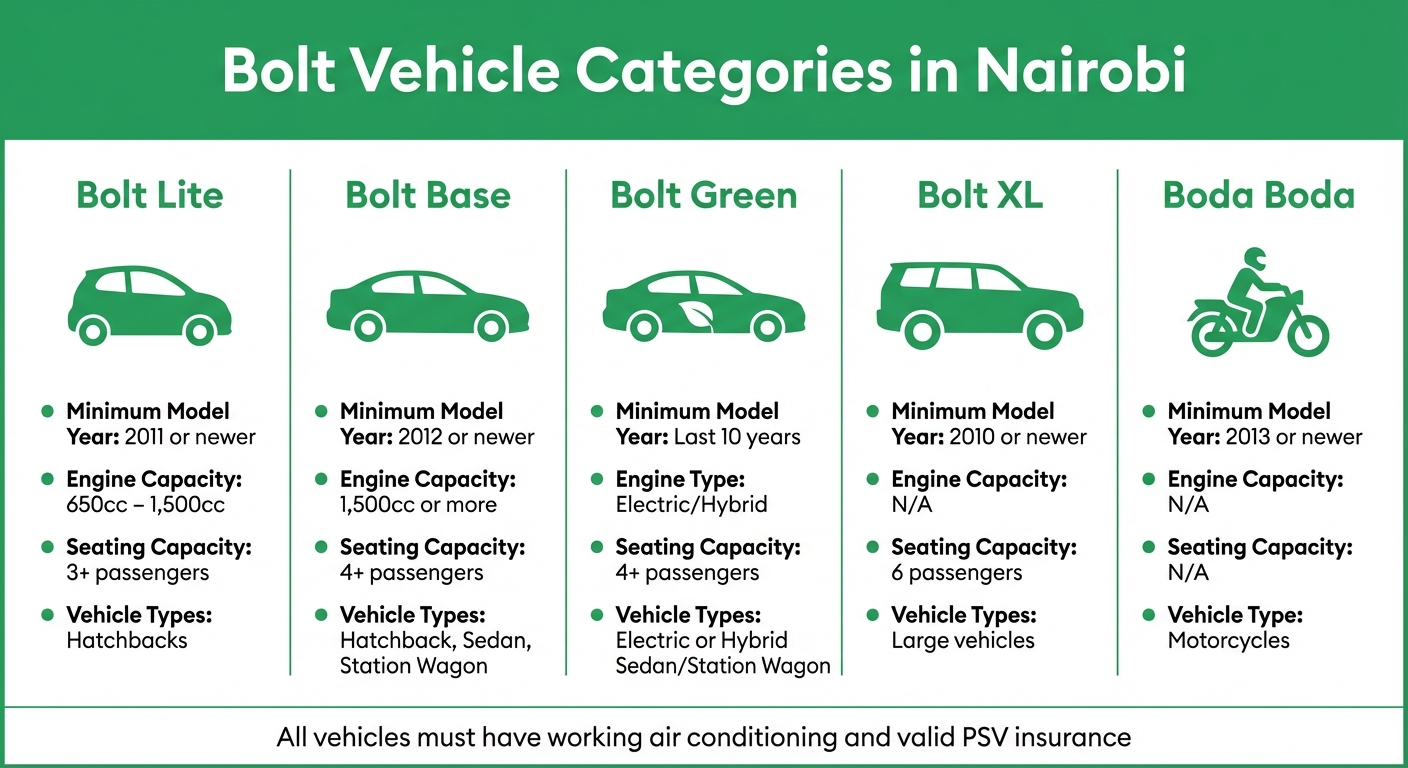
Bolt Vehicle Categories and Requirements in Nairobi
To drive with Bolt in Nairobi, your vehicle must meet specific standards, in addition to the ownership and insurance criteria already outlined. These standards depend on the service category you choose.
Approved Vehicle Categories
Bolt offers five main service categories in Nairobi: Bolt Lite, Bolt Base, Bolt Green, Bolt XL, and Boda Boda (motorcycles). Each category has its own requirements for model year, engine capacity, seating capacity, and vehicle type.
| Category | Minimum Model Year | Engine Capacity | Seating Capacity | Acceptable Vehicle Types |
|---|---|---|---|---|
| Bolt Lite | 2011 or newer | 650cc – 1,500cc | 3+ passengers | Hatchbacks |
| Bolt Base | 2012 or newer | 1,500cc or more | 4+ passengers | Hatchback, Sedan, Station Wagon |
| Bolt Green | Manufactured within the last 10 years | Electric/Hybrid | 4+ passengers | Electric or Hybrid Sedan/Station Wagon |
| Bolt XL | 2010 or newer | N/A | 6 passengers | Large vehicles (capacity must match insurance) |
| Boda Boda | 2013 or newer | N/A | N/A | Motorcycles |
All vehicles must have working air conditioning and be either privately registered or designated for taxi use. Electric and hybrid vehicles are approved for Bolt Lite and Bolt Base, provided they pass logbook verification.
To ensure your vehicle is safe for passengers, you’ll also need to complete an NTSA inspection.
NTSA Inspection and Certification

Before starting with Bolt, your vehicle must pass an inspection by the National Transport and Safety Authority (NTSA). This can be done through the NTSA TIMS portal on the e-Citizen platform. The inspection costs KES 1,050 and evaluates safety and emission standards. Once completed, the inspection report is typically issued within 24 hours.
You’ll need to upload the following documents to your Bolt driver account as clear, full-color photos of the originals to avoid delays:
- NTSA inspection report
- PSV insurance sticker
- Vehicle logbook
Payments for NTSA services must be made via MPESA.
Additionally, your vehicle should be in good cosmetic condition. A clean, well-maintained vehicle enhances passenger comfort and reflects professionalism when driving on the platform.
How to Register as a Bolt Driver
Once your documents and vehicle inspection are ready, the next step is registration. If everything is in order, the process is straightforward, and your account can be activated within 48 hours after document verification.
Creating Your Bolt Driver Account
To get started, head to the Bolt partner portal at partners.bolt.eu/driver-signup or download the Bolt Driver app from the Google Play Store or Apple App Store. During sign-up, you’ll need to provide your email address, phone number, and the city where you’ll be driving – such as Nairobi. The entire process takes about 5 minutes.
Make sure your smartphone meets the required operating system version to ensure the app runs smoothly. After setting up your profile, it’s time to upload your documents.
Uploading Required Documents
Once your account is created, upload clear, high-quality photos of your original documents via the app or driver portal. These include:
- National ID or passport
- Valid Kenyan driver’s license
- PSV badge
- Certificate of Good Conduct
- Vehicle logbook
- PSV insurance sticker
- NTSA inspection report
- A recent passport photo
Avoid uploading blurry images or photocopies, as these may be rejected during the review process. You can complete this step in about 15 minutes, and your application will typically be reviewed within a few hours.
"Opening a Bolt Driver Account is free of charge. The only costs are those associated with acquiring your documents from the correct authorities." – Bolt
Completing Registration and Account Activation
After your documents are approved, you’ll need to attend a mandatory 30-minute training session. This session is conducted at your assigned Bolt hub.
Following the training and final document checks, you’ll receive an SMS or email to set your password and activate your account. This usually happens within 48 hours. If you have questions about the process, you can reach out to [email protected]. Planning to manage multiple vehicles and hire drivers? Register as a Fleet Owner at fleets.bolt.eu/signup.
Tips for Earning More and Handling Nairobi Traffic
Once your Bolt account is up and your vehicle is ready, the next step is making the most of your time on the road. In Nairobi, success hinges on knowing when and where to drive, managing fuel costs, and keeping your customers happy.
Best Times and Routes to Drive
In Nairobi, demand for rides peaks during the morning rush (6:30 AM – 9:00 AM) and evening rush (4:30 PM – 7:30 PM), especially on Mondays and Fridays. During these hours, position yourself near busy areas like Two Rivers, Sarit Centre, JKIA, Wilson Airport, or Westlands. Traffic delays can stretch from 30 to 60 minutes during rush hour, so it’s smart to use the Southern, Northern, or Eastern Bypasses to dodge the CBD congestion. For quicker connections between JKIA, Mombasa Road, and Westlands, the Nairobi Expressway is a solid option – just don’t forget to factor in toll fees.
If you’re looking to avoid the worst of the traffic, consider driving during mid-morning (10:00 AM – 12:00 PM) or later in the evening (after 8:00 PM). Stay informed about accidents or road closures by using navigation apps like Google Maps or Waze, or check updates from NTSA and KeNHA. These tips not only help you save time and fuel but also keep your vehicle in better shape over the long haul.
Saving Fuel and Maintaining Your Vehicle
Fuel costs can eat into your profits fast, so adopting smart driving habits is key. Gradual acceleration and avoiding hard braking can make a noticeable difference. In heavy traffic, switch off your engine during long stops to conserve fuel. Driving a fuel-efficient car – like a Toyota Vitz, Suzuki Swift, or even a hybrid like the Toyota Prius – can also help cut daily expenses.
Regular maintenance is just as important. Keep your tires inflated to the manufacturer’s recommended levels, replace air filters when needed, and ensure your fuel injectors are clean. Lightening your load by removing unnecessary items and taking off roof racks when not in use can further improve fuel efficiency. Lastly, opt for natural ventilation when possible instead of relying heavily on air conditioning.
Improving Customer Ratings
Your customer ratings matter – a lot. Bolt requires drivers to maintain a rating of at least 4.5 stars, and falling below that could lead to deactivation. To keep your ratings high, focus on the basics: show up on time, keep your car clean inside and out, and dress neatly. Use the app to confirm pickup details and arrive at the exact location within the estimated time. A quick question like, “Is the set destination final?” can help avoid route confusion.
Stick to speed limits and avoid distractions like personal calls or social media while driving. When it comes to conversation, take cues from the passenger – if they seem chatty, engage; if not, respect their quiet time. If a passenger doesn’t show up after five minutes, cancel the ride as “client did not show” to avoid a negative impact on your score.
These small but effective steps can help you earn more, save on costs, and maintain a strong reputation on the platform.
Wrapping It Up
Here’s a quick summary: Becoming a Bolt driver in Nairobi is straightforward. First, make sure you meet the basic criteria – like being of age, holding a valid driver’s license, and having an NTSA PSV badge and a Certificate of Good Conduct. Your vehicle also needs to meet the standards: it should be from 2012 or later, have a valid NTSA inspection, and PSV insurance.
The registration process is quick and easy, taking just about 5 minutes online. Once you’ve uploaded your documents, attend a mandatory 30-minute training session at Sarit Centre or Azure Towers. After that, your account should be activated within 48 hours.
To earn more, focus on driving during peak times in high-demand areas, keep your car in great shape to save on fuel, and always provide professional service to passengers.
Keep in mind that Bolt charges an 18% commission plus 16% VAT. Make sure to pay these fees promptly through M-PESA to avoid any interruptions to your account.
If you meet the qualifications and your vehicle is up to standard, sign up and hit the road with Bolt. It’s a great way to start earning while navigating Nairobi’s bustling streets.
FAQs
What are the best times to drive and earn more with Bolt in Nairobi?
If you’re a Bolt driver in Nairobi, timing can make all the difference in maximizing your earnings. The morning rush, typically between 6:00 AM and 9:00 AM, and the evening rush, from 4:30 PM to 8:00 PM, are prime hours when ride demand is at its peak. These are the moments when commuters are heading to work or returning home, making it easier to secure consistent trips.
Weekends and public holidays also offer great opportunities. Whether it’s events, nightlife, or people enjoying their days off, demand tends to spike during these periods. Staying active during these high-demand times can significantly increase your chances of earning more.
What are the safety and inspection requirements for my vehicle to drive with Bolt?
To meet Bolt’s safety and inspection standards, your vehicle needs to be in excellent condition and have the right paperwork. This includes ensuring the car is well-maintained inside and out and meets the necessary safety guidelines. Some key documents you’ll need are a Roadworthiness Certificate and a Vehicle License, which confirm your car is up to code.
As part of the registration process, you’ll also need to upload clear, high-quality photos of your car. These should include shots of the exterior (with the license plate visible) and the interior. Make sure all your documents are up-to-date and submitted properly to avoid any hiccups. Staying on top of maintenance and paperwork will make the process with Bolt much smoother.
What should I do if my customer ratings drop below 4.5 stars?
If your customer ratings dip below 4.5 stars, it’s time to focus on delivering a better experience to bring those scores back up. Start by ensuring every interaction with passengers is polite and respectful – good communication can make all the difference. Also, keep your vehicle in top shape: clean, comfortable, and well-maintained cars leave a lasting impression.
Driving during peak hours is another way to increase your chances of getting positive ratings, as you’ll interact with more passengers. While on the road, follow traffic rules, remain professional, and keep passengers informed about routes or any delays. Finally, take feedback from Bolt seriously – it’s a valuable tool to pinpoint areas where you can improve and show passengers that you’re committed to providing top-notch service.
Related Blog Posts
- Top 5 Reliable Cars for Uber & Bolt Drivers in Kenya
- Ride-sharing Regulations in Nairobi: What You Need to Know
- How to Get Rich as a Ride-sharing Driver in Nairobi: What You Need to Know
- How to Become an inDrive Driver in Nairobi: Tips and Tricks