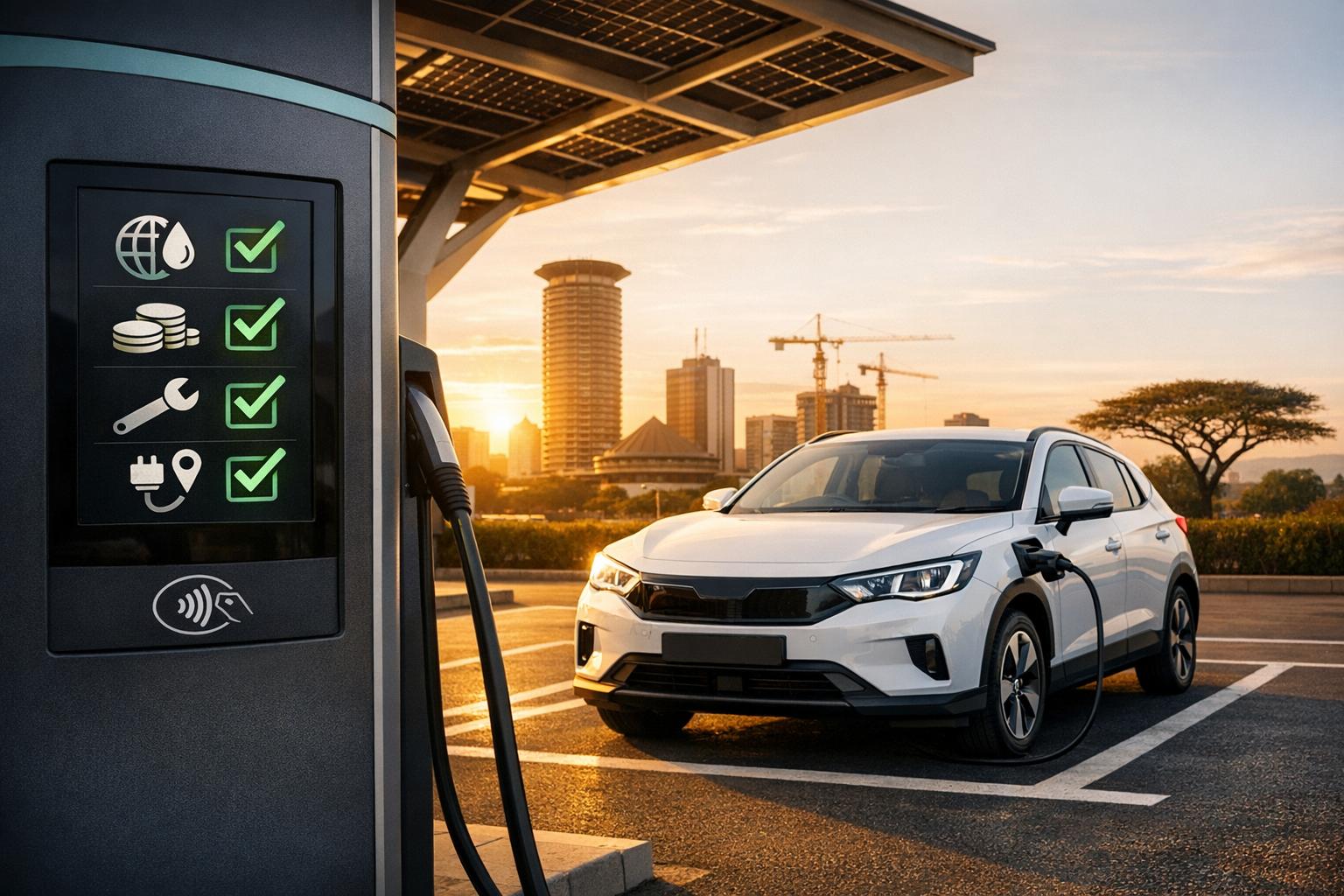
Kenya’s transition to electric vehicles (EVs) is reshaping its economy and energy landscape. Here’s why it matters:
- Lower Fuel Imports: EV adoption reduces Kenya’s $5 billion annual petroleum import bill, easing pressure on foreign reserves.
- Cost Savings: EV owners benefit from cheaper fuel (electricity vs. petrol) and lower maintenance costs due to fewer moving parts.
- Tax Incentives: Zero VAT and reduced excise duties on EVs and components make them more affordable, boosting adoption.
- Job Creation: Local EV assembly plants and battery swap stations are creating jobs across industries.
- Infrastructure Growth: Plans for 10,000 charging stations by 2030 are underway, with Kenya Power reporting rising revenue from EV electricity usage.
- Environmental Goals: EVs help reduce transport-related emissions, which currently account for 13% of Kenya’s total emissions.
Kenya’s National Electric Mobility Policy, launched in February 2026, aims to position the country as a leader in EV manufacturing and adoption across East Africa. By leveraging its 90% renewable energy grid, Kenya is reducing reliance on imported fuels, creating jobs, and modernizing its transport sector.
Kenya’s EV Economy Ready For Lift Off!
sbb-itb-e5ed0ed
Reduced Fuel Import Costs
Kenya’s annual petroleum import bill of $5 billion puts a heavy strain on its foreign exchange reserves. In 2023, fuel prices climbed above KSh 200 per liter, adding further pressure to the economy. Transitioning to electric vehicles (EVs) offers a way to ease this burden by reducing the country’s dependence on fuel imports, which helps stabilize the economy against dollar shortages and exchange rate fluctuations.
"Globally, EV adoption is regarded by governments as an opportunity to rely on less fuel imports that could strain the overall economy. For Kenya, less fuel imports are good for the forex reserves but terrible for revenue." – Brian Nzomo, Journalist, The Kenyan Wallstreet
This shift not only brings cost savings but also strengthens economic resilience, with benefits extending to individual EV users.
Lower Fuel Costs for EV Owners
For EV owners, the savings are immediate and tangible. Electric vehicles significantly lower fuel expenses compared to traditional petrol-powered cars. This is especially beneficial for everyday drivers, boda boda operators, and fleet owners, as it reduces their daily and business-related operating costs.
But the benefits don’t stop at personal savings. The growing adoption of EVs has broader fiscal implications for the nation.
National Fuel Import Savings
By December 2025, Kenya had registered 24,754 electric vehicles. This growing number of EVs played a role in reducing fuel consumption, resulting in a KSh 2 billion (roughly $15 million) drop in the Road Maintenance Levy in 2025. While this reduction highlights a challenge in lost fuel tax revenue, it also means that KSh 2 billion less was spent on imported fuel – money that now stays within Kenya.
Although the government sacrifices some fuel tax revenue, the trade-off comes with improved forex reserves and less vulnerability to global oil price fluctuations. To address the expected KSh 89.5 billion revenue gap by 2043, the government is considering new strategies like annual registration fees and road-use charges.
Lower Operating and Maintenance Expenses
In Kenya, EV owners enjoy reduced operating costs compared to traditional vehicles. This cost advantage benefits not only individual drivers but also commercial fleets and boda boda operators. The savings go beyond just replacing fuel – they also include lower expenses for charging and maintenance.
Affordable Charging Costs
Charging an EV for about 124 miles costs significantly less than refueling a petrol car. Additionally, government-implemented off-peak e-mobility tariffs help bring these costs down even further, which is especially important for boda boda operators who rely on affordable transportation solutions.
Reduced Maintenance Costs
EVs have fewer moving parts compared to internal combustion vehicles, which means lower maintenance expenses. There’s no need for oil changes, transmission repairs, or exhaust system upkeep. This translates to reduced lifetime costs and less downtime, a critical factor for fleet operators and commercial users.
"EVs, particularly when paired with off-grid solar charging, may be cheaper than petrol- or diesel-powered cars in many African countries in the not-so-distant future" – Christian Moretti and Bessie Noll, Senior Researchers at ETH Zürich
Tax Incentives and Fiscal Savings
Beyond the savings on fuel and maintenance, fiscal policies in Kenya are making electric vehicles (EVs) even more accessible and affordable.
Tax Exemptions on EVs and Components
In February 2026, Kenya introduced the National Electric Mobility Policy, which brought significant tax incentives. One of the key measures is the zero-rating of Value Added Tax (VAT) on electric buses, bicycles, motorcycles, and lithium-ion batteries. This means buyers don’t have to pay the standard VAT, immediately lowering the cost of these items. Additionally, excise duties for certain categories of electric vehicles were reduced, making them more competitively priced.
For businesses, the VAT exemption on lithium-ion batteries has a dual benefit. It lowers production costs for local manufacturers and reduces replacement expenses for fleet operators. Transport Cabinet Secretary Davis Chirchir highlighted the broader impact of these policies:
"Electric mobility is crucial to reducing greenhouse gas emissions, decreasing reliance on imported fossil fuels, and fostering economic growth through local manufacturing and job creation".
Implementation Timeline
These initial tax incentives are just the beginning. From July 2026, Kenya plans to expand VAT and excise duty exemptions to include more EV parts and vehicle categories, further reducing upfront costs for buyers. By 2027, there’s an additional plan to cut the stamp tax on charging stations, which will reduce the financial burden for businesses investing in EV infrastructure.
Principal Secretary for Transport Mohammed Daghar emphasized the long-term vision:
"We have now laid the foundation for a cleaner, more efficient, and more sustainable transport system that fully aligns with our climate commitments".
Job Creation and Local Manufacturing Growth
Kenya’s push for electric mobility is doing more than just transforming transportation – it’s creating jobs and fueling growth in local manufacturing. The rapid expansion of EV assembly plants and service-related industries is a clear sign of this progress.
Growth in EV Assembly Plants
Kenya’s local EV assembly sector is growing fast, thanks to supportive government policies. These include a 25% import duty, 10% excise duty, and tax exemptions on EV components, all designed to give manufacturers an edge. By assembling vehicles locally instead of importing fully built ones, companies can cut costs while boosting domestic production.
This growth is opening up a variety of jobs. On the factory floor, workers and technicians handle production, while engineers focus on quality control and innovation. Beyond manufacturing, there’s rising demand for investment advisors to secure funding, supply chain managers to source local components, and trainers to equip the workforce with technical skills. Institutions like the Sirius-X Energy Academy are stepping in to meet this need, offering training in EV maintenance, assembly, and energy management. With global projections estimating that 80% of vehicle sales will be electric by 2050, Kenya’s early commitment to local EV manufacturing could yield lasting economic rewards.
One sector already benefiting from this shift is the bodaboda industry, which is quickly becoming a key player in Kenya’s EV economy.
Opportunities in Bodaboda Electrification
The bodaboda sector is a standout success in Kenya’s electric mobility journey, with electric motorcycles leading the charge in EV registrations. This rapid adoption is driving economic growth, particularly in local manufacturing and support services. Companies like Roam are assembling electric motorcycles in Nairobi, creating industrial growth and technical jobs.
To further support this sector, the National Electric Mobility Policy has eliminated VAT and reduced excise duty to zero for electric motorcycles and lithium-ion batteries. Meanwhile, the rise of battery swap infrastructure is transforming operations, allowing riders to keep moving without downtime. This innovation is not just boosting manufacturing but also creating jobs in running swap stations, maintaining batteries, and managing logistics networks. The electrification of bodabodas showcases how focusing on a specific market segment can spark economic growth across multiple industries.
Infrastructure Investments and Revenue Generation
Kenya is making bold moves to embrace electric mobility, with a significant focus on building a robust charging infrastructure. The Ministry of Energy and Petroleum has unveiled a $47.26 million plan to establish 10,000 EV charging stations nationwide by 2030. This ambitious rollout will happen in three phases: starting with 17 major towns along key highways like the Mombasa-Busia corridor, expanding to 23 regional hubs, and eventually reaching satellite towns and county headquarters. Both public and private stakeholders are working together to turn this vision into reality.
Charging Station Development
Kenya Power is at the forefront of this effort, spearheading the initial deployment of charging stations. The utility has committed $1.93 million (KSh 258 million) over three years to install stations and electrify its internal fleet. By September 2025, five EV chargers were already operational at strategic locations, including Stima Plaza, Donholm, Ruaraka, Electricity House in Nairobi, and Ragati. Plans are underway to expand to Voi, Mombasa, and Nakuru. The rollout is carefully phased:
- Phase 1: $9.16 million investment for highway corridors.
- Phase 2: $13.9 million for regional hubs.
- Phase 3: $24.2 million for nationwide coverage.
Private companies are also stepping in to accelerate the transition. In 2025, Moja EV Kenya announced plans to establish a network of 100 charging stations equipped with 80kW DC chargers. Similarly, BasiGo has expanded its charging infrastructure to support its electric bus fleet in Nairobi neighborhoods such as Embakasi, Kikuyu, and Buruburu. To further support this growth, the National Building Code 2024 now mandates that at least 5% of parking slots in new buildings must include EV charging facilities.
Electricity Revenue from E-Mobility
The financial benefits of this expanding charging network are already becoming clear. In 2025, Kenya Power reported KSh 190.8 million ($1.43 million) in revenue from e-mobility, a sharp rise from KSh 64.8 million the previous year. This increase was fueled by the onboarding of 205 customers to a specialized e-mobility tariff and a total electricity consumption of 8.4 million units, marking a 188% jump from 2024’s 2.9 million units. Between July and December 2024 alone, EV electricity usage surged by nearly 481%.
"This surge in demand has significantly boosted Kenya Power’s bottom line, with revenues from EV charging growing to KSh 190.8 million, up from KSh 64.8 million just a year prior." – Kenya Power Statement
Kenya Power has introduced a time-of-use pricing model to optimize grid usage and boost revenue. The rates are set at KSh 16 per unit during peak hours and KSh 8 per unit during off-peak times. This strategy not only helps manage grid demand but also allows fleet operators to lower their costs by charging at night when the grid has excess capacity. With over 35,000 electric vehicles – mainly motorcycles – registered by 2025, the revenue potential for this sector is only growing.
Increased Exports and Regional Leadership
Kenya is making a bold leap from simply adopting electric vehicles (EVs) to becoming a hub for regional EV manufacturing. By early 2026, the country expects to have over 24,700 electric mobility units on its roads – a massive jump from fewer than 800 in 2022, marking a 30× growth in just a few years. The shift isn’t just about using EVs anymore; it’s about producing them and exporting both vehicles and expertise across East Africa and beyond.
Local EV Production for Export
Kenya’s nearly 90% renewable energy grid gives it a unique edge in manufacturing low-carbon vehicles, especially for neighboring markets that still depend on fossil fuels. Moses Mwemezi Kemibaro, Founder & CEO of Dotsavvy, highlights this opportunity:
"e-mobility becomes a tool for skills creation, engineering jobs, and regional export competitiveness".
To capitalize on this, the government is prioritizing local assembly plants aimed at serving the East African Community, reducing reliance on imports from outside the continent.
Electric motorcycles and tuk-tuks are at the forefront of this movement. By 2025, they made up 7.07% and 4.55% of new vehicle registrations, respectively. These two- and three-wheelers account for nearly 90% of all electric mobility units in Kenya. The government has set an ambitious goal: by 2050, all motorcycles on Kenyan roads will be electric. This focus on motorcycles, especially for delivery services and boda boda operators, underscores the economic advantages of e-mobility and sets the stage for an export-driven manufacturing industry.
Kenya’s production goals are further supported by policies designed to promote regional leadership and standardization.
Policy Roadmap for Regional Leadership
In February 2026, Kenya officially launched its National Electric Mobility Policy, positioning e-mobility as a cornerstone of industrial strategy rather than just a transportation trend. Developed with support from organizations like the EU, GIZ, the UK FCDO, and the IFC, the policy aims to turn ambitious goals into actionable investment programs that attract global manufacturers. As Kemibaro puts it:
"Kenya is quietly positioning itself as a regional reference market for electric mobility in emerging economies with clean power systems".
The policy focuses on building technical expertise across the entire EV value chain – from assembly and component manufacturing to maintenance. It also introduces standardized battery-swapping systems and charging protocols that could be adopted by other emerging markets. By setting these national standards, Kenya is creating a model that could serve as a "testbed" for the region.
To ensure long-term financial sustainability, the government is planning to move from a fuel-levy–based road funding model to a digital road-user charging system. This approach will help maintain infrastructure as EV adoption grows. With transportation accounting for 72% of Kenya’s petroleum imports and 13% of its greenhouse gas emissions, the economic and environmental benefits of this transition are hard to ignore.
Economic Comparisons
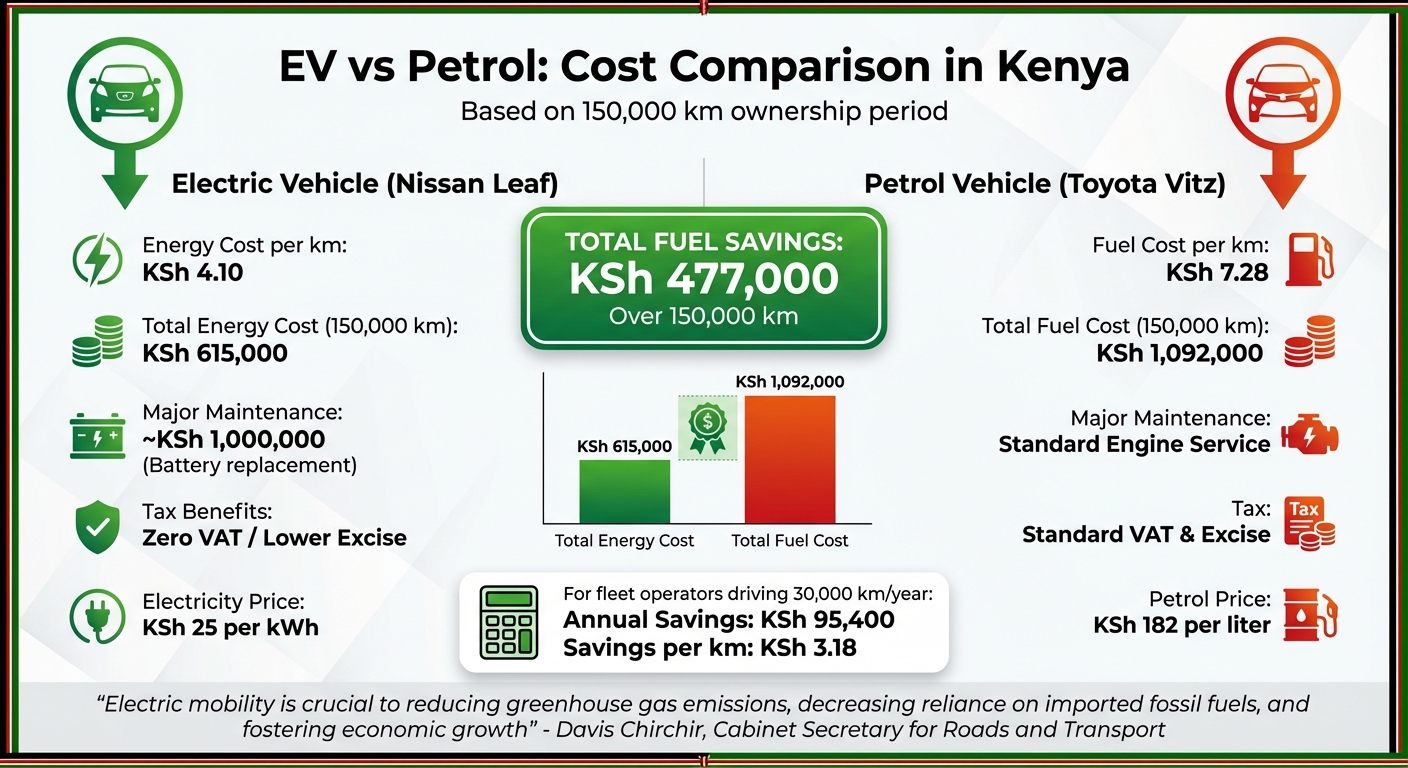
EV vs Petrol Vehicle Cost Comparison in Kenya
Looking at energy and operational costs side by side, the numbers paint a clear picture: EVs like the Nissan Leaf offer a noticeable cost advantage over petrol vehicles. For example, the Nissan Leaf consumes energy at about KSh 4.10 per kilometer, compared to KSh 7.28 per kilometer for the Toyota Vitz – a difference of approximately 44%.
Economic Impact Summary Table
Here’s a closer look at the costs over typical ownership periods for both fleet operators and individual owners:
| Cost Category | EV Amount (Nissan Leaf) | Petrol Amount (Toyota Vitz) | Annual Savings (30,000 km/year) |
|---|---|---|---|
| Energy Cost per km | KSh 4.10 | KSh 7.28 | KSh 95,400 |
| Total Energy Cost (150,000 km) | KSh 615,000 | KSh 1,092,000 | KSh 477,000 (Total) |
| Major Maintenance | ~KSh 1,000,000 (Battery) | Standard Engine Service | (Negative savings at 150k km) |
| Tax Incentives | Zero VAT / Lower Excise | Standard VAT & Excise | Varies by vehicle value |
Over a driving distance of 150,000 kilometers, an EV can save about KSh 477,000 in fuel costs compared to a petrol-powered car. However, it’s important to account for the cost of battery replacement, which is estimated at around KSh 1,000,000 (including parts and labor) once the vehicle reaches this mileage. For fleet operators, the savings amount to roughly KSh 3.18 per kilometer, which quickly adds up for high-mileage operations.
The cost advantage becomes even more apparent when considering energy prices: electricity costs KSh 25 per kWh, while petrol is priced at KSh 182 per liter. Additionally, tax incentives, such as zero VAT and lower excise duties, further reduce the financial burden of owning an EV.
"Electric mobility is crucial to reducing greenhouse gas emissions, decreasing reliance on imported fossil fuels, and fostering economic growth through local manufacturing and job creation", said Davis Chirchir, Cabinet Secretary for Roads and Transport.
These operational savings not only benefit individual car owners and fleet operators but also contribute to Kenya’s economic stability by reducing reliance on costly fuel imports. For more updates on Kenya’s growing EV sector, visit AutoMag.co.ke.
Conclusion
Kenya’s transition to electric vehicles (EVs) is reshaping the economic landscape for drivers, businesses, and the broader economy. For EV owners and boda boda riders, the perks are immediate and tangible: drastically reduced fuel and maintenance costs, along with budget-friendly charging powered by Kenya’s renewable energy grid[24,25].
These individual benefits ripple outward, fueling economic growth on a larger scale. Businesses save on operating costs and benefit from tax breaks on EV parts and charging station setups starting in July 2026[22,23]. On a national level, the launch of the National Electric Mobility Policy on February 3, 2026, cements Kenya’s position as a leader in sustainable transportation within the region[24–26]. While the Road Maintenance Levy Fund may face shortfalls, the savings from cutting fuel imports, the rise of new industries, and increased electricity revenues from e-mobility are expected to help bridge the gap[22,26].
Kenya Power’s adoption of electric cars, pickup trucks, and motorcycles highlights the practicality of this shift. With Africa’s EV market projected to grow at an impressive 56% compound annual growth rate by 2030, Kenya is poised to lead this transformation.
Key drivers of this revolution – lower fuel costs, reduced operating expenses, tax incentives, local manufacturing, and growing infrastructure – underscore the economic potential of Kenya’s EV journey. For more insights on Kenya’s evolving EV market and its economic impact, visit AutoMag.co.ke, and explore transparent EV trading solutions at AUTO24.africa.
FAQs
How long does it take for an EV to pay for itself in Kenya?
The time it takes to recoup the cost of an EV in Kenya depends on several factors, including fuel savings and import duties. Although exact timelines aren’t detailed, there are clear advantages that can speed up the return on investment. For instance, EVs registered between 2016 and 2020 benefit from a ten-year motor vehicle tax exemption. Combined with lower fuel expenses, these incentives can make owning an EV more financially appealing over time.
Will battery replacement wipe out my EV savings?
Battery replacement costs for electric and hybrid vehicles in Kenya typically fall between KSh 150,000 and KSh 300,000. While this might seem like a significant expense, it doesn’t necessarily cancel out the financial advantages of switching to an electric vehicle. With proper planning and regular maintenance, you can manage these costs effectively and continue to enjoy the long-term savings that EVs offer.
How will Kenya fund roads if fuel levies fall?
As Kenya faces a drop in fuel levy revenues, the government is exploring new ways to fund road infrastructure. Proposed options include introducing tolls, implementing new road usage charges, and creating specific levies tied to electric vehicle (EV) ownership. These strategies are designed to maintain steady funding for road projects while addressing the shift toward increased EV adoption.
Related Blog Posts
- Guide to Electric Vehicle Charging Stations in Kenya
- Kenya opens East Africa’s first EV battery lab in Nairobi
- Kenya considers new EV policies to support local adoption
- Kenya Goes Electric: Discover Trusted EV Deals on EV24.africa