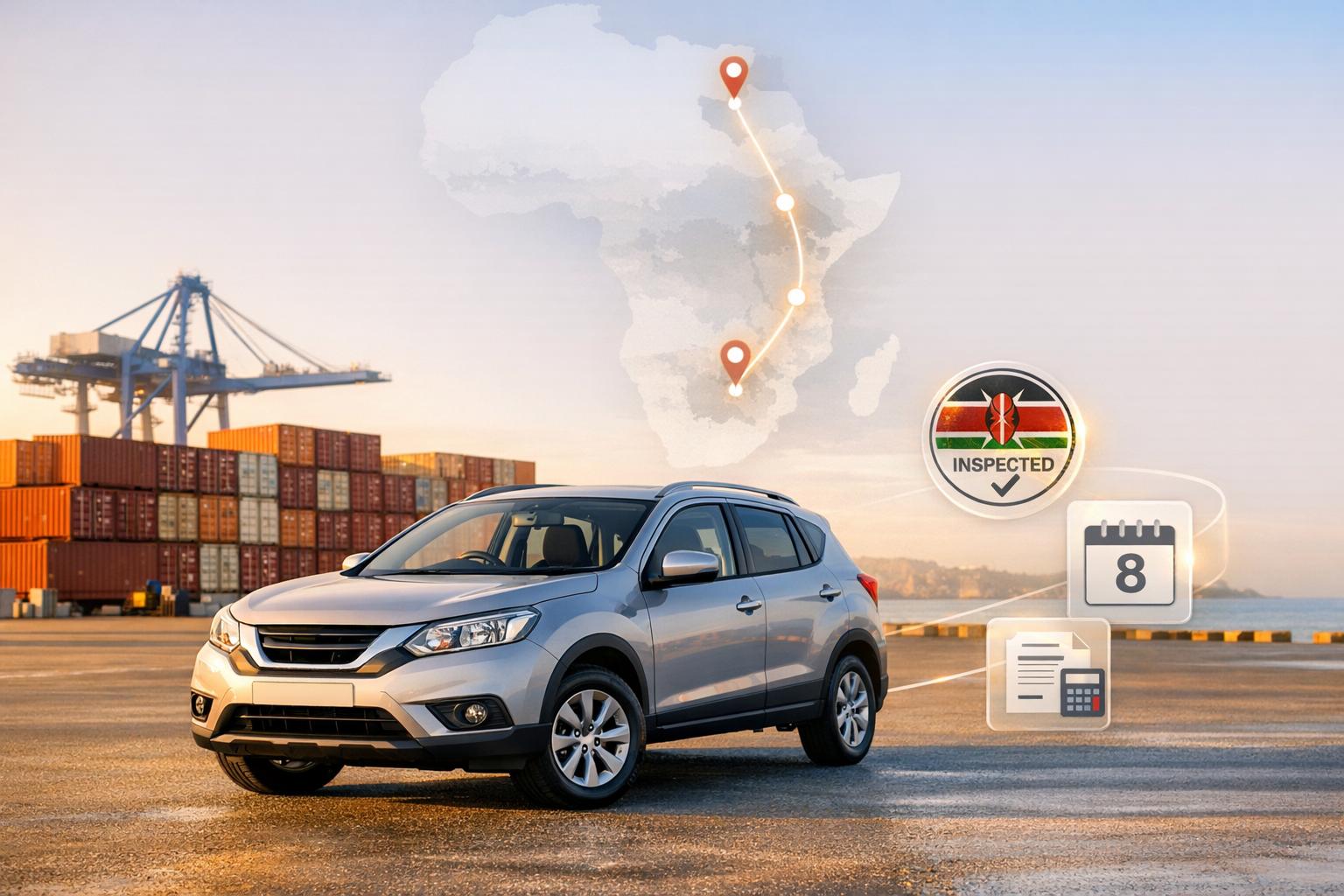
Importing a car from South Africa to Nairobi offers access to better-quality vehicles, predictable mileage, and unique models not easily found locally. It can also save you money compared to buying in Kenya, even after taxes and shipping costs. However, the process involves strict regulations, including Kenya’s 8-year rule (only vehicles from 2019 or later in 2026), mandatory inspections, and taxes based on the Current Retail Selling Price (CRSP).
Here’s what you need to know to avoid costly mistakes:
- Key Regulations: Only right-hand drive cars are allowed. A KEBS pre-shipment inspection is mandatory, and all documentation must be accurate and complete.
- Costs: Taxes include import duty (up to 35%), excise duty (20%-35%), VAT (16%), and additional fees (5.5%). Shipping via RoRo or container adds to the total.
- Process: Work with KRA-licensed agents for customs clearance, which takes about 10 days. Ensure all documents, including the Bill of Lading and Import Declaration Form (IDF), are in order.
- Tips: Verify the vehicle’s age through its chassis number, use trusted dealers like AUTO24.africa, and avoid paying the full amount upfront.
Preparation is key to a smooth import process, saving you time, money, and stress.
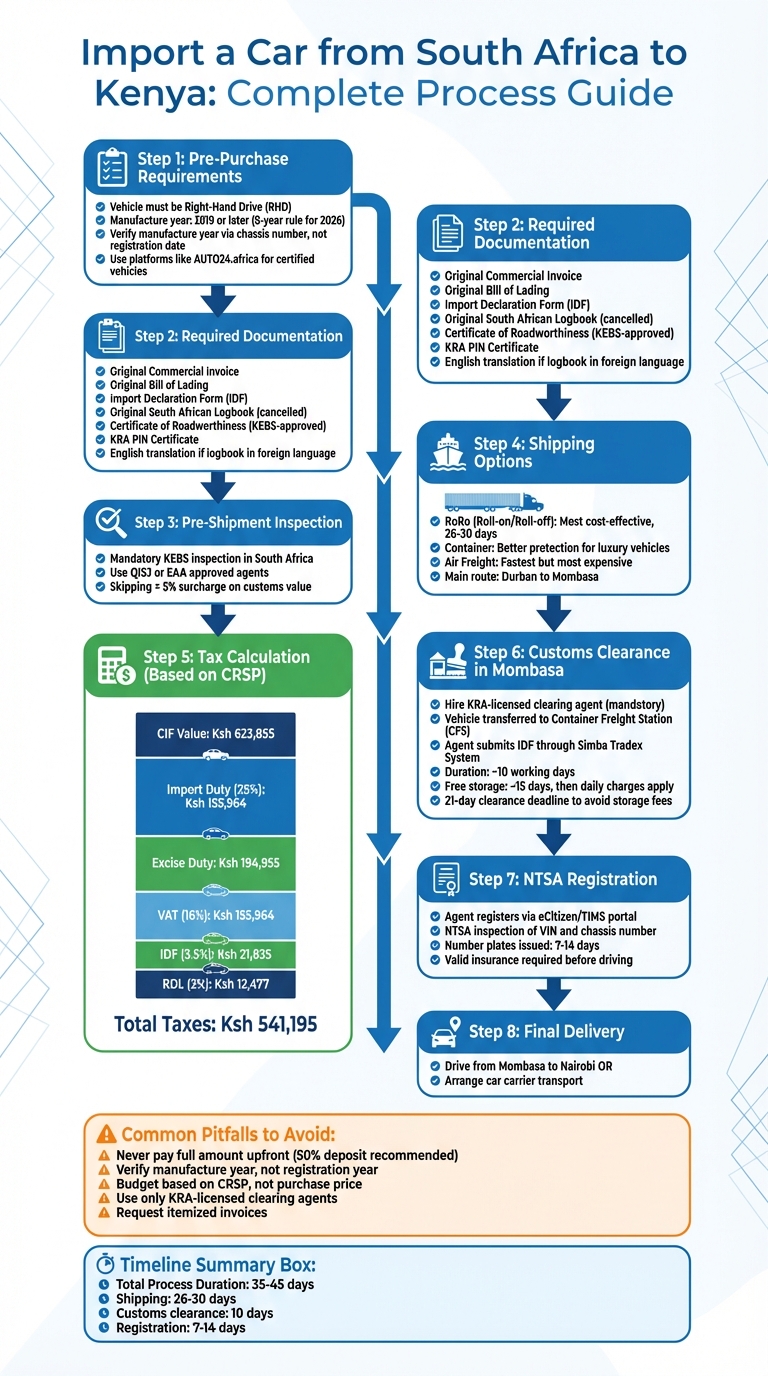
Complete Process for Importing a Car from South Africa to Kenya in 2026
How to Import a Car from Japan to Kenya Without Getting Scammed!
sbb-itb-e5ed0ed
Kenyan Import Regulations You Need to Know
Before making your purchase, it’s important to understand key regulations to avoid unnecessary delays or extra costs.
Vehicle Import Rules
Kenya enforces an 8-year age limit for imported vehicles, calculated strictly from the year of manufacture. For instance, in 2026, only vehicles manufactured in 2019 or later will be eligible for import.
"The 8-year rule is calculated strictly from the year of manufacture, not the year of first registration. In 2026, the oldest acceptable manufacture year is 2019." – Seaways Kenya
Additionally, all vehicles must be right-hand drive (RHD). Left-hand drive vehicles are prohibited for personal use. To meet Kenyan standards, vehicles must comply with KEBS KS 1515:2000 roadworthiness regulations.
A KEBS pre-export inspection is mandatory for all used vehicles. This is typically conducted in South Africa. Skipping this inspection results in a 5% surcharge on the vehicle’s customs value. It’s also recommended to verify the manufacture year using the chassis number rather than relying on registration dates.
Required Documentation
Having the correct paperwork is essential for a smooth clearance process and to avoid storage fees at the port. Below are the primary documents required:
| Document | Purpose |
|---|---|
| Original Commercial Invoice | Confirms the purchase price and transaction details |
| Original Bill of Lading | Shipping document provided by the carrier |
| Import Declaration Form (IDF) | Required from Customs before importation |
| Original South African Logbook (cancelled) | Verifies proof of ownership |
| Certificate of Roadworthiness | Issued by KEBS-approved inspectors in South Africa |
| KRA PIN Certificate | Identifies the importer |
If the logbook is in Afrikaans or another foreign language, an English translation authenticated by the South African embassy or consulate in Kenya is required. Avoid using a "Certificate of Export" in place of the original logbook, as the Kenya Revenue Authority (KRA) will not accept it.
With all documentation in place, you’ll be ready to proceed to customs clearance.
Customs and Clearance Process
To navigate the customs process, you’ll need to hire a KRA-licensed clearing agent. They will handle your declaration through the iCMS system, submit the required paperwork, and process your import entry.
Kenya Customs calculates taxes based on the Current Retail Selling Price (CRSP), not the actual purchase price. This means duties are determined by Kenya’s local market valuation, even if you secured a great deal in South Africa. Reviewing the CRSP matrix can help you estimate your total landed cost.
"To clear the vehicle through Kenya Customs, you will have to contract a licensed clearing agent to process your declaration in the KRA system." – Rhoda Wambui, KRA
Once your vehicle arrives at the port, you’ll have 21 days to clear it. Beyond this period, storage fees will begin to accrue. Most Container Freight Stations in Mombasa provide about 15 days of free storage before daily charges kick in. To avoid complications, it’s best to make tax payments directly to the KRA rather than relying on intermediaries.
How to Calculate Total Import Costs
Understanding the full cost of importing a vehicle is crucial for accurate budgeting. The total expense isn’t just about the purchase price – it includes shipping, taxes, port fees, and inland transport to Nairobi. Here’s a breakdown to help you plan effectively, covering duties, shipping charges, and an example calculation.
Duties, Taxes, and Fees
In Kenya, taxes are based on the Current Retail Selling Price (CRSP) of the vehicle, not the purchase price, unless it’s brand new. The Kenya Revenue Authority (KRA) uses this valuation to calculate duties.
"KRA does not calculate duty based on your purchase price unless it’s a brand new car. Taxes are calculated using the Current Retail Selling Price (CRSP)." – Magari Deals
The tax structure includes several components:
- Import Duty: Typically between 25% and 35% of the CIF value (Cost, Insurance, and Freight).
- Excise Duty: 20% for engines below 1,500cc; 25% to 35% for larger engines.
- Value Added Tax (VAT): A fixed 16%, calculated on the CIF value plus Import Duty and Excise Duty.
- Import Declaration Fee (IDF): 3.5% of the CIF value.
- Railway Development Levy (RDL): 2% of the CIF value.
For hybrid or electric vehicles imported in 2026, reduced excise duty rates may apply as part of Kenya’s efforts to promote cleaner transportation.
Shipping and Transport Costs
Shipping and inland transport costs are another significant part of the total expense. Vehicles are often shipped from South African ports like Durban to Mombasa using Roll-on/Roll-off (RoRo) services, which are cost-effective for standard cars. For luxury vehicles, container shipping offers better protection but comes at a higher price. When arranging shipping, ensure the terms include port transportation under Cost and Freight (C&F).
After clearing customs in Mombasa, the journey to Nairobi involves additional costs for carriers, port handling, and fees such as inspection and Unique Consignment Reference (UCR) charges. It’s wise to set aside a contingency fund – 5% to 10% of your total budget – for unexpected delays or fee adjustments.
Sample Cost Calculation
Here’s an example of the total import cost for a Toyota Auris (1,800cc engine) in February 2026. The CIF value is Ksh 623,855.40, with total taxes and duties amounting to Ksh 541,194.56. This includes Import Duty, Excise Duty, VAT, IDF, and RDL.
| Cost Component | Amount (Ksh) |
|---|---|
| CIF Value | 623,855.40 |
| Import Duty (25%) | 155,963.85 |
| Excise Duty | 194,954.81 |
| VAT (16%) | 155,963.85 |
| IDF (3.5%) | 21,834.94 |
| RDL (2%) | 12,477.11 |
| Total Taxes & Duties | 541,194.56 |
This example highlights how quickly costs can add up beyond the purchase price. Always check the CRSP for your specific vehicle model and use duty calculators from the Kenya Revenue Authority or Seaways to estimate your total landed cost before finalizing a purchase.
How to Find Reliable Vehicles and Dealers
Choosing a reliable dealer is critical when purchasing a vehicle. The wrong choice can lead to scams, hidden costs, or vehicles that fail to meet Kenya’s regulations. Focus on dealers who specialize in Right-Hand Drive (RHD) vehicles manufactured in 2019 or later. It’s also essential to ensure the dealer can arrange the mandatory pre-shipment inspection through Kenya Bureau of Standards (KEBS)-approved agents like QISJ or EAA.
Using AUTO24.africa for Your Purchase

AUTO24.africa simplifies the process of buying certified used cars from South Africa. The platform offers key services like vehicle inspections, clear pricing, and assistance with shipping logistics, reducing the risks associated with unverified sellers. Unlike individual dealers, AUTO24.africa ensures that all vehicles meet Kenyan compliance standards, including RHD configuration and age limits. This saves you time and helps you avoid the frustration of purchasing a vehicle that cannot be registered in Kenya.
How to Inspect Vehicles Before Buying
Before purchasing a vehicle, always verify its Vehicle Identification Number (VIN). Use tools like CarVX to review the auction history, mileage, and records of any past damage or accidents. Confirm the vehicle’s production year through the chassis number or export certificate, as registration dates in countries like South Africa or the UK may not match the actual manufacture date. Be sure to request the original Bill of Lading, Export Certificate (translated into English), and the Pre-Shipment Inspection Certificate.
If possible, arrange for a physical inspection at the Container Freight Station (CFS) in Mombasa when the vehicle arrives. This step allows you to verify that the mileage matches pre-shipment reports and to check for any damage that may have occurred during transit.
Once you’ve confirmed the vehicle’s history and documentation, secure your purchase by following safe payment practices.
How to Avoid Scams and Hidden Costs
Avoid paying the full amount upfront. A safer approach is to make a 50% deposit to secure and ship the vehicle, with the remaining 50% paid after receiving all original shipping documents. Be cautious of clearing agents offering lump-sum fees; instead, request an itemized invoice to understand every charge. Always work with KRA-licensed clearing agents.
To further protect yourself, confirm that the dealer is registered with reputable trade organizations and ask for references from past customers. Keep in mind that the Kenya Revenue Authority calculates taxes based on the Current Retail Selling Price (CRSP) of the vehicle – not your purchase price – so plan your budget accordingly to avoid unexpected costs at customs.
Shipping, Clearance, and Delivery Process
Shipping Options Explained
When transporting your car from South Africa to Kenya, you have three main shipping options. The most popular and budget-friendly choice is Roll-on/Roll-off (RoRo). With RoRo, your car is simply driven onto a vessel in Durban and offloaded in Mombasa. For those seeking added security, container shipping encloses your car in a dedicated container, making it a great option for luxury or classic vehicles. If speed is your priority, air freight is the quickest method, flying your car from OR Tambo in Johannesburg to JKIA in Nairobi within hours. However, this comes with a hefty price tag.
"Air freight your vehicle directly out of OR Tambo airport, Johannesburg and it will arrive a few hours later at JKIA in Nairobi." – UVS Cars
Most importers stick with RoRo because it balances cost and reliability. Ocean freight generally takes 26 to 30 days, while air freight, though faster, is significantly more expensive. Once your car reaches Mombasa, the customs clearance process begins.
Clearing Customs in Mombasa
After arriving at the Port of Mombasa, your vehicle is transferred to a Container Freight Station (CFS), such as Kencont or Bossfreight. These stations often provide free storage for a short period to facilitate the clearance process. Importantly, individuals cannot clear vehicles themselves at the port. You’ll need an approved clearing agent, authorized by the Kenya Revenue Authority (KRA), to handle the process through the Simba Tradex System.
The clearing agent will:
- Submit the Import Declaration Form (IDF).
- Calculate taxes using the Current Retail Selling Price (CRSP).
- Arrange payments and oversee KRA inspections.
- Secure a Customs Release Note.
"It is not possible to clear a car at the port of Mombasa as an individual. This is because clearing agents are empowered by the KRA (Kenya Revenue Authority) to conduct this process." – Croton Motors
The entire clearance process usually takes about 10 working days. However, if your vehicle lacks the mandatory pre-shipment inspection certificate from QISJ or EAA, you may face a 5% surcharge on the customs value.
Registering Your Car in Nairobi
Once customs clearance is complete, your clearing agent will register the vehicle with NTSA using the eCitizen/TIMS portal. NTSA will perform a final inspection to confirm the VIN and chassis number, and number plates are typically issued within 7 to 14 days. Before hitting the road, you’ll also need valid insurance to legally drive in Kenya.
After registration is finalized and your number plates are installed, you can either drive your car from Mombasa to Nairobi or arrange transport using a car carrier. These steps mark the final transition from shipping to enjoying your new car on Kenyan roads.
Conclusion
Bringing a car from South Africa to Nairobi in 2026 might seem complex, but with the right preparation, the process can be manageable and efficient.
The 8-year rule is a critical factor – always confirm the vehicle’s manufacture year to avoid issues at the Port of Mombasa. This regulation is strictly enforced, so skipping this step could lead to costly mistakes.
Taxes and levies are another key consideration. The Kenya Revenue Authority (KRA) bases these charges on the Current Retail Selling Price (CRSP), not the purchase price. Make sure your budget reflects this to avoid surprises.
Using platforms like AUTO24.africa can simplify your search for Kenya-compliant vehicles, helping you avoid scams and unexpected costs. Additionally, don’t overlook the pre-shipment inspection requirement by KEBS-approved agents such as QISJ or EAA. Failing to meet this requirement leads to a 5% surcharge on the customs value.
The process also involves securing original documents like the Bill of Lading and Export Certificate, as well as registering the car through the NTSA eCitizen/TIMS portal. Work exclusively with KRA-licensed clearing agents and insist on fully itemized invoices. Once registration is complete, number plates are typically issued within 7–14 days.
FAQs
How do I confirm a car meets Kenya’s 8-year rule?
If you’re planning to import a car into Kenya in 2026, it must have been manufactured in 2018 or later to meet the country’s 8-year rule. The vehicle’s age is calculated from January 1 of its manufacture year to December 31 of the import year.
To ensure compliance, verify key documents like export certificates and logbooks. Use authorized agencies such as Quality Inspection Services Inc. Japan (QISJ) to confirm the vehicle’s legitimacy and adherence to this regulation.
What costs should I budget beyond KRA taxes and shipping?
When importing goods, it’s not just about KRA taxes and shipping costs. You also need to consider additional fees like the Import Declaration Fee (IDF), expenses for pre-shipment inspections, and charges for customs clearing agents. These costs can add up quickly, so make sure to include them in your budget to avoid surprises.
How can I pay safely and avoid car import scams?
When it comes to paying safely and steering clear of scams, it’s crucial to verify the seller’s reputation. Opt for secure payment methods like bank transfers or telegraphic transfers (TT), as these provide a clear transaction record. Stick to licensed dealers, reliable platforms, and experienced customs agents to ensure everything aligns with regulations.
Avoid payment methods that can’t be traced, and always inspect the vehicle in person before making any payments. Lastly, never hand over the full amount upfront unless you have proper documentation or guarantees in place.
Related Blog Posts
- FAQ: Importing Used Cars to Kenya in 2025
- Importing a car to Kenya: costs & taxes
- Import a Car from the UK to Nairobi: Step-by-Step Guide for Buyers
- Import a Car from South Korea to Kenya: Tips, Prices, and Customs Process