
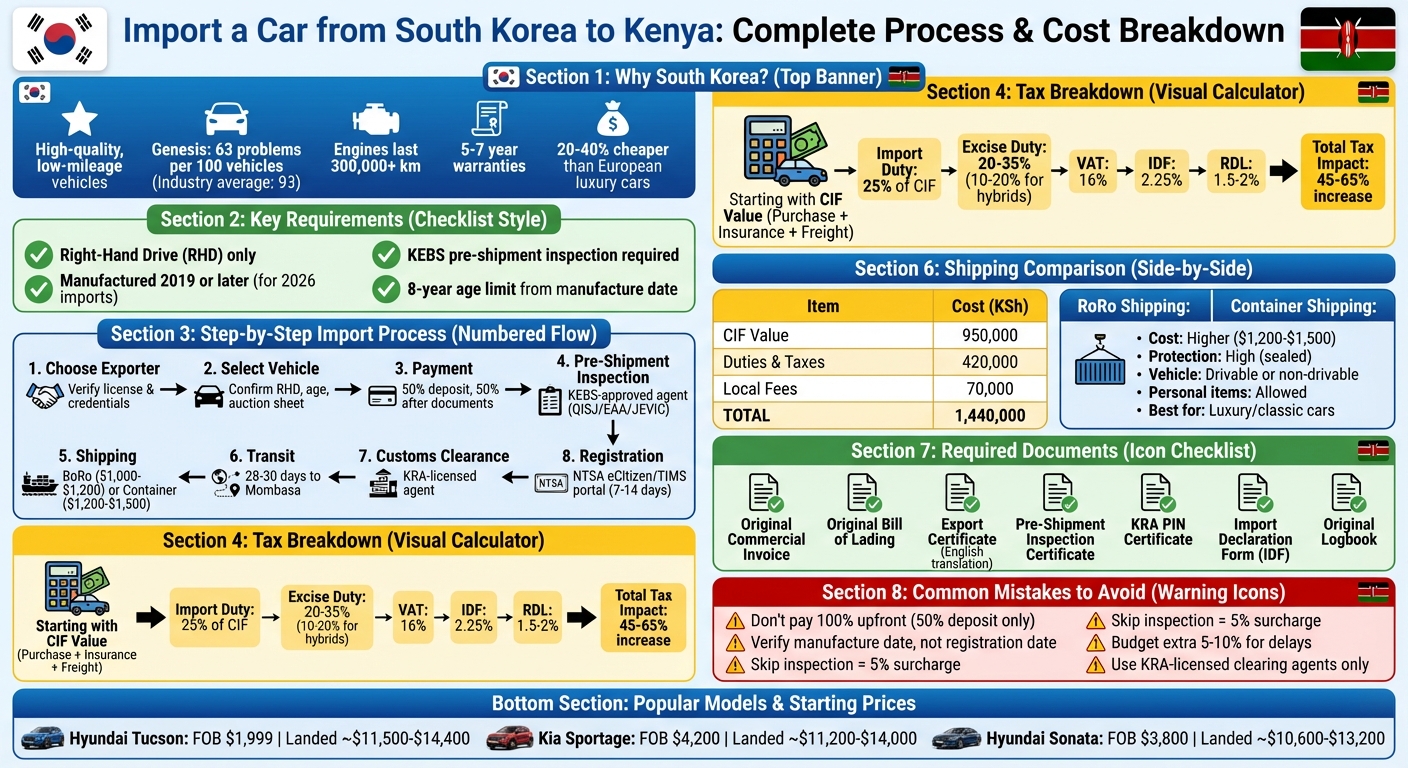
If you’re planning to import a car from South Korea to Kenya, here’s what you need to know:
- Why South Korea? You get access to high-quality, low-mileage cars with advanced features at competitive prices. Popular brands like Hyundai, Kia, and Genesis dominate the market.
- Key Regulations: Cars must be right-hand drive (RHD), manufactured in 2019 or later, and pass a pre-shipment inspection by KEBS-approved agents.
- Costs: Taxes and fees can increase the car’s value by 45%-65%. You’ll pay import duty (25%), excise duty (20%-35%), VAT (16%), and additional fees for shipping, clearing, and registration.
- Shipping Options: Choose between RoRo (affordable, for standard cars) or container shipping (more secure, for luxury or non-drivable vehicles).
- Documents Needed: Ensure you have the original commercial invoice, bill of lading, export certificate (translated), pre-shipment inspection certificate, and KRA PIN certificate.
- Avoid Mistakes: Verify the car’s age and mileage, work with licensed clearing agents, and ensure all documents are in order to avoid delays or penalties.
Complete Guide to Importing Cars from South Korea to Kenya: Costs, Taxes and Process
[Interview] The best three ways to import used cars from Korea
sbb-itb-e5ed0ed
Benefits of Importing Cars from South Korea
South Korean cars have built a strong reputation for reliability, often outperforming traditional automakers. According to the JD Power Initial Quality Survey, Genesis leads the pack with only 63 problems per 100 vehicles, followed closely by Kia and Hyundai. For context, the industry average sits at 93 problems per 100 vehicles.
These vehicles are designed with streamlined systems to reduce technical issues, making them ideal for Kenyan roads. Their excellent fuel efficiency also helps drivers save on monthly expenses, especially in high-traffic areas. Additionally, South Korean manufacturers now include advanced safety features – like Forward Collision-Avoidance Assist, Lane Departure Warning, and Rear Cross Traffic Alert – as standard in many models.
This reliability and innovation make South Korean brands an attractive choice for Kenyan drivers.
Popular Korean Brands for Kenya
Hyundai and Kia are the most popular South Korean brands in Kenya, dominating the import market with a steady supply of used vehicles. SUVs like the Hyundai Tucson, Santa Fe, and Palisade are well-suited for Kenya’s varied terrains, while models like the Kia Sportage, Sorento, and Seltos offer similar versatility. For urban driving or taxi services, fuel-efficient sedans such as the Hyundai Elantra, Sonata, and Kia Pegas are widely favored.
Genesis, Hyundai’s luxury division, is also gaining attention among buyers looking for premium engineering at a more accessible price point. With warranties ranging from 5 to 7 years, Korean engines are built to last, often exceeding 186,000 miles (300,000 kilometers) with proper care.
Price Advantages Over Other Markets
Cost efficiency is another major draw for South Korean cars. In South Korea, vehicles are typically replaced every three to five years, leading to a surplus of low-mileage cars in the export market. This high turnover allows buyers to access well-maintained vehicles at prices significantly lower than comparable Japanese models.
South Korean automakers also pack their vehicles with advanced features – like touchscreens, Bluetooth connectivity, and safety systems such as ABS and ESC – at prices that often undercut their European counterparts. For instance, luxury models like the Kia K900 can cost 20% to 40% less than similarly equipped European or Japanese luxury cars.
Starting FOB (Free on Board) prices for popular models include the Hyundai Tucson ix at $1,999, the Kia Bongo 3 at $2,648, and the Hyundai Grand Starex at $2,443. Beyond competitive pricing, maintenance costs remain affordable due to Hyundai and Kia’s global supply network, which ensures easy access to spare parts. With more than two decades of presence in Africa, these brands have established service networks, making ownership practical and convenient in Kenya.
How to Choose a Trustworthy South Korean Exporter
After understanding the benefits and cost considerations, the next step is selecting a dependable South Korean exporter. This decision is crucial – not only to safeguard your investment but also to ensure compliance with Kenya’s import regulations. A poor choice could result in shipment rejection, extra fees, or even financial loss.
What to Look for in an Exporter
Start by confirming the exporter’s legal standing and credentials. Ask for proof of their export license and ensure they are registered with recognized industry organizations.
A reliable exporter will handle the required KEBS pre-shipment inspection through approved agents such as QISJ, EAA, or JEVIC. Skipping this inspection could lead to a 5% surcharge on the vehicle’s customs value. They should also provide transparent access to auction sheets and vehicle history reports, allowing you to independently verify the vehicle’s condition.
Professionalism is reflected in proper documentation. Insist on receiving original hard copies – not just digital scans – of critical documents like the Bill of Lading, Export Certificate (with an English translation), and Pre-Shipment Inspection Certificate. Additionally, make sure your contract specifies C&F terms, covering shipping to Mombasa and the KEBS inspection.
| Factor | Requirement for Reliability |
|---|---|
| Vehicle Age | Must confirm the car is less than 8 years old (2019 or newer for 2026 imports) |
| Steering | Must guarantee Right-Hand Drive (RHD) configuration |
| Inspection | Must provide a Certificate of Roadworthiness from a KEBS-approved agent |
| Documentation | Must provide original Bill of Lading, Export Certificate, and Pre-Shipment Inspection Certificate |
Once you’ve verified the exporter’s credentials and documentation, it’s time to protect yourself from potential scams.
How to Avoid Scams
To minimize risk, pay only a 50% deposit and release the remaining balance after receiving all original documents. Opt for Telegraphic Transfer (TT) to maintain a clear financial record.
Be cautious of exporters offering suspiciously low all-inclusive prices (standard RoRo shipping costs range from $1,000 to $1,200, while container shipping typically costs $1,200 to $1,500). Avoid those who dismiss mandatory inspections or pressure you to skip essential documentation steps. For reference, shipping to Kenya usually costs between KSH 100,000 and KSH 180,000, with clearing agent fees ranging from KSH 20,000 to KSH 50,000.
Always verify the vehicle’s auction grade and mileage using independent tools like CarVX. Additionally, check the exporter’s online reputation through independent customer reviews and request references from other Kenyan buyers to confirm successful transactions.
Common Models and Price Ranges
Best-Selling Models for Kenyan Buyers
In Kenya, South Korean vehicles like the Hyundai Tucson, Kia Sportage, Hyundai Sonata, Kia Sorento, and Kia Carnival are among the most sought-after options. These cars are known for their durability, with engines often lasting beyond 300,000 kilometers when properly maintained. Even older models come equipped with modern features such as touchscreens, Bluetooth, ABS, ESC, and lane-keeping assist. Another big plus is the easy availability of spare parts, thanks to the global supply chains of Korean automakers [12, 14].
South Korea’s compact size and strict vehicle inspections also play a role in the quality of exported cars. Many of these vehicles have low mileage and are well-maintained, as South Korean drivers tend to replace their cars every three to five years. This creates a steady flow of lightly used cars for export.
If you’re considering one of these models, it’s essential to factor in the total cost – including purchase price, shipping, and taxes – to find the best option for your budget.
Cost Breakdown: Purchase Price, Shipping, and Taxes
Calculating the total landed cost involves adding up the FOB (Free on Board) price, shipping fees, and Kenya’s import taxes. Here’s a breakdown of estimated costs for some of the most popular models:
| Model | Est. FOB Price | Shipping (RoRo) | Total Taxes (60–120% of CIF) | Estimated Landed Cost |
|---|---|---|---|---|
| Hyundai Tucson (2019–2022) | $4,398+ | $2,800 | $4,300 – $7,200 | $11,500 – $14,400 |
| Kia Sportage (2019–2022) | $4,200+ | $2,800 | $4,200 – $7,000 | $11,200 – $14,000 |
| Hyundai Sonata (2019–2022) | $3,800+ | $2,800 | $4,000 – $6,600 | $10,600 – $13,200 |
| Kia Sorento (2019–2022) | $5,000+ | $2,800 | $4,700 – $7,800 | $12,500 – $15,600 |
| Hyundai Grand Starex | $2,443+ | $2,800 | $3,100 – $5,200 | $8,300 – $10,400 |
Taxation typically accounts for 60% to 120% of the CIF (Cost, Insurance, and Freight) value [23, 25]. On top of that, plan to set aside approximately KSH 160,800 (around $1,200) to cover port charges, clearing agent fees, and local transport. If you’re considering a hybrid model, you could save significantly on taxes. Hybrid vehicles are subject to lower excise duty rates (10–20%) compared to conventional engines, which are taxed at 20–35% [21, 7].
Shipping Methods: RoRo vs. Container
Roll-on/Roll-off (RoRo) Shipping
RoRo shipping is one of the most cost-effective ways to transport a car. In this method, your drivable vehicle is loaded onto the ship using ramps and secured on the deck until it reaches Mombasa. Once the ship arrives, the car is simply driven off. It’s a straightforward process: drive on, secure, and drive off.
This option is ideal for standard, drivable vehicles like a Hyundai Tucson or Kia Sportage. However, it’s important to note that personal items cannot be stored inside the car. While RoRo provides moderate protection, your car will still be exposed to sea air and handling during the 28 to 30-day journey to Mombasa. On the bright side, port fees for RoRo are generally lower since it requires less heavy machinery and manual work.
If you’re shipping a high-value, classic, or non-running vehicle, container shipping might be a better alternative.
Container Shipping
Container shipping involves placing your vehicle inside a sealed 20-foot or 40-foot container, offering superior protection from weather, sea spray, salt air, and theft. However, this added security comes at a higher cost.
This method is perfect for luxury, classic, or high-value cars that require extra care during transit. Another advantage is that you can load spare parts, accessories, or even personal belongings into the container alongside your vehicle. Additionally, container shipping can accommodate non-running or damaged cars, making it a versatile option. The downside? Higher costs due to container rental, packing, and additional port handling fees. If you’re only shipping one car, you can reduce costs by opting for a shared container (LCL), where expenses are split with other shippers.
Now, let’s compare these two methods to help you decide which one aligns with your needs.
Shipping Method Comparison
| Feature | RoRo Shipping | Container Shipping |
|---|---|---|
| Cost | Lower (most economical) | Higher |
| Protection | Moderate (exposed to sea air) | High (fully enclosed/sealed) |
| Vehicle Condition | Must be drivable | Drivable or non-drivable |
| Personal Items | Strictly prohibited | Allowed (spare parts/goods) |
| Loading Speed | Faster turnaround | Slower (requires packing/lifting) |
| Best For | Standard used cars, budget buyers | Luxury, classic, or non-running cars |
For most Kenyan buyers importing standard vehicles, RoRo is a practical and budget-friendly choice. On the other hand, if you’re shipping a high-value car or need to include additional items, the added cost of container shipping is well worth the peace of mind and extra protection it provides. Your decision will ultimately depend on your budget and the level of security your vehicle requires during transit.
Required Documents and Kenyan Regulations
Documents Needed for Import
Getting the paperwork right is essential for a hassle-free import process. Here’s what you’ll need:
- Original Commercial Invoice: This document from your South Korean exporter outlines the vehicle details and sale price.
- Original Bill of Lading: Issued by the shipping line, this serves as proof of cargo ownership and your contract of carriage.
- Export Certificate: Provided by the exporter, this certificate proves the vehicle has been deregistered. An official English translation is also required.
- Pre-Shipment Inspection Certificate: This certificate, also known as the Certificate of Roadworthiness, must be issued by a KEBS-approved agent (such as QISJ or EAA) before the vehicle is shipped. Skipping this step results in a 5% surcharge on the vehicle’s customs value.
- KRA PIN Certificate: Needed for tax identification purposes.
- Import Declaration Form (IDF): This is applied for through the KRA iTax/Customs portal, typically handled by your clearing agent.
- Original Logbook: This document from South Korea will later be exchanged for a Kenyan logbook at NTSA.
One important tip: Hold off on paying the final 50% of the purchase price until you’ve received all the original shipping documents. Having these documents ensures compliance with Kenya’s strict import rules.
Kenya’s Import Regulations
Once your documents are sorted, you’ll need to follow Kenya’s specific import regulations, which cover age, configuration, and emissions standards.
Kenya enforces an 8-year age limit for imported vehicles, calculated strictly from the year of manufacture – not the registration date. For example, a car manufactured in December 2018 would not qualify for import in 2027.
"The 8-year rule is calculated strictly from the year of manufacture, not the year of first registration." – Seaways Kenya Limited
Additionally, only right-hand drive (RHD) vehicles are allowed for general use. Left-hand drive vehicles are restricted to special purposes, such as diplomatic missions, fire engines, or ambulances. While South Korea mainly produces left-hand drive vehicles, exporters often supply RHD units specifically for markets like Kenya. Always double-check that your vehicle is RHD before making a purchase.
Finally, all vehicles must meet Kenyan emissions standards, assessed during the mandatory pre-shipment inspection. This inspection ensures compliance with the KS 1515:2000 standard.
Customs Clearance Steps in Kenya
Before the Vehicle Arrives
Once you’ve purchased your vehicle, it’s important to act quickly. Your clearing agent should apply for the Import Declaration Form (IDF) through the KRA iTax portal. This step ensures your vehicle is registered in the Integrated Customs Management System (ICMS).
Make sure your exporter completes the KEBS pre-shipment inspection through an approved agent, such as QISJ or EAA. Skipping this inspection will lead to a customs surcharge. The agent will issue a Certificate of Roadworthiness, confirming the vehicle meets Kenya’s KS 1515:2000 emissions and safety standards.
Gather all original documents, including the Commercial Invoice, Bill of Lading, South Korean logbook, and inspection certificate. If the logbook is in a language other than English, you’ll need an official translation from the South Korean Embassy or Consulate in Kenya. The original Bill of Lading is essential to claim your vehicle once it arrives at the port.
After the Vehicle Arrives
Once your vehicle reaches Kenya, the next steps kick in. Your clearing agent will lodge the import entry in the ICMS, attaching all required documents. The Kenya Revenue Authority (KRA) calculates duties based on the Current Retail Selling Price (CRSP) of the vehicle, not the purchase price. You can pay these duties through the KRA iTax portal or at authorized banks.
At the Container Freight Station (CFS), KRA officers may inspect your vehicle to confirm details like engine capacity and manufacture year match the provided documents. After duties are paid and verified, KRA will issue a Customs Release Note, which allows you to claim your vehicle at the port.
To register your vehicle, use the Customs Release Note along with valid insurance and the inspection certificate. Log into your TIMS account on the eCitizen portal to complete the registration process and get your number plates and logbook. Don’t forget to settle any port storage and handling fees with the CFS. Typically, number plates and logbooks are ready within 7 to 14 days after registration.
Following these steps ensures your vehicle is cleared, registered, and ready for the road in Kenya.
Import Taxes and Total Cost Estimates
Taxes and Fees Explained
To budget effectively for importing a vehicle into Kenya, it’s crucial to understand the country’s tax structure. Kenya calculates taxes sequentially, meaning each tax builds on the total from the previous step. It all starts with determining the Cost, Insurance, and Freight (CIF) value, which includes the purchase price, marine insurance, and shipping fees to the Port of Mombasa. However, the Kenya Revenue Authority (KRA) often relies on the Current Retail Selling Price (CRSP) of a new vehicle, adjusted for depreciation based on the car’s age, rather than the invoice price.
Here’s the breakdown of the tax sequence:
- Import Duty: This is set at 25% of the CIF value.
- Excise Duty: This depends on the engine size and fuel type. For engines below 1,500cc, it’s typically 20%, while engines above 1,500cc attract 30–35%. Hybrids and electric vehicles benefit from lower rates, usually 10–20%. Excise Duty is calculated on the CIF value plus Import Duty.
- Value Added Tax (VAT): Applied at 16%, VAT is calculated on the sum of the CIF value, Import Duty, and Excise Duty.
- Import Declaration Fee (IDF): Set at 2.25% of the CIF value, with a minimum charge of KSh 5,000.
- Railway Development Levy (RDL): This adds another 1.5–2% of the CIF value.
These taxes are part of the customs clearance process, which ties back to earlier steps in the importation procedure.
In addition to taxes, several local fees apply:
- KEBS Inspection Fees: Typically range from KSh 15,000 to 18,000.
- Port Handling and Storage: Costs vary based on vehicle size, usually between KSh 18,500 and 34,000.
- Clearing Agent Fees: Generally range from KSh 15,000 to 30,000.
- Vehicle Registration: Costs for number plates fall between KSh 10,000 and 18,000.
- Shipping Line Delivery Order Fee: Adds KSh 10,000 to 12,000, plus VAT.
Sample Cost Calculations
To see how these taxes and fees add up, let’s look at an example for a 2019 Toyota Fielder Hybrid:
| Component | Estimated Cost (KSh) |
|---|---|
| CIF Value (Purchase + Shipping to Mombasa) | 950,000 |
| Total Duties & Taxes (Import, Excise, VAT, IDF, RDL) | 420,000 |
| Local Fees (Inspection, Port, Clearing, Registration) | 70,000 |
| Total Landed Cost | ~1,440,000 |
Before making a purchase, it’s wise to verify the CRSP for your specific vehicle model through the KRA iTax portal. Customs often use this standardized valuation instead of the negotiated invoice price. Additionally, set aside an extra 5–10% of the total cost to cover potential delays or port storage fees (demurrage). Vehicles cleared within the 7-day free period at the Container Freight Station can avoid these extra charges.
Common Mistakes to Avoid
Frequent Errors in the Import Process
One of the biggest pitfalls in the import process is submitting incorrect documentation. For instance, some buyers mistakenly use a Certificate of Export instead of the original logbook from South Korea. However, the Kenya Revenue Authority (KRA) strictly requires the authentic original logbook. If the logbook is in Korean, you must get an official English translation that’s authenticated by the Korean embassy or consulate. Additionally, you need to provide physical originals – not scanned copies – of essential documents like the Bill of Lading, Export Certificate, Pre-Shipment Inspection Certificate, and Commercial Invoice.
Another common oversight is misunderstanding how to verify a vehicle’s age. Kenya enforces an 8-year manufacturing rule, which is based on the year of manufacture, not the year of first registration. To avoid issues, confirm the manufacture date using the chassis number before making a purchase. If the vehicle arrives before its registration anniversary in the eighth year, you’ll face a steep 10% duty penalty.
Skipping the KEBS-approved pre-shipment inspection is another costly error, as it results in a 5% surcharge on the customs value. Some buyers also try to understate the purchase price to reduce taxes, but this can backfire. KRA calculates duties based on the Current Retail Selling Price (CRSP), which often leads to higher charges regardless of your invoice price.
Pay attention to these details to avoid unnecessary expenses and headaches during the import process.
Tips for a Smooth Import Experience
Follow these tips to make your vehicle import process as smooth as possible. First, always confirm the manufacture date before making any payment. For example, vehicles imported in 2026 must have been manufactured in 2019 or later to meet the 8-year rule. Do not release your final payment until you’ve received all original shipping documents. To avoid fraud, verify the auction sheet details to ensure the mileage hasn’t been tampered with.
Only work with KRA-licensed clearing agents, and double-check their credentials on the KRA website. Be cautious of agents offering "all-inclusive" lump sum fees without itemized breakdowns. Use the documents checklist provided earlier to ensure compliance, and share critical documents like the Bill of Lading with your clearing agent before the vehicle arrives at the port. This helps them start the clearance process early.
Lastly, budget an extra 5–10% of the total cost to cover unexpected delays or port storage fees. Aim to clear your vehicle within the 15-day free storage period offered by most Container Freight Stations to avoid daily demurrage charges. These proactive steps can save you time, money, and stress.
Conclusion
Importing a car from South Korea to Kenya requires careful attention to the steps outlined in this guide. By following these instructions – from selecting a trustworthy exporter to navigating customs clearance – you can sidestep unnecessary expenses and delays.
Key requirements to keep in mind: your car must be Right-Hand Drive (RHD) and manufactured in 2019 or later for imports in 2026. Taxes are calculated based on the Current Retail Selling Price (CRSP), not the purchase price. Expect total import costs to increase the car’s value by 45% to 65%. To avoid surprises, use the KRA Vehicle Duty Calculator to estimate your duties before making a purchase.
Ensure you complete the KEBS-approved pre-shipment inspection to avoid a 5% penalty. Work only with verified exporters, paying a 50% deposit upfront and settling the balance once you receive the original documents. For customs clearance at the Port of Mombasa, hire a KRA-licensed clearing agent and budget an extra 5–10% for unexpected costs like port storage fees or delays. After clearing, register your vehicle through the NTSA eCitizen/TIMS portal to get your number plates and logbook within 7–14 days.
FAQs
How do I confirm a Korean car is right-hand drive before I pay?
To make sure a Korean car is right-hand drive before making a payment, check the vehicle’s steering setup through its original registration papers or other official documentation. If you’re purchasing a used car, it’s a good idea to inspect it in person to confirm this detail. For imports to Kenya, only right-hand drive vehicles are permitted, so verifying this is crucial to prevent problems during customs clearance.
What’s the fastest way to estimate my total landed cost using CRSP?
To get a quick estimate of your total landed cost using CRSP, start by calculating your vehicle’s CIF (Cost, Insurance, and Freight) value. Next, use the KRA online tax calculator to estimate key charges like import duties, VAT, and other taxes. Finally, factor in standard costs for port handling, inspection, and clearance. This method offers a quick and fairly accurate way to gauge your costs without diving into detailed manual calculations for every component.
How long does clearance and registration take after the car reaches Mombasa?
Once the car reaches Mombasa, the process of clearance and registration typically takes 1 to 2 weeks. The exact timeline can vary based on how smoothly customs procedures are managed and whether all necessary paperwork is submitted without delays.
Related Blog Posts
- FAQ: Importing Used Cars to Kenya in 2025
- Importing a car to Kenya: costs & taxes
- Import a Car from Japan to Kenya: Costs, Duties, and How to Avoid Scams
- Car import duties in Kenya: Full guide to KRA fees and clearance