Planning to import a car into Kenya? Here’s what you need to know upfront:
- Age Limit Rule: Starting January 1, 2026, only vehicles first registered on or after January 1, 2019, can enter Kenya. Vehicles older than 8 years will be rejected at the port, and importers will bear all costs.
- Mandatory Pre-Export Inspection: Cars must pass a Pre-Export Inspection in the country of origin (e.g., Japan, UK, South Africa) by KEBS-approved agencies like JEVIC or QISJ. A Certificate of Roadworthiness (CoR) is required for customs clearance.
- Right-Hand Drive Only: Kenya allows only right-hand drive (RHD) vehicles. Left-hand drive (LHD) cars are prohibited.
- Inspection Process: Inspections cover mechanical integrity, safety features, emissions, and documentation. Vehicles failing these checks must be repaired and re-inspected.
- Import Costs: Taxes and fees can add 25%-60% to the vehicle’s customs value. Other charges include VAT (16%), Import Declaration Fee (3.5%), and Railway Development Levy (2%).
Non-compliance means delays, penalties, or outright rejection. Proper documentation – like the original logbook, Bill of Lading, and KRA PIN certificate – is critical to avoid issues. Follow these steps to ensure a smooth import process.
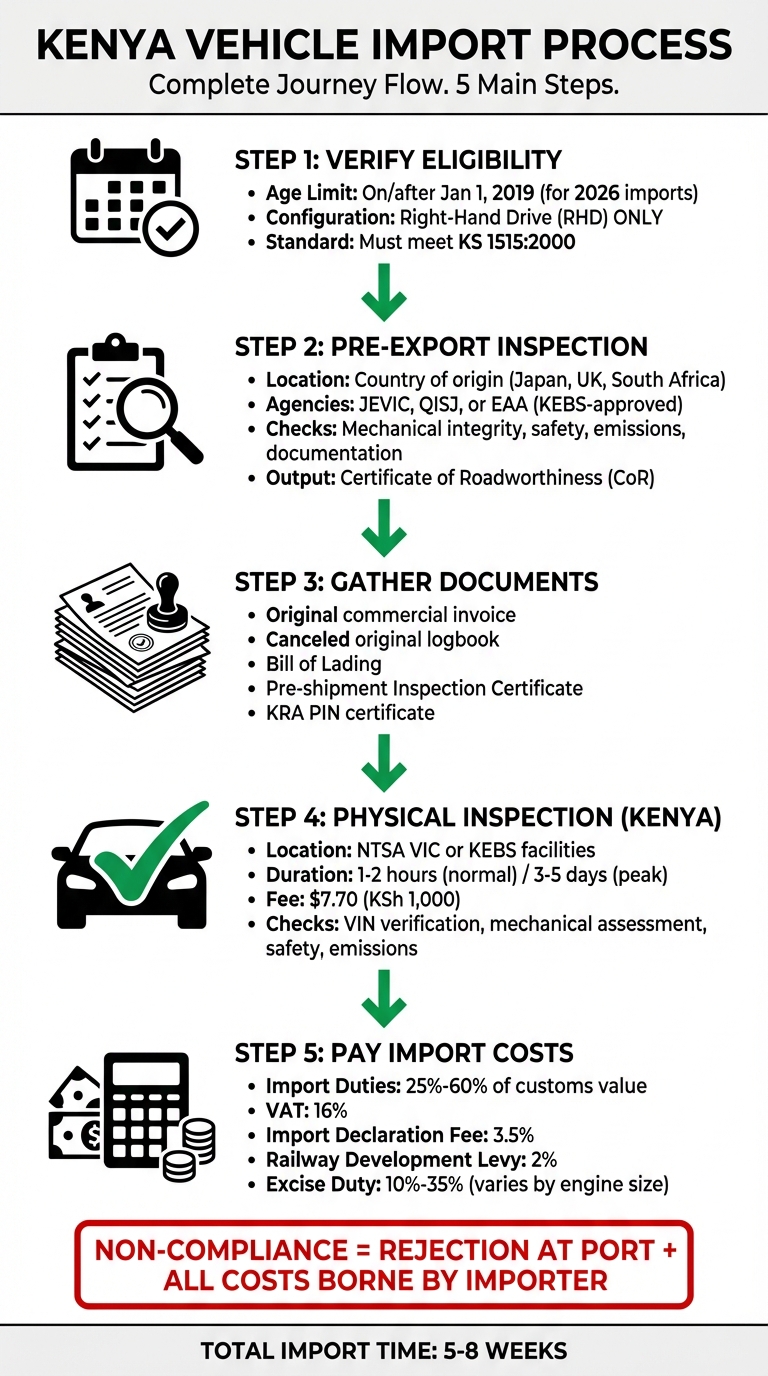
Kenya Car Import Process: 5 Steps from Pre-Export to Registration
Pre-Export Inspections: Required Checks Before Shipping
What is Pre-Export Inspection (PSI)?
Pre-Export Inspection (PSI) is a mandatory process to ensure a vehicle’s roadworthiness before it is shipped to Kenya. This check is carried out by agents appointed by the Kenya Bureau of Standards (KEBS) in countries like Japan. It operates under the Verification of Conformity to Kenya Standards Imports Order, 2005 (Legal Notice No. 78) and the KS 1515:2000 Kenya Standard Code of Practice for Inspection of Road Vehicles. The goal? To confirm that the vehicle complies with Kenya’s safety and environmental regulations. Once the vehicle passes the inspection, the agent issues a certificate that is essential for customs clearance.
Inspection Agencies: JEVIC, EAA, and QISJ
KEBS has authorized agencies such as JEVIC, EAA, and QISJ to handle these inspections. These agencies follow strict KEBS guidelines, conducting thorough physical checks on vehicles and confirming documentation accuracy. Afterward, they issue the Certificate of Roadworthiness, which is a key requirement for importation.
Inspection Checklist: What Gets Examined?
Inspectors focus on several critical areas, including:
- Ensuring the vehicle is less than 8 years old from its initial registration.
- Verifying it has a Right-Hand Drive (RHD) configuration.
- Confirming compliance with the KS 1515:2000 roadworthiness standards.
These steps guarantee that only vehicles meeting Kenya’s import criteria make it through the process.
sbb-itb-e5ed0ed
Car Importation Process In Kenya | Croton Motors

Kenya’s Import Rules: Age Limits and Roadworthiness Standards
Kenya has strict guidelines for importing used vehicles, focusing on both age limits and vehicle configurations. These rules are enforced after pre-export inspections to ensure safety and compliance.
8-Year Age Limit for Imported Cars
Kenya enforces an 8-year age limit for imported used vehicles, calculated from the date of first registration. Starting January 1, 2026, only vehicles first registered on or after January 1, 2019, will be allowed into the country. This rule changes annually, so a vehicle registered in December 2018 must arrive at a Kenyan port no later than December 31, 2025, to remain eligible.
"Any vehicle registered in 2018 or earlier, arriving after 31st December 2025, will be deemed not compliant with KS 1515:2000 and shall be rejected at the importer’s expense." – KEBS Public Notice
This policy prioritizes road safety. Vehicles that do not meet these requirements are rejected at the port, and the importer bears all associated costs, including shipping and clearance. To avoid rejection, it’s critical to verify the vehicle’s first registration date – not its manufacturing year – before importing.
Adhering to configuration standards is equally important.
Right-Hand Drive and KEBS Compliance
Kenya mandates that all imported vehicles must be Right-Hand Drive (RHD). Left-Hand Drive (LHD) vehicles are prohibited, aligning with the country’s road system, where vehicles drive on the left side.
In addition to the RHD requirement, all vehicles must meet the KS 1515:2000 standard, which outlines the Kenya Standard Code of Practice for Inspection of Road Vehicles. This standard evaluates key aspects such as mechanical integrity, brakes, lighting, and emissions. John Mwangi, Director of Quality Assurance at KEBS, explained the importance of these regulations:
"In compliance with the Kenya Standards, we are enforcing the eight-year age limit on all used motor vehicles entering Kenya. This is aimed at improving road safety and ensuring better-quality vehicles on our roads." – John Mwangi, Director of Quality Assurance, KEBS [[7]](https://eastleighvoice.co.ke/second-hand vehicles/92518/kebs-sets-new-rules-for-importing-used-vehicles-effective-january-2025)
To clear customs, a Certificate of Roadworthiness (CoR) is required. This certificate must be obtained before shipment from KEBS-authorized inspection agencies, such as QISJ, to confirm compliance with KS 1515:2000. Without this document, customs clearance is not possible.
Document Requirements: What You Need for Inspections
Bringing a vehicle into Kenya involves a detailed process, and having the right paperwork is critical. Any missing document can cause delays or even rejection. The required documentation is split into two main stages: pre-export documents (before shipping) and post-import documents (for local registration).
Pre-Export Documents
Before your vehicle is shipped, you’ll need to gather several key documents. The original commercial invoice acts as proof of purchase and is used to determine customs valuation. You’ll also need the canceled original logbook from the country of origin. This is essential for obtaining a Kenyan logbook later through the National Transport and Safety Authority (NTSA).
Another critical document is the Bill of Lading, which confirms the shipment’s port of origin and destination. Additionally, you must secure a Pre-shipment Inspection Certificate (also known as a Certificate of Roadworthiness or Conformity) from a KEBS-approved agent, such as JEVIC, QISJ, or EAA, before shipping. This certificate is mandatory for the vehicle to be allowed entry into Kenya.
These documents ensure that your vehicle complies with Kenyan import regulations before leaving its country of origin.
Post-Import and NTSA Inspection Documents
Once the vehicle arrives in Kenya, you’ll need to prepare additional paperwork. These include a Kenyan insurance certificate, customs clearance certificates, and a copy of your KRA PIN certificate (or a Certificate of Incorporation if importing on behalf of a company). The KRA PIN certificate is required for all clearance and inspection processes with the Kenya Revenue Authority.
You’ll also need the Export/Import Motor Vehicle Clearance Certificate issued by the Kenya Police Service. This document confirms that the vehicle hasn’t been reported stolen and is valid for only 90 days, so timing is crucial. Lastly, double-check all documents for accuracy. Mistakes in the Bill of Lading or PIN certificate, for example, can lead to customs clearance delays.
Inspection Process: What Happens During Physical Checks?
After verifying documents and completing pre-export evaluations, the physical inspection ensures that vehicles meet Kenya’s strict safety requirements. Licensed inspectors carry out this detailed process to address safety and compliance concerns before vehicles are cleared for Kenyan roads.
Steps in the Physical Inspection
- Document and VIN verification: Inspectors cross-check the pre-export certificate, bill of lading, import declaration, and NTSA PVD 001 form against the vehicle’s VIN, chassis, and engine details. This step ensures the car’s details match the shipping declarations and helps detect any tampering.
- Mechanical assessment: Inspectors focus on critical components like brake pad thickness (which must be at least 0.12 inches or 3 mm) and evaluate suspension systems for leaks or wear. They also check steering alignment and look for engine oil leaks. According to NTSA data, underinflated tires cause 30% of inspection failures, while faulty brakes account for 25% of rejections.
- Safety check: Functional headlights, a working horn, windshield wipers, properly secured seatbelts, and correctly inflated tires are all reviewed during this step.
- Emissions testing: Using gas analyzers, inspectors measure carbon monoxide (CO) and hydrocarbon (HC) emissions. Gasoline engines must record CO levels below 4.5%, while diesel engines are limited to 0.6%.
If the vehicle passes all these checks, it receives a roadworthiness certificate, which is a requirement for NTSA registration. The inspection typically takes 1–2 hours under normal conditions but may stretch to 3–5 days during peak times or if repairs are needed.
Where Are Inspections Conducted?
Once all inspection steps are completed, vehicles are examined at authorized NTSA Vehicle Inspection Centers (VIC) and KEBS-approved facilities across Kenya. For vehicles arriving at the port, the NTSA Mombasa VIC handles most inspections. In Nairobi, imported cars are processed at the Industrial Area KEBS center. Regional hubs like Nakuru and Eldoret also have NTSA stations. All inspectors must hold valid NTSA licenses and undergo annual training to stay updated on roadworthiness standards.
Cost Impact of Inspections and Non-Compliance Penalties
When it comes to vehicle inspections, understanding the costs and penalties involved is essential for accurate budgeting. These expenses can add up quickly, so knowing what to expect helps avoid surprises.
Inspection Fees and Added Costs
The NTSA vehicle inspection fee is $7.70 (about KSh 1,000), covering the roadworthiness check necessary for registration. Pre-export inspections, conducted by agencies like JEVIC or EAA, come with their own fees, while import duties and taxes make up the bulk of the costs. These duties range from 25% to 60% of the vehicle’s customs value. On top of that, there are additional charges:
- Import Declaration Fee: 3.5% of the customs value
- Railway Development Levy: 2%
- VAT: 16%
Excise Duty also varies: 10% for electric vehicles and up to 35% for larger combustion engines (over 3,000 cc for petrol or 2,500 cc for diesel).
If a vehicle fails inspection, you’ll face repair expenses and a re-inspection fee. For context, entry-level imported vehicles typically cost around KES 2–3 million once all these fees and taxes are factored in. While a typical NTSA inspection takes 30–60 minutes, you might face longer wait times during busy periods.
Penalties for Non-Compliance
Failing to meet compliance standards doesn’t just delay the process – it can significantly increase costs. Failed inspections result in penalties tied to the severity of the issues. Vehicles that don’t pass cannot legally operate on Kenyan roads until all defects are fixed and a re-inspection is completed. Serious offenses could lead to vehicle impoundment or restrictions on renewing registration. Cars that exceed the 8-year age limit or fail to meet the Right-Hand Drive requirement are outright rejected at the port. For Public Service Vehicles (PSVs), inspection fees typically range from KSh 1,500 to KSh 5,000.
Inspection Type Comparisons
To make sense of the different inspection processes, here’s a side-by-side comparison:
| Inspection Type | Cost | Primary Purpose | Potential Delays |
|---|---|---|---|
| NTSA (Local) | $7.70 (KSh 1,000) | Ensures roadworthiness, safety, and registration compliance | 30–60 minutes; longer during peak hours |
| Pre-Export (JEVIC/EAA) | Varies by agency | Verifies KEBS compliance and roadworthiness before shipping | May delay shipping; total import time: 5–8 weeks |
| Re-inspection | Additional fee applies | Confirms repairs after a failed inspection | Requires a new appointment, adding processing time |
Understanding these costs and penalties is crucial for planning and staying compliant throughout the vehicle importation process.
Conclusion
Kenya’s vehicle inspection rules are designed to safeguard your investment and prevent costly errors. Starting January 1, 2025, only right-hand drive vehicles registered on or after January 1, 2018, will be permitted entry into the country. Missing this deadline means your vehicle could be rejected at the port, emphasizing the importance of thorough pre-shipment verification.
Before shipping, obtaining a Certificate of Roadworthiness (CoR) from KEBS-approved agencies such as JEVIC or QISJ in the vehicle’s country of origin is a must. Without this certification, you risk hefty penalties or outright rejection. Once the vehicle reaches Kenya, ensuring it meets NTSA’s roadworthiness standards is crucial. This involves submitting proper documentation, including the original logbook, Bill of Lading, and Import Declaration Form, to ensure a seamless customs clearance process.
Financial considerations also play a significant role. Import duties, VAT, and other levies can substantially increase the total cost of the vehicle. Duties range between 25% and 35% of the vehicle’s customs value, and additional charges include VAT (16%), the Import Declaration Fee (3.5%), and the Railway Development Levy (2%). Failing to comply with these requirements could lead to your vehicle being rejected at the port, leaving you responsible for all associated costs, including possible re-exportation fees.
FAQs
How do I confirm the car’s first registration date is within the 8-year rule?
To comply with the 8-year rule, make sure the car was initially registered on or after January 1, 2018. Vehicles registered before 2017 do not qualify for import under the current guidelines.
What happens if my car fails the pre-export inspection or the NTSA inspection?
If your car doesn’t pass the pre-export inspection or the NTSA inspection, you could face penalties, delays, or even the inability to legally register your vehicle in Kenya. To steer clear of these problems, make sure your car complies with all inspection standards before moving forward.
How can I estimate the total landed cost after duty, VAT, and other levies?
You can figure out the total landed cost of a vehicle by using tools like the KRA Vehicle Import Duty Calculator. These tools take into account factors such as the vehicle’s current retail selling price (CRSP), its age, fuel type, and engine size. They provide a detailed breakdown of costs, including import duty, VAT, and other associated fees.
Related Blog Posts
- FAQ: Importing Used Cars to Kenya in 2025
- Importing a car to Kenya: costs & taxes
- Car import duties in Kenya: Full guide to KRA fees and clearance
- 8 Things You Need to Know Before Importing a Car into Kenya