Kenya’s car market is evolving due to key economic shifts. Here’s what’s driving the changes:
- Steady Economic Growth: A 4.9% GDP growth in 2025 boosted demand for vehicles, especially commercial ones like trucks and pickups.
- Lower Interest Rates: The Central Bank of Kenya reduced rates from 13% to 9% in 2025, making auto loans more accessible, leading to a 20% rise in new vehicle sales.
- Inflation and Used Cars: Rising inflation has pushed buyers toward budget-friendly used imports and repossessed vehicles, as new car prices remain steep.
- Local Assembly Expansion: About 85% of new cars sold in Kenya are now assembled locally, supported by tax incentives, though affordability remains a challenge.
- Tax Reforms Impacting Imports: Higher import duties and updated vehicle valuation rules have increased costs, reducing used car imports by 43% since 2021.
Kenya’s car market is growing, but challenges like inflation, tax changes, and affordability continue to shape consumer behavior. Local assembly and infrastructure projects are shifting preferences, while financing options remain crucial for buyers.
5 Economic Trends Shaping Kenya’s Car Market: Key Statistics and Data
2025 MOST BOUGHT CARS-REASONS WHY-0725152722
sbb-itb-e5ed0ed
1. GDP Growth and Rising Car Demand
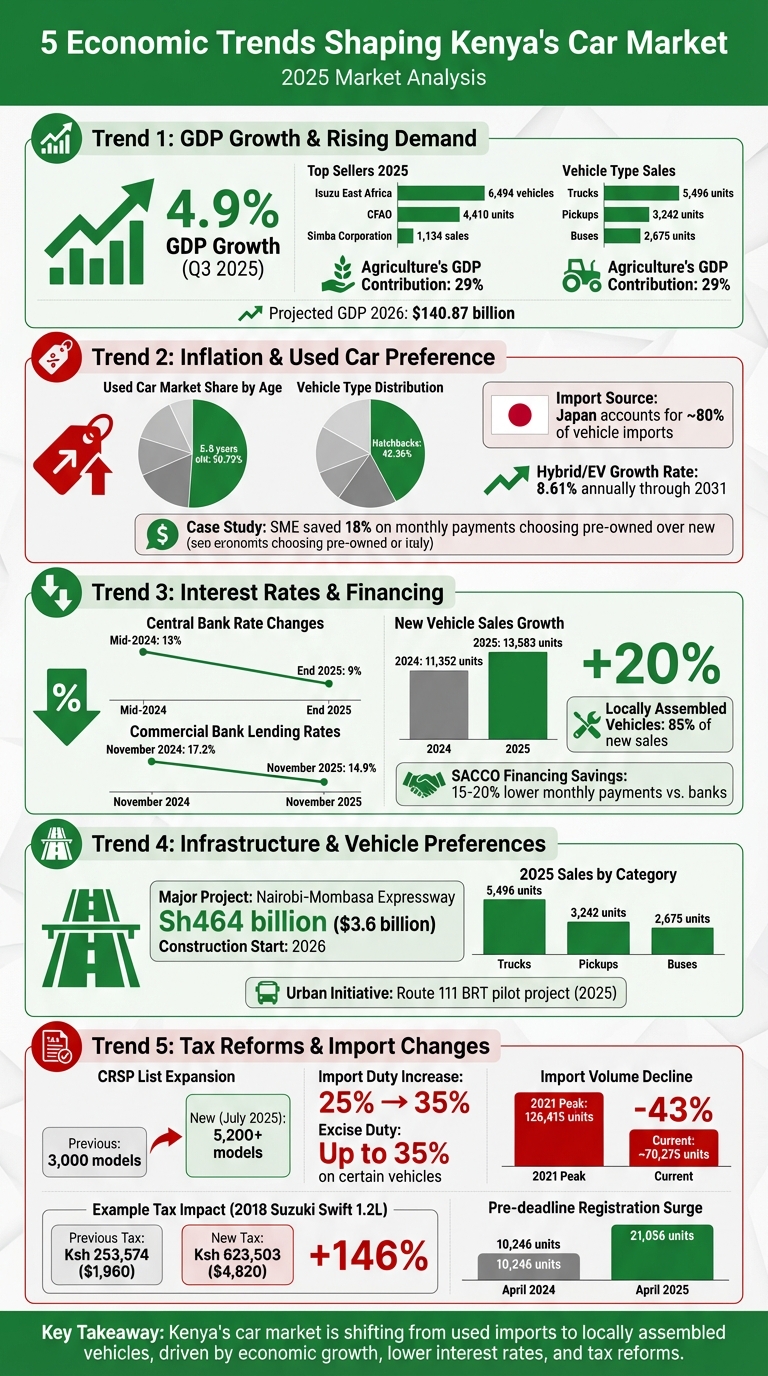
Kenya’s economy grew by 4.9% in the third quarter of 2025, giving consumers more purchasing power to invest in vehicles. This economic boost also spurred growth in industries like construction, manufacturing, and logistics, increasing the need for vehicles to transport goods and workers.
In 2025, major players in Kenya’s automotive market saw a rise in sales: Isuzu East Africa sold 6,494 vehicles, CFAO moved 4,410 units, and Simba Corporation recorded 1,134 sales. Trucks (5,496 units), pickups (3,242 units), and buses (2,675 units) dominated the market, signaling a recovery and highlighting the different needs of urban and rural buyers.
Urban buyers tend to prefer compact models such as the Fielder and Axio, which are ideal for families and small businesses. On the other hand, rural and tourism-driven regions lean toward durable options like the Land Cruiser and Hiace, which can handle tougher terrain and meet local requirements. Agriculture plays a significant role in this demand, as it contributes 29% to Kenya’s GDP. The country’s nominal GDP is forecasted to reach $140.87 billion by 2026.
However, while the market shows clear signs of growth, challenges like inflation and currency instability could still shape consumer purchasing behavior.
2. Inflation Pushing Buyers Toward Used Cars
Inflation is making both new car prices and operational costs harder to manage, leaving many buyers with less disposable income. As a result, people are leaning toward more budget-friendly options like late-model used imports and repossessed vehicles. This shift is also influenced by currency fluctuations, which further drive up costs.
When the Kenyan shilling weakens against major currencies like the U.S. dollar and Japanese yen, the Cost, Insurance, and Freight (CIF) value of imported cars rises. Add to that taxes such as VAT and excise duty, and the final price can increase by six figures in Kenyan shillings. With these expenses piling up, new car sales have slowed, while used imports – especially from Japan, which accounts for roughly 80% of Kenya’s vehicle imports – remain a more feasible option for many buyers.
Shoppers are now focusing on the Total Cost of Ownership (TCO) rather than just the sticker price. They’re opting for models with strong resale value and easy-to-find spare parts, like the Toyota Hilux, Isuzu D-Max, Fielder, and Hiace, to better manage long-term costs. For example, in 2025, a Nairobi-based SME managed to cut monthly payments by 18% over five years by choosing a certified pre-owned Isuzu D-Max and a repossessed Toyota Hiace instead of buying a new Hilux.
The used car market is also seeing some notable trends. Hatchbacks made up 42.36% of transactions in 2025, while vehicles aged 5–8 years accounted for 50.73% of sales. Hybrid options like the Toyota Prius are becoming increasingly popular too, as hybrid and electric vehicles are expected to grow at an annual rate of 8.61% through 2031.
If you’re considering importing a vehicle, it’s wise to check the Kenya Revenue Authority’s CRSP guide. A slight change in a car’s price band can significantly increase your tax bill – sometimes by hundreds of thousands of shillings.
3. Interest Rates and Auto Loan Accessibility
Interest rate changes are playing a big role in how Kenyans finance vehicle purchases. When the Central Bank of Kenya (CBK) reduced its benchmark rate from 13% in mid-2024 to 9% by the end of 2025, the impact was clear – new vehicle sales surged by nearly 20%, rising from 11,352 units in 2024 to 13,583 units in 2025. Alongside this, commercial bank lending rates dropped from 17.2% in November 2024 to 14.9% in November 2025, making auto loans more affordable for corporate and high-income buyers.
"A notable driver for the growth in 2025 was the progressive CBK interest rate decrease in the first half of 2025, with lower financing costs enabling more vehicle purchases and a recovery in business confidence." – Kenya Motor Industry Association (KMIA)
However, while lower rates helped some buyers, traditional lenders have grown more cautious. Banks have tightened their risk assessments, which has made it harder for middle- and lower-income earners to secure auto loans. As a result, many buyers have turned to SACCOs (savings and credit cooperatives). Unlike banks, SACCOs rely on membership history and flexible credit evaluations instead of rigid credit scores. This makes them a crucial option for individuals with irregular incomes or limited collateral.
Financing options now depend heavily on income levels. Corporate buyers and government agencies have benefited the most from lower rates, with almost 85% of new vehicles sold in 2025 being locally assembled and financed through traditional banks. On the other hand, budget-conscious buyers are opting for repossessed vehicles with in-house bank financing or certified pre-owned imports financed through SACCOs. To get the best deal, it’s wise to compare at least three lenders – your main bank, a SACCO, and any in-house financing tied to repossessed units – to find the most favorable Annual Percentage Rate (APR) and terms.
When planning a purchase, it’s important to look at the Total Cost of Ownership (TCO) over a 60-month period. This includes not just monthly payments but also maintenance and resale value. For example, financing a certified pre-owned vehicle through a SACCO can reduce monthly payments by 15–20% compared to financing a new car at higher bank rates, while still ensuring dependable performance for everyday use.
4. Infrastructure Projects Changing Vehicle Preferences
Kenya’s infrastructure boom is reshaping vehicle preferences across various sectors. In 2025, trucks led new vehicle sales with 5,496 units, followed by pickups at 3,242 units and buses at 2,675 units. This surge in demand is closely tied to the rise in construction and logistics activities. A notable example is the Sh464 billion (approximately $3.6 billion) Nairobi–Mombasa expressway project, set to begin construction in 2026. These massive projects are not only fueling the need for heavy-duty vehicles but are also influencing choices for everyday commuters.
In the commercial segment, rugged models like the Toyota Hilux, Land Cruiser, and Isuzu D-Max continue to dominate. Infrastructure projects have heightened the demand for durable vehicles that can handle tough conditions while offering strong resale value. For companies involved in construction and logistics, reliability and long-term value are critical considerations, as these factors directly impact operational efficiency and investment returns over multi-year projects.
Urban infrastructure upgrades are also creating new opportunities. For instance, the Route 111 BRT pilot project in Nairobi, launched in 2025, has modernized public transport with dedicated lanes and high-capacity buses. These enhancements are encouraging fixed-route businesses to explore EVs and hybrids as a way to cut fuel costs over time.
Beyond urban centers, road improvements in areas like Eldoret and Nakuru are expanding vehicle markets outside the traditional Nairobi–Mombasa corridor. Improved connectivity is pushing urban families toward fuel-efficient crossovers and compact cars like the Toyota Fielder and Axio. Meanwhile, commercial sectors continue to rely heavily on rugged, heavy-duty models to meet their needs.
For businesses tied to construction and logistics, rugged vehicles with dependable resale value remain essential. On the other hand, urban commuters might find hybrids or EVs appealing, especially when considering daily mileage and access to charging infrastructure. These evolving trends highlight a market in transition, signaling significant shifts in automotive demand as infrastructure projects progress.
5. Tax Reforms and Import Rules Reshaping the Market
Recent tax reforms have added another layer of complexity to Kenya’s already shifting car market, heavily influenced by infrastructure-driven changes in vehicle preferences.
In July 2025, Kenya’s tax system saw a major update that directly impacted the automotive sector. The Kenya Revenue Authority (KRA) introduced a revised Current Retail Selling Price (CRSP) list, the first significant update since 2019. This new list expanded its coverage from 3,000 to over 5,200 vehicle models. Alongside this, import duties jumped from 25% to 35%, and excise duties on certain vehicles climbed as high as 35%. These changes, combined with rising inflation and currency instability, have driven vehicle prices to new heights.
For everyday buyers, the effects have been staggering. Take the 2018 Suzuki Swift with a 1.2-liter petrol engine as an example: its total tax burden skyrocketed by 146%, increasing from Ksh 253,574 (about $1,960) to Ksh 623,503 (around $4,820). As a result, the retail price now exceeds Ksh 2 million (roughly $15,460). Popular small cars like the Mazda Demio and Toyota Vitz have faced similar tax hikes, putting them out of reach for many Kenyans.
Peter Otieno, Chairman of the Car Importers Association of Kenya (CIAK), expressed the industry’s frustration:
"The greatest enemy of any business is not high taxes, it is unpredictable taxes. Currently, our members are operating in a state of customs roulette."
Dealers are grappling with sudden valuation changes at the port, which can inflate costs by hundreds of thousands of shillings without warning. This uncertainty has led some to abandon imports altogether. Import volumes have dropped sharply – down 43%, from a peak of 126,415 units in 2021 to just about 70,275 units.
The market saw a brief surge in activity before the July 1st deadline, with registrations doubling from 10,246 in April 2024 to 21,056 in April 2025. However, this was short-lived. Domestic production, with only 4,386 units assembled in the first four months of 2025, has been unable to compensate for the decline in imports.
If you’re considering importing a vehicle, it’s crucial to get a preliminary valuation from a clearing agent using the 2025 CRSP list before making any bids. Be prepared to account for foreign exchange fluctuations and unexpected regulatory changes. To mitigate higher upfront costs, focus on models with strong resale value and readily available local parts, like the Hilux, Isuzu D-Max, and Toyota Fielder. These choices can help offset some of the financial strain caused by the new tax landscape.
Conclusion
Kenya’s car market is undergoing a noticeable transformation, driven by five key economic trends. In Q3 2025, the country experienced a 4.9% GDP growth, which fueled a 20% jump in new vehicle sales, reaching 13,583 units. At the same time, inflation and tax uncertainties have heavily impacted used car imports, which have plummeted by 43% – from their 2021 high of 126,415 units to around 70,275 units. These changes align with the growing momentum toward local vehicle assembly.
The rise of domestic assembly has been a game-changer. Around 85% of new vehicles sold in Kenya are now assembled locally, prompting major players like Isuzu and Toyota to lower prices significantly – saving buyers millions of Kenyan shillings. This shift is further supported by large-scale infrastructure projects and improved financing options. With lending rates averaging 14.9%, middle-class buyers are finding it easier to afford locally assembled vehicles. The narrowing price gap between a brand-new locally assembled SUV and an eight-year-old import is giving buyers more reasons to consider new vehicles.
Infrastructure development has also reshaped consumer preferences, driving up demand for heavy-duty vehicles. Sales figures for trucks (5,496 units), pickups (3,242 units), and buses (2,675 units) reflect this shift. However, tax reforms have added an unpredictable element to the market. Sudden valuation changes can increase a vehicle’s cost by as much as 500,000 Kenyan shillings (about $3,860), a situation aptly described as "customs roulette" by Peter Otieno, Chairman of the Car Importers Association of Kenya.
The organized dealer segment is gaining traction over informal vendors, thanks to better access to bank financing and warranty options. Meanwhile, the market is beginning to embrace electric vehicles, particularly in public transport. The introduction of BasiGo electric buses signals Kenya’s ambition to achieve a 5% EV market share. With buyers prioritizing predictability and transparent pricing, the current economic landscape favors financed purchases of locally assembled new vehicles over the traditional reliance on importing used cars.
FAQs
Is it cheaper to buy locally assembled cars than to import used ones now?
Buying locally assembled cars in Kenya is now more budget-friendly than importing used ones. Thanks to local assembly, prices for new vehicles have dropped, making them a strong alternative to second-hand imports. On top of that, higher local production and reduced interest rates have driven up the demand for new cars, making them even more accessible. This shift positions locally assembled vehicles as a smart, cost-effective choice over imported used cars.
How can I estimate total car costs under the new KRA CRSP rules?
To get a clear picture of total car costs under the new KRA CRSP rules, you need to account for the CRSP-based valuation of used imports. But that’s just one piece of the puzzle. Other factors, like higher import duties, changing exchange rates, and inflation, play a big role in shaping the final price. It’s important to consider how these elements work together to accurately calculate the overall costs.
Should I finance a car through a bank or a SACCO in 2026?
In 2026, with interest rates in Kenya expected to drop, both banks and SACCOs could become attractive choices for car financing. Banks are known for offering larger loan amounts and more flexible terms, making them a good fit for those needing substantial funding. On the other hand, SACCOs often provide their members with lower interest rates and more favorable repayment terms, which can lead to significant savings.
The right choice will depend on factors like your credit history, the loan amount you need, and how you prefer to handle repayments. For those who qualify as SACCO members, the lower costs and member-focused benefits might make them the better option.
Related Blog Posts
- Car prices in Nairobi 2025
- Car Prices in Kenya in 2025: Full Market Guide
- Why Car Prices in Kenya Are Changing in 2025
- New vs Used Cars in Kenya: What You’ll Pay in 2025