
Buying or selling a used car in Kenya has always been tricky. Inconsistent pricing, fraudulent listings, and unclear evaluations make it hard for buyers and sellers to trust each other. But AI is changing that.
Here’s how:
- Objective Pricing: AI analyzes data like mileage, age, and market trends to generate fair car valuations.
- Fraud Detection: AI tools spot scams, odometer tampering, and fake listings by cross-referencing databases and identifying patterns.
- Standardized Evaluations: AI ensures all vehicles are assessed using the same criteria, reducing confusion and price discrepancies.
For example, AI models like Stacking Regressors have achieved 97.25% accuracy in predicting fair prices, and platforms like Peach Cars and AUTO24.co.ke are using these tools to improve transparency.
This shift is helping Kenya’s used car market become more reliable and efficient, benefiting both buyers and sellers.
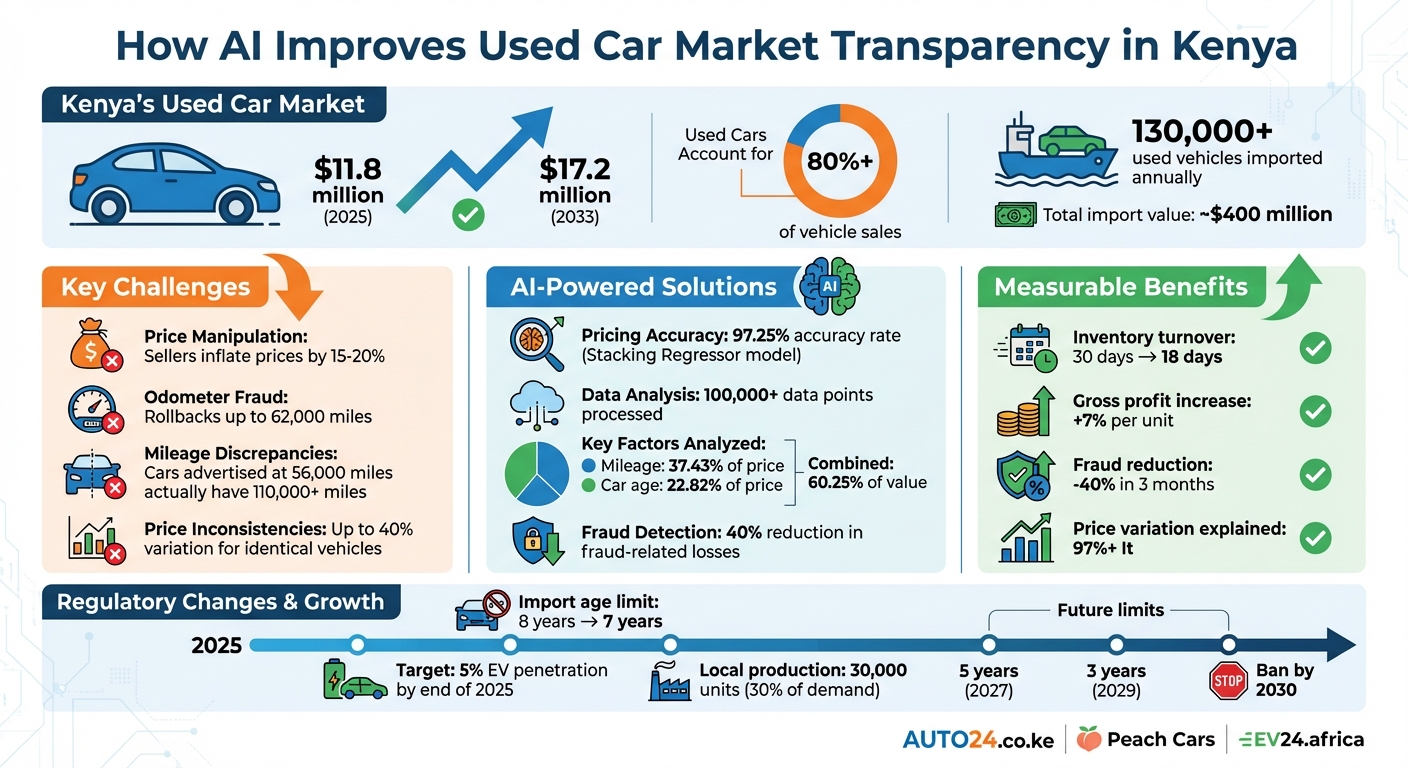
How AI Transforms Kenya’s Used Car Market: Key Statistics and Impact
Problems in Kenya’s Used Car Market
Kenya’s used car market is grappling with several pressing issues. The lack of reliable, data-driven pricing systems has created an environment where trust between buyers and sellers is often compromised. Key challenges include subjective pricing, fraudulent practices, and inconsistent vehicle evaluation methods.
Subjective Pricing and Price Manipulation
One of the biggest hurdles is the absence of objective pricing benchmarks. Sellers frequently inflate prices – sometimes by as much as 15–20% – relying on guesswork rather than solid data. This leads to significant inconsistencies, even among vehicles with nearly identical specifications and conditions. With used cars accounting for over 80% of vehicle sales in Kenya, the problem is widespread. Many sellers lack the tools to properly assess factors like mileage and car age, which together account for 60.25% of a vehicle’s value.
Moses Onserio from the Co-operative University of Kenya highlights the issue:
"Sellers often overestimate vehicle prices to maximize profits, leading to long delays in sales, while buyers struggle with unreliable pricing information, which breeds mistrust."
Market manipulation further complicates the situation. Sellers may create false scarcity or tamper with odometers – sometimes rolling them back by as much as 62,000 miles – to inflate perceived value.
Fraudulent Listings and Inaccurate Information
A lack of transparency has also fueled fraudulent activities. For example, vehicles advertised with mileage around 56,000 miles have been found to have actual usage exceeding 110,000 miles. Even small inaccuracies in mileage can significantly impact a car’s valuation, often by thousands of dollars.
Dealers sometimes hide critical details, such as accident histories or prior repairs, to manipulate pricing. According to NewsTrendsKE:
"The shift to online verification is being driven by a lack of trust. Odometer rollback, hidden accident damage, and undisclosed repairs are among the most common issues cited by victims who only discover the truth after buying."
This erosion of trust has prompted buyers to turn to independent verification platforms like Japanstat, where chassis number checks cost about $6–7. While these tools provide some reassurance, they underline the market’s broader transparency issues.
Lack of Standardized Evaluation Metrics
Another major challenge is the lack of uniform standards for evaluating vehicles. Different stakeholders – insurers, financiers, and fleet managers – use varying criteria to assess vehicles, which adds to the confusion. For instance, insurers prioritize repairability, financiers focus on liquidation value, and fleet managers consider operational costs. For individual buyers, this inconsistency can make the buying process overwhelming.
This lack of clarity contributes to what economists call the "lemons problem", where high-quality cars are undervalued or ignored, while lower-quality vehicles dominate the market. The financial consequences are substantial. Kenya’s used car market, valued at $11.8 million in 2025, is expected to grow to $17.2 million by 2033. However, sellers who overprice their cars face extended sales delays, while those who undervalue their vehicles risk significant financial losses.
James Nderitu from AA Kenya sums it up well:
"A price tag is a moment in time. Value is a combination of past care, present condition, and future cost."
Without standardized evaluation metrics, aligning price with true value remains an ongoing struggle – one that could benefit from AI-driven innovations to bring consistency and trust to the market.
sbb-itb-e5ed0ed
How AI Improves Market Transparency
AI is stepping in to address long-standing issues in Kenya’s used car market, such as price manipulation and unreliable listings. By replacing subjective judgment with data-driven precision, artificial intelligence is reshaping how vehicles are priced, evaluated, and listed. Instead of relying on outdated pricing books or dealer estimates, AI systems analyze massive datasets – over 1 million historical transactions – to identify accurate market trends and fair valuations. This approach tackles key challenges like inflated prices, fraudulent listings, and inconsistent vehicle assessments, paving the way for better transparency in the market.
AI-Powered Pricing Models
AI-driven pricing models rely on machine learning techniques that combine multiple algorithms for improved accuracy. A notable example comes from Moses Onserio of the Co-operative University of Kenya, who developed a Stacking Regressor model in 2025. Using 13,667 records from local online marketplaces, this model achieved an impressive 97.25% accuracy rate in predicting fair market prices, far surpassing simpler methods like Linear Regression.
These models consider crucial factors specific to Kenya’s market. For example, mileage influences 37.43% of a vehicle’s price, while car age contributes 22.82%. Other factors, such as engine size, body type, and whether the car was imported or locally used, further refine valuations. AI also identifies subtle patterns – like mechanical issues or regional factors such as coastal corrosion – that human evaluators might overlook.
In 2026, Peach Cars launched "Peach Insight" in Kenya, an AI-powered valuation tool trained on over 100,000 data points. This tool analyzes real-time trends and comparable listings to provide accurate pricing reports for private sellers. As COO Zachary Petroni explained:
"Whether you end up selling your car with Peach or not, we believe this innovative tool will improve the ability of all in the used car market to discern good v. bad prices."
Real-time integration makes these tools even more effective. For instance, Cars24 in India uses a pricing engine that processes data from over 1 million historical transactions and 10 million inspections. It adjusts valuations dynamically based on live bidding from more than 20,000 verified dealers. This ensures sellers receive fair market value based on current demand, not outdated estimates. Beyond pricing, AI also strengthens fraud detection, ensuring listings are as reliable as their valuations.
AI for Fraud Detection and Verified Listings
AI systems are revolutionizing fraud detection by analyzing thousands of data points simultaneously. Machine learning models can identify duplicate images, VIN cloning, and title washing by cross-referencing national safety and insurance databases. Advanced computer vision even detects odometer tampering, a critical feature in a market where advertised mileage often doesn’t match reality.
Graph-based machine learning uncovers connections in organized scam networks. By linking devices, emails, payment methods, and VINs across suspicious listings, these systems reveal hidden patterns that would otherwise go unnoticed. AI platforms also use optical character recognition (OCR) to verify documents like titles and bills of sale, ensuring authenticity.
The results speak for themselves. A regional dealer group that implemented AI-powered pricing and fraud detection in 2026 saw its inventory turnover time drop from 30 days to 18 days. Additionally, fraud-related losses decreased by 40% within just three months, thanks to AI’s ability to block high-risk leads. Automotive technology reporter Ethan Collins captured the importance of these tools:
"Buying a car online in 2026 without using AI-based fraud detection tools is like driving without a seatbelt. You might be fine – but the risk isn’t worth it."
AI Tools on Platforms Like AUTO24.co.ke

Platforms like AUTO24.co.ke are integrating AI tools to provide transparent and objective market data. By leveraging machine learning models validated by local research, these platforms offer verified listings and fair pricing for buyers. The systems continuously process live data from listings, auctions, and other market signals to ensure valuations stay up to date.
For buyers, this means fixed, transparent pricing that reflects the true market value of a vehicle, free from manipulation. Sellers benefit from tools that help set optimal prices based on local demand trends, reducing the time it takes to close a sale. Altogether, AI is leveling the playing field, building trust, and enhancing transparency in Kenya’s used car market.
Benefits of AI-Driven Transparency
AI’s ability to streamline valuations and detect fraud is now delivering clear advantages for both buyers and sellers. By replacing subjective dealer estimates with data-driven insights, AI is reshaping the way transactions are conducted.
Improved Buyer and Seller Trust
AI eliminates much of the uncertainty in transactions by providing valuations rooted in objective, data-backed analysis. This approach addresses long-standing issues like subjective pricing and fraudulent practices. AI can detect factors human evaluators might overlook, such as specific mechanical risks tied to certain models or environmental damage like coastal corrosion. As a result, trust grows between buyers and sellers. Sellers avoid unfairly low offers, while buyers gain confidence they’re paying a fair price, free from marketing tricks or high-pressure tactics.
Jim O’Brien, General Manager at RAVIN.AI, highlights this shift:
"The subjective variables in assigning condition grades can cause what many see as unfair and incorrect fluctuations in what should be the true, objective price of a vehicle".
By standardizing evaluations and offering consistent condition reports, AI reduces disputes and fosters smoother transactions.
Data-Driven Decision-Making for Buyers
AI levels the playing field for buyers, giving them access to market intelligence that was once the domain of seasoned dealers. Through processing vast amounts of transaction data, AI provides insights into current trends and even predicts future maintenance issues. For instance, it can flag that a specific hatchback model often experiences AC problems after 25,000 miles. Armed with this knowledge, buyers can better evaluate long-term ownership costs and make decisions that align with their budgets. This predictive edge helps reduce unexpected expenses and promotes fairer pricing across the board.
Reduction in Price Discrepancies
AI transforms pricing by replacing inconsistent dealer margins with objective data drawn from historical transactions. Real-time data ensures valuations reflect current market conditions, moving away from outdated pricing methods. The impact is measurable: a regional dealer group that adopted AI-driven pricing in 2026 reported a 7% increase in gross profit per unit within three months, alongside a 40% reduction in fraud-related losses.
For individual buyers and sellers, this means fewer frustrations over overpriced listings or undervalued vehicles. With AI standardizing valuations, fair market value becomes the norm, creating a more transparent market where both parties can engage confidently.
Future of AI in Kenya’s Used Car Market
Kenya’s used car market is experiencing a wave of transformation, driven by regulatory changes and advancements in technology. AI-powered platforms like AUTO24.co.ke and AUTO24.africa are stepping up as key players, helping the industry adapt to new policies and stricter standards introduced by the government.
Regulatory Changes Supporting Transparency
In July 2025, Kenya revised its import policy, reducing the age limit for imported cars from 8 years to a rolling 7-year threshold. This means only vehicles manufactured from July 2018 onward can now be imported. The government has outlined an even stricter timeline, proposing a 5-year limit by 2027, a 3-year limit by 2029, and a complete ban on used car imports by 2030.
These tighter regulations demand more precise verification processes. AI plays a critical role here, confirming manufacturing dates, validating compliance with emission standards, and ensuring vehicles meet roadworthiness criteria.
Peter Otieno, National Chairman of the Car Importers Association of Kenya (CIAK), remarked, "The proposed timelines are economically catastrophic, technologically premature and legally inconsistent with Kenya’s obligations under international trade law".
While some industry players have expressed concerns about the economic and legal implications of these policies, the regulatory path forward is clear. AI tools are already helping buyers and dealers navigate these changes, making compliance less daunting and reinforcing trust in the market.
Market Growth and Sustainability Potential
AI is also driving growth in Kenya’s eco-friendly vehicle segment. Platforms like EV24.africa are expanding access to electric and hybrid vehicles, supported by government incentives aimed at achieving a 5% electric vehicle (EV) penetration rate by the end of 2025. AI-powered tools are helping buyers understand long-term ownership costs, making EV adoption more accessible.
Another area of growth is local vehicle assembly. Currently, local production meets only 30% of the market demand – 30,000 units compared to the over 100,000 vehicles required annually. AI is helping bridge this gap by giving buyers tools to compare locally assembled cars with imports, fostering transparency and better decision-making. As import restrictions tighten, AI’s ability to ensure compliance, promote competitive pricing, and support sustainability becomes even more critical.
With about 130,000 used vehicles imported each year, valued at approximately $400 million, the market remains vast. AI’s ability to unify and analyze market data is creating a more transparent and reliable system. This shift toward newer, cleaner vehicles not only aligns with environmental goals but also strengthens trust and efficiency in Kenya’s used car market.
Conclusion
Kenya’s used car market has long struggled with issues like price manipulation and inconsistent valuations. But now, AI is changing the game. Machine learning models, trained on vast amounts of transaction data, can explain over 97% of price variations. This ensures that identical vehicles are priced consistently, eliminating much of the guesswork.
The impact goes far beyond just numbers. AI is helping close the information gap between buyers and dealers, addressing price discrepancies that once reached as high as 40% for the same vehicle models. By factoring in critical details such as mileage and model age, these tools adjust prices to reflect a car’s actual worth, even accounting for hidden issues that may affect its value.
"Whether you end up selling your car with Peach or not, we believe this innovative tool will improve the ability of all in the used car market to discern good v. bad prices, and better know the relative value of their vehicle." – Zachary Petroni, COO, Peach Cars
Platforms like AUTO24.co.ke are using AI to foster a more transparent marketplace where both buyers and sellers can make smarter, more informed decisions. As Kenya moves toward stricter import regulations and works toward sustainability goals, AI’s role in ensuring fair pricing and stabilizing the market is set to become even more important.
FAQs
What data does AI use to price a used car?
AI uses a variety of data points to figure out the price of a used car. These include real market transactions, details about the vehicle like its make, model, year, mileage, and condition, current market trends, similar listings, and even live dealer bids. By analyzing all this information, it ensures pricing is both accurate and easy to understand.
Can AI really detect odometer rollback or fake listings?
AI has the ability to spot odometer rollbacks and detect fake car listings by analyzing crucial indicators. These include reused images, discrepancies in VINs (Vehicle Identification Numbers), unusual pricing patterns, and historical data trends. By identifying these red flags, AI plays a key role in promoting transparency and building trust within the used car market.
How can I verify an AI valuation before I buy?
To check if an AI valuation is accurate, make sure it relies on up-to-date market data and considers specifics like the make, model, year, mileage, and overall condition. Choose platforms that provide a clear explanation of how they calculate their values and use broad, reliable datasets. For added confidence, compare the AI-generated estimate with quotes from other trusted sources or platforms. This approach ensures better accuracy and consistency, helping you make a well-informed choice.
Related Blog Posts
- Where to buy certified used cars in Kenya
- Car Prices in Kenya in 2025: Full Market Guide
- Why Car Prices in Kenya Are Changing in 2025
- Why more Kenyans are buying certified used cars from AUTO24.co.ke