
Fuel prices in Kenya have skyrocketed, making fuel-efficient cars a game-changer for drivers. Whether you’re a daily commuter or a rideshare driver, choosing the right car can save you thousands annually. Here’s a quick look at the top contenders:
- Toyota Aqua: Delivers 28–35 km/l, with prices starting at KSh 800,000. Ideal for city driving but struggles on rough roads.
- Honda Fit Hybrid: Offers 22–36.4 km/l, priced between KSh 1.3–1.6 million. Balances efficiency and performance with a powerful engine.
- Toyota Prius: Known for 22–25 km/l efficiency, priced at KSh 1.5–2.8 million. Great for long drives but pricier upfront.
- Mazda Demio: Affordable at KSh 500,000–1.3 million, with 18–24 km/l. Perfect for city commutes but limited on rugged terrain.
- Nissan Note ePower: Leads with 24–37.2 km/l, starting at KSh 1.2 million. Features an innovative hybrid system for smooth urban driving.
These cars are tailored for Kenya’s roads, offering fuel savings, reliability, and performance. Below is a comparison table for a quick overview.
| Car Model | Fuel Economy (km/L) | Price Range (KES) | Best Use |
|---|---|---|---|
| Toyota Aqua | 28–35 | 800,000–2.2M | City driving |
| Honda Fit Hybrid | 22–36.4 | 1.3M–1.6M | City & highway |
| Toyota Prius | 22–25 | 1.5M–2.8M | Long-distance driving |
| Mazda Demio | 18–24 | 500K–1.3M | Urban commutes |
| Nissan Note ePower | 24–37.2 | 1.2M–3.8M | Urban & long-distance |
Choosing the right car depends on your budget, driving habits, and typical road conditions. Let’s dive into the details of each model.
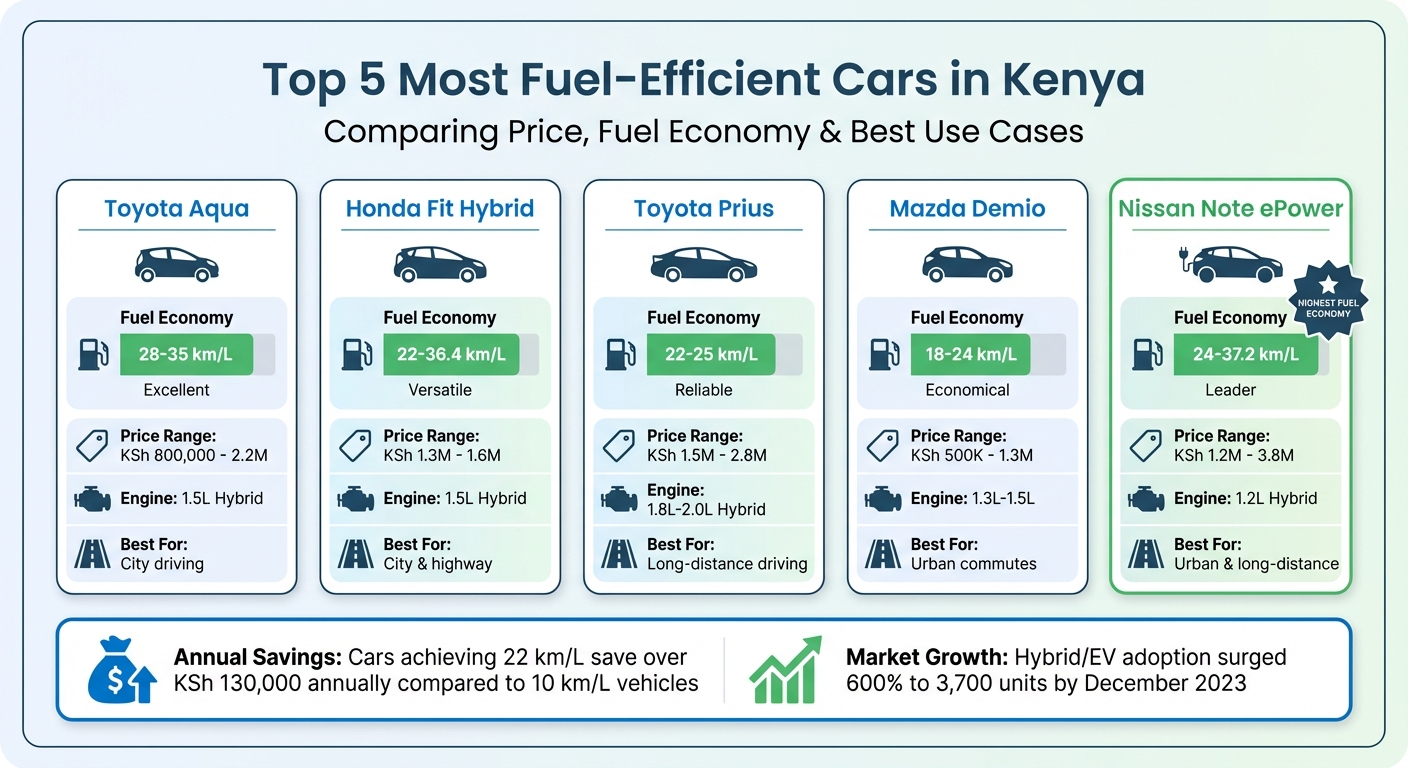
Top 5 Fuel-Efficient Cars in Kenya: Comparison of Price, Fuel Economy and Performance
5 MOST FUEL EFFICIENT CARS IN KENYA UNDER KSH 1.5M
1. Toyota Aqua
The Toyota Aqua stands out as Kenya’s most fuel-efficient non-plug-in car. Its 1.5L hybrid engine delivers an impressive 35.4 km/L (83 mpg) under ideal conditions. In everyday driving, you can expect around 28–35 km/L (66–82 mpg) in city traffic and 22–28 km/L (52–66 mpg) on highways. For those navigating Nairobi’s stop-and-go traffic, the Aqua achieves 30–33 km/L (71–78 mpg), translating to monthly fuel savings of approximately KSh 18,000.
Price Range
The Aqua’s price depends on the model year. Older models from 2013–2015 are priced between KSh 800,000–1.1 million, while 2016–2018 models range from KSh 1.2–1.5 million. For newer models (2019–2022), which meet 2026 import regulations, expect to pay between KSh 1.6–2.2 million. The car holds its value well, retaining about 60% of its resale price after five years. For maintenance, reconditioned hybrid batteries cost between KSh 80,000–200,000, while brand-new OEM batteries are priced at KSh 250,000–300,000.
Market Availability
The Aqua is widely available throughout Kenya, especially in major cities like Nairobi and Mombasa. In Mombasa, direct imports are often 10–15% cheaper. Its popularity among rideshare drivers ensures a steady supply of spare parts and helps keep fuel costs manageable. When buying, always request a diagnostic scan to confirm the hybrid battery’s State of Health (at least 70%) and review the Japanese auction sheet to check for any accident history.
Road Performance
The Aqua is well-suited for both city streets and highways, though it struggles on rough terrain. Its compact 3.9-meter length makes it perfect for navigating Nairobi’s heavy traffic and squeezing into tight parking spots. The 1.5L hybrid engine generates 98 HP, allowing the car to accelerate from 0 to 100 KPH (about 0 to 62 mph) in 10.7 seconds. While this is sufficient for city driving, it feels less powerful for highway overtaking. Its low ground clearance can be a drawback on rural roads, as it’s prone to underside damage from speed bumps and rough surfaces. Buyers should inspect the car’s underside for scrapes and maintain proper tire pressure while driving gently to maximize fuel efficiency and protect the hybrid system.
2. Honda Fit Hybrid
The Honda Fit Hybrid boasts an impressive fuel economy of 36.4–37 km/L (85.6–87.0 mpg) under ideal conditions. However, in Kenyan driving scenarios, it typically achieves 22–25 km/L (51.7–58.8 mpg). Its 1.5L Atkinson cycle i-VTEC engine, combined with an electric motor, delivers a total output of 135–137 horsepower. Paired with a 7-speed dual-clutch transmission (DCT), it offers smoother and more responsive acceleration compared to standard CVT systems. With more power than the Aqua’s 98 horsepower, it brings a balance of efficiency and performance to the table.
Price Range
For the 2025/2026 market, the Honda Fit Hybrid is priced between KSh 1.3–1.6 million, while older models range from KSh 1.0–2.35 million. When considering a used model, it’s essential to check the hybrid battery’s condition, as these batteries generally last 8–10 years. With its competitive pricing and strong market support, the Fit Hybrid is a compelling choice for Kenyan drivers.
Market Availability
The Honda Fit Hybrid is readily available across Kenya, offered both as fresh imports from Japan and as locally used vehicles. Spare parts are easy to find, simplifying maintenance. Autobarn Limited highlights its stylish design and quiet engine, which appeal to many buyers.
Road Performance
This hybrid performs exceptionally well in urban settings, thanks to its regenerative braking system that recovers energy during deceleration – perfect for Nairobi’s stop-and-go traffic. Weighing in at 1.1 tons and featuring a compact design, it maneuvers easily through congested streets. On highways, the 7-speed DCT ensures smooth and confident acceleration, making it more engaging to drive than vehicles equipped with CVT transmissions. For optimal performance, maintaining proper tire pressure and avoiding aggressive driving are key. Whether for daily commutes or longer trips, the Fit Hybrid provides a comfortable and reliable experience.
3. Toyota Prius
Fuel Economy (mpg)
The Toyota Prius offers an impressive fuel efficiency of 22–25 km/L (about 51.7–58.8 mpg) in Kenyan driving conditions, making it well-suited for the region’s varied traffic patterns. While its performance is on par with the Honda Fit Hybrid, the Prius is slightly heavier – about 1.3 tons compared to the Toyota Aqua’s 1 ton – which can slightly impact its efficiency during stop-and-go traffic.
Under the hood, the Prius features either a 1.8L engine producing 136 HP or a 2.0L hybrid setup with up to 196 HP. Its e-CVT transmission enhances both performance and fuel economy, allowing it to go from 0 to 100 km/h (roughly 62 mph) in around 10.5 seconds.
"The Toyota Prius is the world’s first mass produced hybrid and for a long time, it has been the yardstick with which hybrid compacts have been measured." – Topcar Kenya
Price Range
In Kenya, the Toyota Prius is priced between KSh 1.5 million and KSh 2.2 million. Although this is a higher upfront cost compared to lighter models like the Aqua or Fit Hybrid, many owners find the investment worthwhile, as fuel savings typically offset the premium within two years. Its regenerative braking system, particularly effective in Nairobi’s stop-and-go traffic, further boosts efficiency by recovering energy during frequent deceleration. This pricing also reflects the benefit of a well-established supply and service network.
Market Availability
The Prius enjoys widespread availability across Kenya, supported by a reliable supply of spare parts and a network of mechanics experienced with hybrid systems. This extensive market support simplifies maintenance and ensures long-term reliability. Its proven track record on Kenyan roads also contributes to its high resale value, making it a solid choice for buyers mindful of depreciation.
Road Performance
Known for its smooth ride, the Prius excels in heavy traffic thanks to its efficient idle-stop features. The 1.8L engine, delivering 134 horsepower (100 kW), provides enough power for highway cruising. Experts praise the Prius for its well-balanced combination of space, comfort, and efficiency. Its mid-size hatchback design offers extra room, making it a comfortable option for both city commutes and long highway trips.
sbb-itb-e5ed0ed
4. Mazda Demio
Fuel Economy
The Mazda Demio stands out with a fuel economy of 18–22 km/L (42–52 mpg), offering around 18 km/L in city driving and up to 24 km/L on highways. Designed to handle Kenya’s varied road conditions, this car benefits from Mazda’s SkyActiv technology, which not only enhances fuel efficiency but also delivers a responsive and enjoyable driving experience. Newer models include the i-Stop system, which automatically shuts off the engine when idling, making it a smart choice for reducing fuel use in heavy traffic.
Price Range
The Mazda Demio combines efficiency with affordability, making it a popular choice. Prices for used models vary depending on their year: 2010–2014 models are priced between KES 500,000–750,000, while 2015–2017 models range from KES 850,000–1.2 million. For the latest 2021–2022 models, expect to pay KES 1.8–2.5 million. Routine servicing costs around KES 10,000–15,000, and insurance options range from KES 15,000 for third-party coverage to over KES 40,000 for comprehensive plans.
Market Availability
The Demio is easy to find in Kenya, whether you’re browsing through authorized dealerships, local car yards, or online platforms like Jiji and Eleven Motors. Its popularity with ride-hailing services like Uber and Bolt helps maintain a steady supply of spare parts and ensures access to knowledgeable mechanics. This widespread use also contributes to its strong resale value.
Road Performance
Weighing between 940–1,040 kg, the Mazda Demio offers nimble handling that’s perfect for city driving while maintaining solid acceleration on highways. However, its low ground clearance makes it more suitable for paved roads rather than rugged rural terrain. Beyond its efficiency and affordability, the Demio is praised for its safety features, balanced handling, and modern tech – qualities that cater well to Kenyan drivers.
5. Nissan Note ePower
The Nissan Note ePower stands out in the lineup of fuel-efficient hybrids, offering a unique approach to driving efficiency.
Fuel Economy
The Nissan Note ePower boasts an impressive manufacturer-rated fuel economy of 37.2 km/L (87 mpg). However, in everyday Kenyan driving, you can expect around 24 km/L in city traffic and up to 28 km/L on highways. This translates to a 30% efficiency improvement over traditional petrol models. What makes it special is its innovative powertrain: a 1.2L petrol engine acts solely as a generator for the electric motor, which drives the car. This setup delivers instant torque and a quiet, smooth ride. It’s a step up in efficiency, but it does come with a higher price tag.
Price Range
The ePower models are priced higher than their petrol counterparts. For used 2018 models, prices range from KES 1,199,000 to KES 1,400,000, while 2021 models are priced between KES 1,599,000 and KES 2,500,000. Newer 2025+ models cost KES 3.2–3.8 million, and if you’re eyeing the sportier Nismo variant, expect to pay around KES 2.1 million. While the upfront cost is higher, the car compensates with savings of approximately KES 90,000 annually on fuel and a 20% reduction in maintenance expenses. Insurance costs start at about KES 8,000 per month.
Market Availability
The higher price point means the Nissan Note ePower is less common than its petrol siblings. However, you can find it through authorized dealers like DT Dobie Kenya, which offers a 5-year warranty on new models, or via platforms such as Jiji and Magari Deals. Importers like Eleven Motors and Peach Cars are also good options. If you choose to import directly from Japan, the process typically takes five to eight weeks. To avoid scams, always check for the hybrid badge and verify the drive battery display, as some sellers have been known to pass off petrol models as hybrids.
Road Performance
The Note ePower shines in urban settings, particularly in Nairobi’s stop-and-go traffic. Its e-POWER Drive mode allows you to accelerate and decelerate using just the accelerator pedal, thanks to regenerative braking. This system recaptures energy during braking to recharge the battery, enhancing efficiency during congested commutes. The electric motor generates 108 horsepower and, combined with the car’s lightweight 1-ton chassis, delivers quick acceleration and responsive handling. It’s perfect for city driving but also performs well on highways, with the Nismo variant reaching 0–100 km/h in just 7.2 seconds. Its compact size and agility make it well-suited for tight city streets, while the 410L boot capacity provides ample space for small families. These features make the Note ePower a top pick for fuel-conscious drivers in Kenya.
Comparison Table
Here’s a quick look at how different car models stack up in terms of fuel economy, price, and performance:
| Car Model | Fuel Economy (km/L) | Price Range (KES) | Engine Size | Best Driving Conditions |
|---|---|---|---|---|
| Toyota Aqua | 35.4 | 1,000,000 – 1,500,000 | 1.5L Hybrid | City commuting and daily errands |
| Honda Fit Hybrid | 22–36.4 | 1,300,000 – 1,600,000 | 1.3L – 1.5L Hybrid | Ideal for both city driving and longer commutes |
| Toyota Prius | 22–25 | 1,500,000 – 2,800,000 | 1.8L – 2.0L Hybrid | Best for highway driving and long trips |
| Mazda Demio | 18–24 | 1,000,000 – 1,300,000 | 1.3L – 1.5L | City driving; popular among ride-hailing drivers |
| Nissan Note ePower | 24–37.2 | 1,199,000 – 3,800,000 | 1.2L Hybrid | Great for urban commuting and long-distance travel |
When it comes to fuel efficiency, the Nissan Note ePower takes the lead with an impressive 37.2 km/L. However, real-world results often range between 24 and 28 km/L. Close behind is the Toyota Aqua, offering 35.4 km/L, making it a strong contender for fuel savings.
For those on a budget, the Mazda Demio, priced between 1,000,000 and 1,300,000 KES, stands out. Its fuel economy of 18–24 km/L and affordability make it a favorite among ride-hailing drivers.
If you frequently drive longer distances, the Honda Fit Hybrid and Toyota Prius are worth considering. Both models deliver reliable performance on highways while maintaining excellent fuel efficiency.
Here’s an interesting fact: a car achieving 22 km/L can save you over 130,000 KES annually compared to one that achieves just 10 km/L. This means that while hybrids like the Aqua or Fit may have higher upfront costs, they can pay for themselves in just a few years through significant fuel savings.
Conclusion
Our review of these five models highlights how a mix of cutting-edge engineering and practical design caters to the specific needs of Kenyan drivers. With Japanese engineering and hybrid technology at their core, these vehicles bring a combination of efficiency and reliability to the country’s roads, offering real savings for both short commutes and longer trips.
However, the benefits don’t stop at the cars themselves – your driving habits play a big role in getting the most out of these vehicles. If you primarily drive in the city, the Toyota Aqua or Mazda Demio are excellent choices. On the other hand, the Honda Fit Hybrid and Nissan Note ePower are versatile options that work equally well for highway and urban driving.
"Hybrid vehicles are set to play a crucial role in the country’s transition towards greener mobility."
– Thee Agata, Inventory Manager, Motorhub Ltd
To maximize fuel efficiency, keep a few tips in mind: maintain moderate engine revs, check your tire pressure regularly, and avoid overloading the cabin. Even something as simple as limiting A/C use can improve mileage by about 1.5 km/L.
With hybrid and electric vehicle adoption surging by 600%, reaching 3,700 units by December 2023, Kenya is clearly embracing more fuel-efficient transportation. Whether you’re a daily commuter or a ride-hailing driver, these five models provide reliable ways to cut fuel costs and reduce your environmental footprint.
FAQs
What should I consider when choosing a fuel-efficient car for driving in Kenya?
When choosing a fuel-efficient car for Kenyan roads, it’s essential to focus on a few critical factors to find the right match for your needs. Start with fuel economy – opt for vehicles with high miles per gallon (mpg) ratings. Hybrids and compact models stand out for their efficiency and reduced emissions, making them a smart choice for cutting fuel costs.
The engine type is another key consideration. Hybrid engines generally provide better fuel savings compared to traditional gasoline or diesel options, which can make a noticeable difference over time.
Next, think about affordability and availability in Kenya. Cars like the Suzuki Alto or Nissan March are not only budget-friendly but also easy to maintain, making them ideal for city driving. Also, consider the car’s size and durability – compact cars are perfect for navigating Nairobi’s traffic and handling the occasional rough road.
Finally, with rising fuel prices, it’s crucial to choose a car that delivers reliable performance in everyday conditions. This way, you’ll ensure you’re getting the most value for your investment.
How do hybrid cars like the Toyota Aqua and Honda Fit Hybrid help you save on fuel costs?
Hybrid cars, like the Toyota Aqua and Honda Fit Hybrid, are designed to cut down on fuel costs by blending the power of a gasoline engine with an electric motor. This clever system lets the car seamlessly switch between the two power sources or use them together, ensuring better fuel efficiency whether you’re navigating city streets or cruising on the highway.
In stop-and-go traffic, hybrids shine by primarily using their electric motor, which significantly reduces fuel consumption. On top of that, features such as regenerative braking recharge the battery as you drive, meaning less reliance on gasoline. For anyone aiming to save money at the pump while reducing their carbon footprint, hybrids are a smart option.
What should I know about maintaining a hybrid car in Kenya?
Maintaining a hybrid car in Kenya requires attention to both its traditional components, like the gas engine and brakes, and hybrid-specific features, such as the battery pack, electric motor, and inverter. Regular servicing is key to ensuring the car runs smoothly, and the hybrid battery should be checked periodically to assess its cooling system and overall condition.
Kenya’s diverse road conditions and climate make it especially important to stick to the manufacturer’s recommended maintenance schedule and to use genuine replacement parts. It’s also wise to choose service providers with expertise in hybrid technology, as these vehicles often require specialized care. Taking proper care of your hybrid not only extends the life of its components but also keeps fuel efficiency high and repair costs manageable over time.
Related Blog Posts
- Top Fuel-Efficient Cars for Long-Distance Drives in Kenya
- Top Fuel-Efficient Cars for Daily Commutes in Nairobi
- Best Fuel-Saving Vehicles for Everyday Driving Across Kenya
- Most Fuel-Efficient Cars in Kenya for Budget-Conscious Drivers