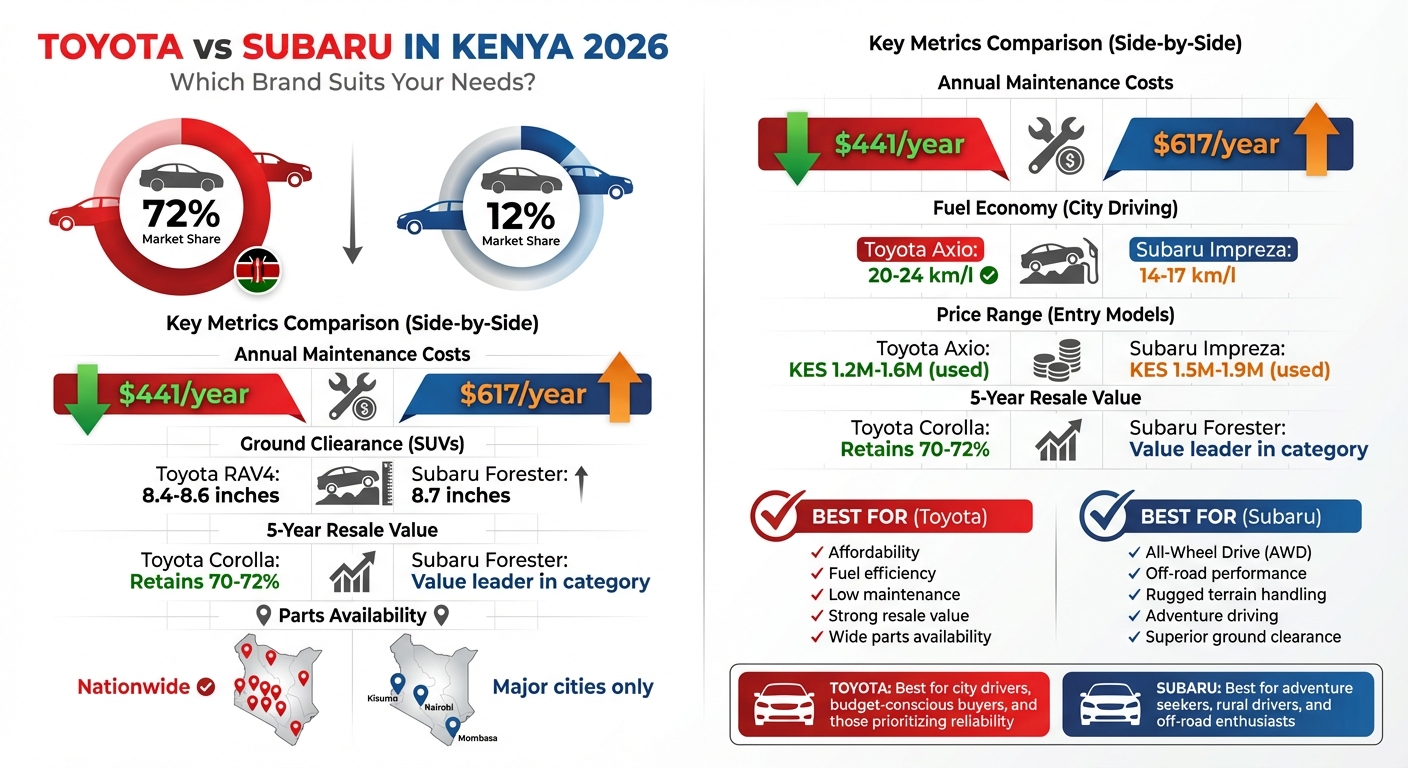
Deciding between Toyota and Subaru in Kenya comes down to your priorities: Toyota excels in affordability, fuel efficiency, and resale value, while Subaru impresses with its all-wheel drive and off-road capabilities. Toyota dominates with 72% market preference, thanks to its lower maintenance costs and widespread parts availability. Subaru, appealing to adventure seekers, holds a niche 12% share due to its performance on rugged terrain.
Key Takeaways:
- City Driving: Toyota Axio offers better fuel economy (20–24 km/l) and lower prices, while Subaru Impreza delivers more power and handling with AWD.
- SUVs: Toyota RAV4 Hybrid is more fuel-efficient (≈47 mpg) and cost-effective; Subaru Forester provides superior ground clearance and traction.
- Maintenance: Toyota costs less to maintain annually ($441 vs. Subaru’s $617) and has easier access to parts across Kenya.
- Resale Value: Toyota retains more value over time, with models like the Prado being highly sought after.
Quick Comparison:
| Feature | Toyota | Subaru |
|---|---|---|
| Market Share | 72% | 12% |
| Fuel Economy (City) | 20–24 km/l (Axio) | 14–17 km/l (Impreza) |
| Ground Clearance (SUVs) | 8.4–8.6 in (RAV4) | 8.7 in (Forester) |
| Annual Maintenance | $441 | $617 |
| Best For | Affordability, resale value | Off-road performance, AWD |
Conclusion: Toyota is the practical choice for most Kenyan drivers, offering reliability and cost savings. Subaru suits those prioritizing rugged performance and AWD for tough terrains.
Toyota vs Subaru Kenya 2026: Complete Comparison Guide
Toyota Axio vs Subaru Impreza: City Driving and Fuel Economy
City Traffic and Fuel Consumption
For urban drivers in Kenya, the Toyota Axio stands out as a top choice for those prioritizing fuel efficiency. With an impressive fuel economy of 20–24 km/l (47–56 mpg), the Axio nearly doubles the Subaru Impreza’s 14–17 km/l (33–40 mpg). This makes a significant difference for drivers navigating the stop-and-go traffic of Nairobi, where fuel costs can quickly add up.
The Impreza’s reduced fuel efficiency is largely attributed to its Symmetrical All-Wheel Drive (AWD) system. While this feature provides remarkable handling and grip, it also increases fuel consumption.
"If you enjoy a spirited drive and extra road grip, the Subaru Impreza is a solid choice." – James Mwangi, Automag Kenya
Both vehicles are well-suited for city driving but cater to different preferences. The Axio, equipped with 1.5L or 1.8L engines delivering 74–138 hp, focuses on fuel economy and practicality. On the other hand, the Impreza’s 2.0L Boxer engine, with 152 hp and 145 lb-ft of torque, offers a more dynamic driving experience. It also boasts a tighter turning diameter of 34.8 ft compared to the Axio’s 35.6 ft, making it slightly more agile in tight urban spaces.
These distinctions in fuel efficiency and performance highlight the contrasting strengths of each model, paving the way for a deeper technical breakdown.
Comparison Table: Toyota Axio vs Subaru Impreza
| Feature | Toyota Axio (2016–2018) | Subaru Impreza G4 (2016–2018) |
|---|---|---|
| Engine | 1.5L or 1.8L 4-cylinder | 2.0L Boxer |
| Horsepower | 74–138 hp | 152 hp |
| Drive Type | Front-Wheel Drive | Symmetrical AWD (Standard) |
| City Fuel Economy | 20–24 km/l (47–56 mpg) | 14–17 km/l (33–40 mpg) |
| Price Range | $9,300–$12,400 (KES 1.2M–1.6M) | $11,600–$14,700 (KES 1.5M–1.9M) |
| Turning Diameter | 35.6 ft | 34.8 ft |
| Parts Availability | Widely available | More specialized |
| Best For | Fuel efficiency & daily commuting | Handling & all-weather grip |
Toyota RAV4 vs Subaru Forester: SUV Performance in Kenya
Ground Clearance and Off-Road Ability
Navigating Kenya’s diverse terrain demands SUVs with the right specs. The Subaru Forester edges ahead with 8.7 inches of ground clearance, slightly more than the Toyota RAV4’s 8.4–8.6 inches. That extra clearance can make a difference when dealing with rugged murram roads, deep potholes, and sizable speed bumps. Let’s dive into how these two SUVs handle off-road conditions and their powertrain features.
The Forester comes equipped with Symmetrical All-Wheel Drive as a standard feature, ensuring solid traction on uneven surfaces. Meanwhile, the 2026 Toyota RAV4, available exclusively in hybrid models, relies on an Electronic AWD-i system that delivers between 236 and 320 horsepower, depending on the version. For those seeking off-road extras, Toyota offers the Rugged Woodland trim, which includes all-terrain tires, black cladding, and a roof rack for added utility.
"The Subaru Forester is one of Kenya’s most trusted compact SUVs, known for standard AWD, excellent road grip, a spacious cabin, and reliability on rough roads." – Magari Deals
When it comes to off-road tech, the Forester’s X-MODE adjusts to different terrains like dirt, snow, or deep mud, while the RAV4 counters with Multi-Terrain Select, offering modes for rock, mud, or snow, along with Downhill Assist Control for added stability. On the fuel efficiency front, the RAV4 Hybrid shines with an impressive 5.0 L/100km (about 47 mpg), significantly outperforming the Forester’s 7.4 L/100km (around 32 mpg).
Toyota RAV4 vs Subaru Forester
| Feature | 2026 Toyota RAV4 | 2025/2026 Subaru Forester |
|---|---|---|
| Ground Clearance | 8.4–8.6 inches | 8.7 inches |
| AWD System | Electronic AWD-i (Hybrid-based) | Symmetrical AWD (Standard) |
| Horsepower | 236 hp (Hybrid) / 320 hp (PHEV) | 150–194 hp |
| Off-Road Tech | Multi-Terrain Select, Downhill Assist | X-MODE (Dirt/Snow/Deep Mud) |
| Fuel Economy | ≈47 mpg (5.0 L/100km) | ≈32 mpg (7.4 L/100km) |
| Special Off-Road Trim | Rugged Woodland (with all-terrain tires) | Standard across all trims |
| Price Range (New) | $37,900–$51,800 (KSh 4.9M–6.7M) | $46,400–$52,600 (KSh 6.0M–6.8M) |
| Best For | Fuel efficiency & hybrid tech | Consistent AWD grip on rough roads |
Choose Between Toyota Harrier, Subaru Forester, and Mazda CX-5
Pricing: Toyota vs Subaru Models in 2026
When it comes to choosing between Toyota and Subaru, the price tag often plays a pivotal role. Toyota generally offers a more budget-friendly entry point in several segments, making it a popular choice for cost-conscious buyers. For instance, the Toyota Glanza starts at KES 918,480, making it an attractive option for first-time car owners. On the other hand, Subaru’s most affordable model, the Stella, begins at KES 1,225,500. This pricing disparity is one reason why Toyota commands a 72% market preference in Kenya, compared to Subaru’s 12%. Pricing not only affects the initial purchase but also has implications for resale value and long-term affordability.
Sedans: Toyota’s Price Advantage
In the sedan category, Toyota continues to dominate with competitive pricing. The Toyota Yaris Sedan, which is built on the Axio platform, starts at KES 2,515,500. In contrast, the Subaru Impreza Sport Hatchback begins at a higher KES 3,424,950. For buyers considering used imports, the difference remains noticeable: 2016–2018 Toyota Axios typically cost between KES 1.2 million and 1.6 million, while Subaru Impreza G4s from the same years range from KES 1.5 million to 1.9 million.
SUVs: Closer Competition
In the SUV segment, the pricing battle tightens. The Toyota RAV4 Woodland comes in at KES 4,773,000, slightly undercutting the Subaru Forester Wilderness, which starts at KES 5,148,390. However, when it comes to premium models, Toyota pulls ahead with the Land Cruiser 300 Series, priced at KES 12,448,500. Subaru’s most expensive offering, the Ascent Touring, is significantly lower at KES 6,599,640. For used options, 2016–2021 Subaru Foresters generally range between KES 2.2 million and 4.8 million.
Comparison Table: Price Breakdown
| Model | Base Trim Price (KES) | Mid-Trim Price (KES) | Top-Trim Price (KES) |
|---|---|---|---|
| Toyota Axio/Yaris | 2,515,500 (Yaris Sedan) | 3,861,000 (Camry) | 3,870,000 (Corolla 2028) |
| Subaru Impreza | 3,424,950 (Sport) | 3,584,910 (Base 2026) | 3,771,960 (RS Hatchback) |
| Toyota RAV4 | 4,773,000 (Woodland) | 5,418,000 (Limited) | 6,700,000 (PHEV/Prime) |
| Subaru Forester | 5,148,390 (Wilderness) | 6,000,000 (Hybrid/New) | 6,800,000 (XT/Premium) |
sbb-itb-e5ed0ed
Maintenance Costs and Parts Availability in Kenya
Toyota stands out for its lower maintenance costs. On average, Toyota owners spend about $441 annually on maintenance, while Subaru owners face a heftier bill of around $617 – nearly 50% more. Over a decade, the difference becomes even more apparent: maintaining a Toyota Corolla costs about $4,434 ($443 annually), compared to $6,343 ($634 annually) for a Subaru Impreza. For SUVs, the gap is also notable: the Toyota RAV4 averages $600 per year, while the Subaru Forester costs about $861 annually.
Annual Maintenance and Reliability
These cost differences aren’t just numbers – they reflect the way these cars are built. Subaru’s higher expenses are largely due to its Boxer engine design, which makes repairs more complex and labor-intensive. Additionally, Subaru’s standard All-Wheel Drive (AWD) system requires all four tires to be replaced at the same time to avoid drivetrain issues, further increasing costs. Older Subaru models are also prone to head gasket failures, with repairs ranging from $1,915 to $2,220.
Toyota, on the other hand, benefits from simpler engine designs that reduce the likelihood of major breakdowns. This simplicity translates into fewer costly repairs, making it a more budget-friendly option for owners.
When it comes to reliability, both brands perform well. Toyota scores a 66 out of 100 for reliability in 2025/2026, with Subaru close behind at 63 out of 100. Toyota’s 72% market share in Kenya ensures that spare parts are widely available, even in remote areas. Subaru parts, while accessible, are primarily found through official dealers in major cities like Nairobi, Kisumu, and Mombasa. Occasionally, Subaru offers promotions, such as 35% off parts and 20% off labor, which can help offset costs.
"Toyota is one of the most consistent car brands in the world and is known for its low-cost and dependable vehicles that last for many years longer than most cars." – Michael Stewart, Safford Brown Toyota
Comparison Table: Maintenance Costs and Parts Availability
| Feature | Toyota | Subaru |
|---|---|---|
| Average Annual Cost | ~$441 | ~$617 |
| 10-Year Cost (Corolla/Impreza) | $4,434 | $6,343 |
| 10-Year Cost (RAV4/Forester) | $6,004 | $8,609 |
| Reliability Score (2025/2026) | 66/100 | 63/100 |
| Parts Availability | Nationwide (very high) | Major cities/dealers (high) |
| Common Issues | Fewer major repairs | Head gaskets (older models), CVT and AWD tire-related costs |
| Brake Pad Replacement | $150–$300 | Higher labor costs |
| Alternator Replacement | $400–$600 | $638–$821 |
Toyota’s lower maintenance costs and widespread parts availability make it a practical choice for many Kenyan car owners. These factors, combined with its reputation for reliability, contribute to its strong appeal in the market.
Resale Value and Performance by Road Type
Resale Value and Long-Term Ownership
Toyota’s dominance in the market – holding a 72% share – translates to quicker sales and stronger resale prices. For instance, the Land Cruiser Prado retains about 73.83% of its original value after five years. Similarly, the Corolla (including the Axio) experiences minimal depreciation, losing only 28–30% of its value over the same period. This impressive resale value complements Toyota’s reputation for fuel efficiency and low maintenance costs, making it a smart choice for long-term ownership.
Subaru, while not as broadly appealing, shines in niche markets. The Forester, for example, has earned accolades like the 2020 Best Resale Value Award from Kelley Blue Book and the ALG Residual Value Award for six consecutive years. However, Subaru’s resale strength is often tied to a smaller, more specialized audience – outdoor enthusiasts and thrill-seekers who appreciate the Symmetrical AWD system. Unlike Toyota, which attracts a wide range of buyers including corporates, NGOs, and government agencies, Subaru vehicles can take longer to sell in the used market due to their more targeted appeal.
Hybrid models like Toyota’s RAV4 and Harrier have seen growing demand, particularly as fuel prices climb. Buyers view these vehicles as a practical hedge against rising fuel costs. Additionally, Toyota models in white or silver tend to fetch higher resale prices in Kenya, as these colors are more universally appealing and easier to sell.
The table below provides a side-by-side comparison of resale value and road performance.
Comparison Table: Resale Value and Road Performance
| Feature | Toyota (Corolla/RAV4/Prado) | Subaru (Forester) |
|---|---|---|
| 5-Year Depreciation | 28–30% (Corolla) | Value leader in category |
| Market Preference | 72% | 12% |
| Resale Strength | ★★★★★ (Prado), ★★★★☆ (RAV4) | ★★★★☆ |
| Ground Clearance | 195–215 mm | 220 mm |
| City Fuel Economy | 14–20 km/l (hybrid models) | 12–18 km/l |
| Rural Road Suitability | Excellent (Prado), Good (RAV4) | Excellent (AWD advantage) |
| Parts Availability | Nationwide, including rural areas | Major cities (Nairobi, Kisumu, Mombasa) |
| Best Use Case | City commuting & investment value | Adventure & rough terrain |
For urban drivers, Toyota’s hybrid models stand out with their excellent fuel economy, especially in stop-and-go traffic. On the other hand, Subaru’s Forester is a top choice for rural and off-road conditions. Its 220 mm ground clearance surpasses the RAV4’s 200 mm, and the Symmetrical AWD system offers added stability on uneven roads. This makes the Forester ideal for those who frequently tackle rugged terrains or venture into remote areas.
Conclusion: Toyota vs Subaru in 2026
After weighing performance, pricing, and maintenance, the choice becomes clearer. For Kenyan buyers in 2026, Toyota stands out as the more practical option, especially if you value strong resale value, low upkeep costs, and easy access to parts. Toyota’s reputation for reliability, combined with its extensive service network, makes it a dependable choice for long-term ownership. Models like the Prado are particularly known for retaining their value over time.
Subaru, on the other hand, caters to a different audience. If you’re someone who needs all-wheel drive and solid performance on rough terrain, Subaru delivers. The Forester, for instance, is perfect for those who enjoy adventures or often drive on rural, unpaved roads. However, Subaru’s service network is more limited, with most options concentrated in major cities like Nairobi, Kisumu, and Mombasa, which could be a drawback for some.
Toyota also shines with its hybrid models, offering excellent fuel efficiency and helping drivers save on fuel costs. For budget-conscious buyers, options like the Toyota Axio or Vitz provide reliable, entry-level choices. Subaru, meanwhile, leans toward performance-focused models, which may appeal to enthusiasts but come with higher maintenance demands.
FAQs
What should I consider when choosing between Toyota and Subaru for city driving in Kenya?
When choosing between Toyota and Subaru for city driving in Kenya, key factors to weigh include cost, fuel efficiency, maintenance, reliability, and urban handling.
Toyota models, like the Axio, are typically easier on the wallet both upfront and over time. With a strong network of spare parts suppliers and service centers, maintenance is straightforward and affordable. Plus, their fuel efficiency is impressive, averaging around 20–24 km per liter, which is perfect for daily city commutes. On the other hand, Subaru models, such as the Forester, shine when it comes to all-wheel-drive traction. This feature is especially handy for navigating rainy or uneven urban roads. However, Subarus tend to be thirstier, averaging about 13–14 km per liter.
For most city drivers, a Toyota sedan or hatchback is the smarter pick, thanks to its lower running costs and solid resale value. But if you value superior grip and handling for tricky urban terrains, a Subaru might still be worth the added fuel and maintenance costs.
How do Toyota and Subaru compare in terms of maintenance costs and parts availability in Kenya?
In Kenya, Toyota vehicles are a popular choice for their affordability when it comes to maintenance. Thanks to an extensive service network and a steady supply of spare parts, models like the Vitz and Passo are particularly easy on the wallet. Annual service costs for these vehicles typically range between $150 and $450, making them an economical option for many drivers. The availability of parts also means repairs are quicker and less expensive.
Subaru, by contrast, is known for its sturdy build and performance. However, maintaining a Subaru tends to be pricier. Spare parts aren’t as readily available as they are for Toyota, which can drive up repair costs and lead to longer wait times. That said, Subaru vehicles often hold their resale value well, but owners should anticipate spending more on upkeep.
For drivers in Kenya prioritizing reliability and cost-efficiency, Toyota remains the more practical choice, especially when considering maintenance and parts availability.
Which brand has better resale value and is a smarter long-term investment in Kenya?
When it comes to resale value and long-term investment, Toyota takes the lead in Kenya. Toyota vehicles, especially SUVs like the Land Cruiser Prado, are famous for holding their worth – often retaining about 73% of their original value even after five years. This makes Toyota a go-to option for buyers who want to safeguard their investment.
Subaru models, such as the Forester, also maintain decent resale value. However, Toyota’s wider range of models, proven reliability, and strong brand reputation give it an edge. For Kenyan car buyers focused on resale value, Toyota remains the smarter choice.
Related Blog Posts
- Top 10 Most Popular Used Cars in Kenya in 2025
- Toyota vs Nissan in Kenya: Which One Should You Choose?
- 10 Most Reliable Cars in Kenya in 2025
- Most reliable car brands in Kenya: What to choose in 2025