Finding the right car for Uber or Bolt in Kenya can make or break your ride-hailing business. Drivers in cities like Nairobi and Mombasa typically cover 150–200 kilometers daily, so fuel efficiency, maintenance costs, and passenger comfort are key factors. With platforms like Bolt charging a 20% commission, keeping expenses low is essential to maximize profits. Here’s a quick breakdown of the top car options:
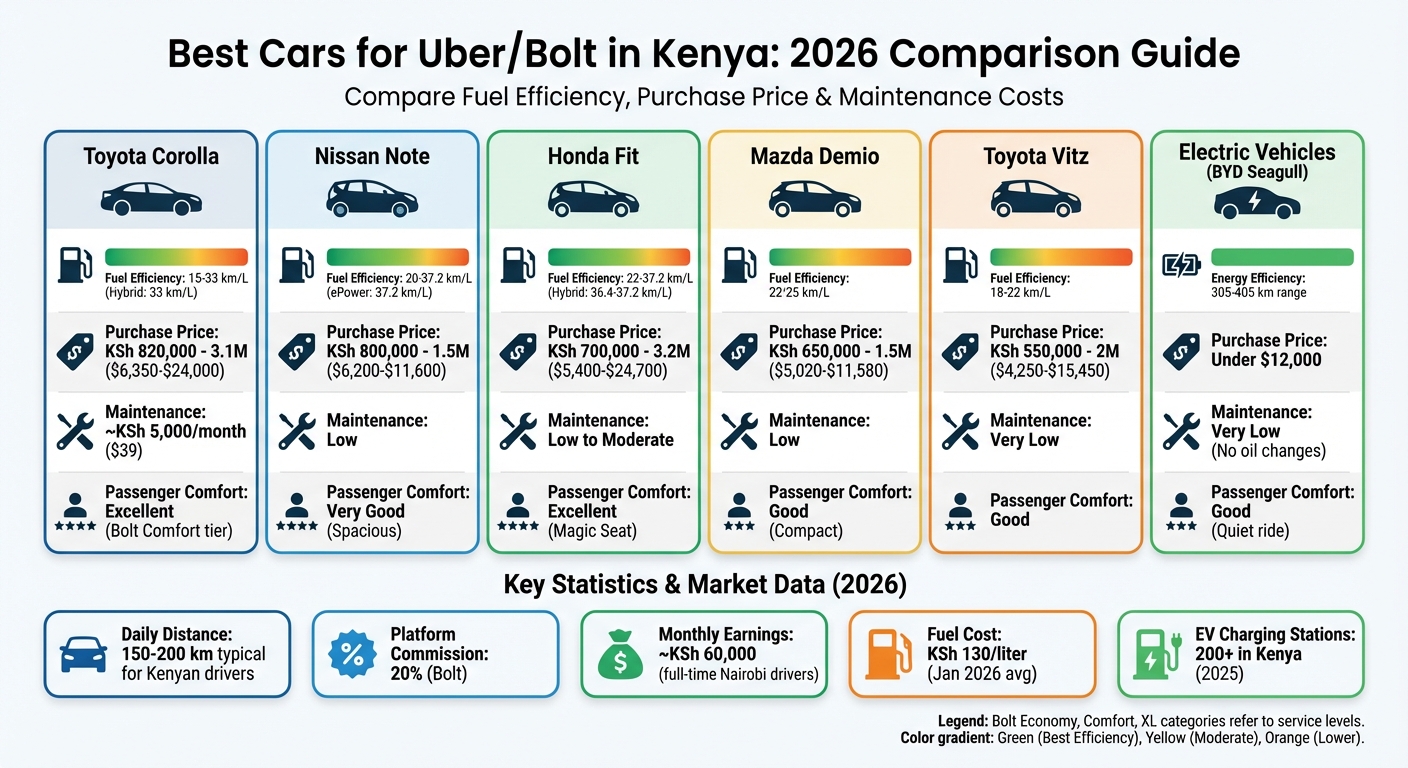
- Toyota Corolla: Reliable, spacious, and fuel-efficient (15–33 km/L). Prices range from $6,350–$24,000.
- Nissan Note: Compact yet roomy with hybrid models offering 37.2 km/L. Costs $6,200–$11,600.
- Honda Fit: Excellent fuel economy (up to 37.2 km/L) and flexible interior. Prices range from $5,400–$24,700.
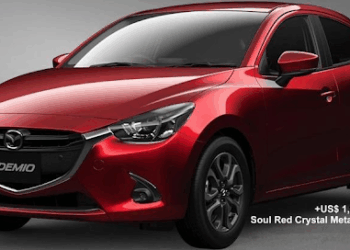
- Mazda Demio: Affordable and efficient (22–25 km/L). Priced at $5,020–$11,580.
- Toyota Vitz: Low maintenance and great for city commutes (18–22 km/L). Costs $4,250–$15,450.
- Electric Vehicles (e.g., BYD Seagull): Lower energy costs, with ranges up to 405 km. Starting under $12,000.
Each option has strengths depending on your budget, fuel preferences, and passenger needs. Below, we dive into details to help you pick the best car for your ride-hailing goals.
Best Uber and Bolt Cars in Kenya 2026: Fuel Efficiency, Price and Maintenance Comparison
BEST CARS FOR UBER, UBER X AND UBER XL IN 2025
1. Toyota Corolla
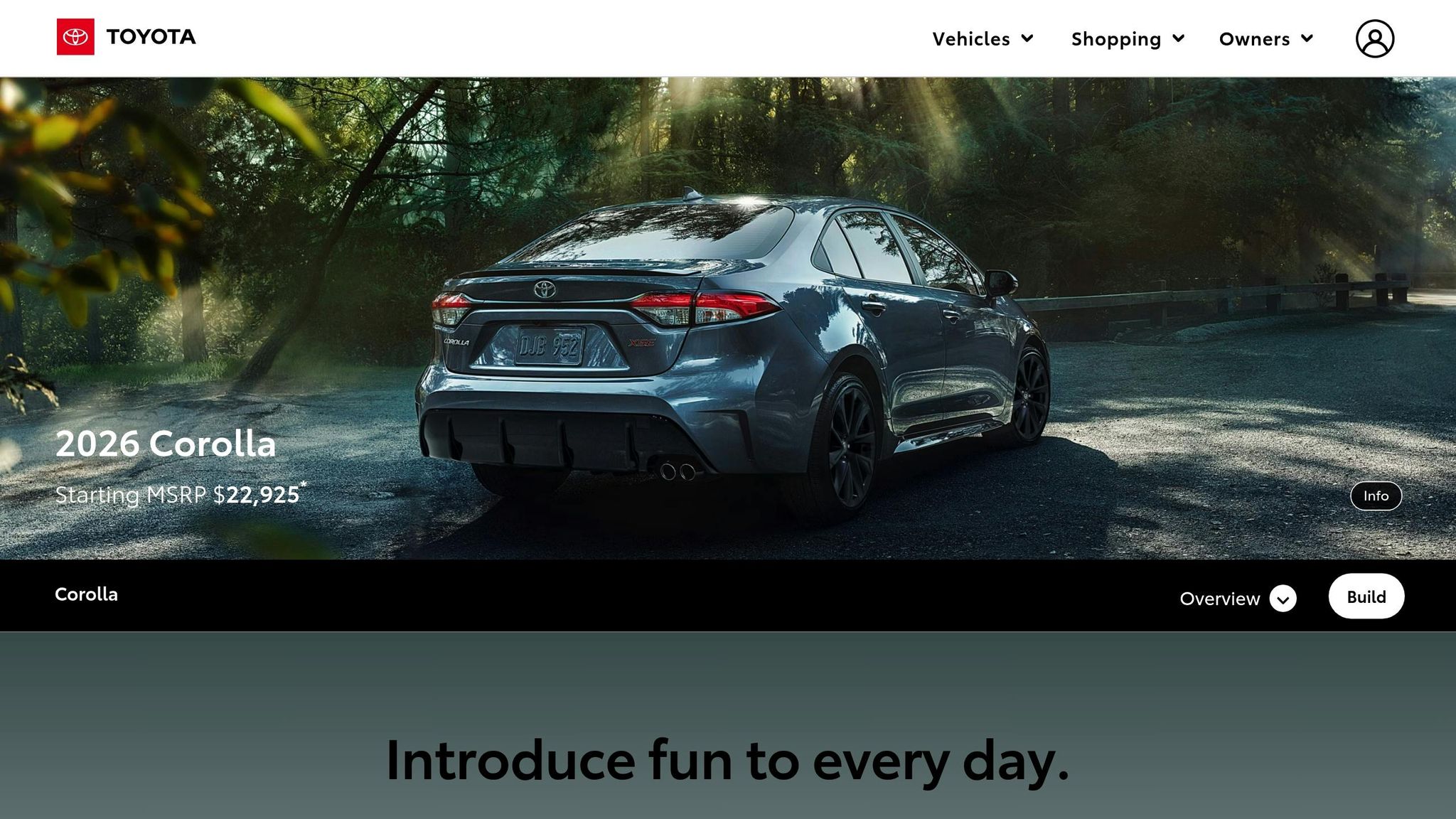
The Toyota Corolla – known as the Axio or Fielder in Kenya – has earned its place as a favorite among ride-hailing drivers. Why? It strikes the perfect balance between space, reliability, and fuel efficiency. With a roomy interior, it handles standard city trips with ease and is equally suited for airport transfers, comfortably accommodating passengers and their luggage. This versatility makes it a strong benchmark for evaluating other ride-hailing vehicles.
Fuel Efficiency
If fuel savings are a priority, the hybrid version of the Corolla is hard to beat. It delivers an impressive 33.0 km/L (about 77.7 mpg), far surpassing the 15–20 km/L (35–47 mpg) range typical of standard sedans. Even the non-hybrid models hold their own, offering fuel efficiency in the same 15–20 km/L range. For drivers, this translates to fewer stops at the pump and more money in their pockets.
Purchase Price and Maintenance Costs
The Corolla offers a range of pricing options to fit various budgets. Prices for used models range from Ksh 820,000 to Ksh 3.1 million (roughly $6,350–$24,000), depending on the year and trim level. If you’re considering a hybrid Axio, expect starting prices around Ksh 1.45 million (approximately $11,200). Maintenance is another win for the Corolla, with monthly costs averaging about Ksh 5,000 (around $39). Spare parts are easy to find across Kenya, and most mechanics are well-versed in working on these vehicles, making upkeep straightforward and hassle-free.
Passenger Comfort
The Corolla is a great fit for Bolt’s Standard (2014+) and Comfort (2022+) categories, thanks to its spacious rear legroom and smooth ride. With engine capacities ranging from 1.3L to 1.8L and a strong resale value, it’s not just a practical choice – it’s a smart investment. Now, let’s dive into the next contender to see how it stacks up against the Corolla’s strong reputation.
2. Nissan Note
The Nissan Note has become a go-to choice for many Kenyan ride-hailing drivers, thanks to its clever blend of compact size and roomy, family-friendly interior. It strikes a balance that’s hard to find in this price range: excellent fuel efficiency combined with a surprisingly spacious cabin. For drivers handling both city commutes and airport runs, the Note delivers where it matters most – ample legroom and cargo space that passengers genuinely value.
Fuel Efficiency
The ePower hybrid version stands out with an impressive fuel economy of 37.2 km/L (87.5 mpg), making it one of the top contenders in Kenya’s ride-hailing market. What’s particularly convenient is that the ePower doesn’t need plug-in charging. Instead, its petrol engine powers the electric motor, allowing you to refuel at any regular gas station. For those opting for the standard petrol model, you can still expect solid numbers – 20–24 km/L (47–56 mpg) – and a full tank that stretches up to 800 km (about 497 miles). This kind of range is ideal for drivers covering long distances daily.
Purchase Price and Maintenance Costs
Affordability is another reason the Note is so popular. Used models are priced between Ksh 800,000 and Ksh 1.5 million (approximately $6,200–$11,600). Maintenance is straightforward and cost-effective, thanks to the availability of spare parts in major cities and the relatively simple engine design. Additionally, local mechanics are well-versed in handling the Note, ensuring repairs and upkeep remain hassle-free – an essential factor for full-time ride-hailing drivers.
Passenger Comfort
One of the Note’s standout features is its spacious interior, which plays a big role in earning positive passenger feedback. With extra legroom and a smooth suspension, it’s well-suited for Kenya’s varied road conditions, especially during longer trips, like those to the airport. The hatchback design also offers more cargo space compared to rivals like the Toyota Vitz, making it a practical choice for passengers with luggage. Its easy maneuverability in Nairobi’s traffic, combined with its roomy cabin, cements its position as a favorite among ride-hailing drivers. Up next, we’ll look at another top contender.
3. Honda Fit
The Honda Fit is a compact, efficient vehicle that’s ideal for ride-hailing services. What makes it stand out? Its impressive fuel efficiency – especially in the hybrid version – and the clever Magic Seat® Technology. This unique seating system offers incredible flexibility, making it perfect for drivers handling airport trips or passengers with oversized luggage. These features often lead to better passenger ratings and repeat business.
Fuel Efficiency
When it comes to fuel economy, the Honda Fit is a standout choice for ride-hailing. The Honda Fit Hybrid offers an impressive 36.4–37.2 km/L (85.6–87.5 mpg), making it one of the most economical options on the market. The hybrid system combines a 1.5L engine with an electric motor and a 7-speed dual-clutch transmission, delivering around 137 horsepower. With a full tank, you can expect an estimated range of 1,000 km (about 621 miles), which is perfect for drivers covering long daily distances. The standard petrol model is no slouch either, delivering around 22 km/L (51.8 mpg). Additionally, hybrid drivers can save approximately Ksh 15,000 per month ($116) on fuel compared to petrol models, meaning the higher upfront cost of the hybrid version can be recouped in about two years.
Purchase Price and Maintenance Costs
The cost of a Honda Fit depends on the model year and type. Older models from 2012 start at Ksh 700,000–800,000 (around $5,400–$6,200), while used standard models range between Ksh 1.2 million and Ksh 2.5 million ($9,300–$19,300). Hybrid versions are priced higher, ranging from Ksh 2.2 million to Ksh 3.2 million ($17,000–$24,700), but the savings on fuel can make them a smart investment for full-time drivers. Maintenance costs are among the lowest in its class, and the Fit retains about 65% of its value after three years, making it a solid choice for resale. One thing to consider: hybrid battery replacement costs hover around Ksh 150,000 ($1,160) after about eight years of use. Overall, the Honda Fit strikes a great balance between affordability, reliability, and long-term value.
Passenger Comfort
The Honda Fit truly excels in passenger comfort, which is a key factor for ride-hailing success. The third-generation model offers 12.2 cm (4.8 inches) of additional rear legroom and 136 liters of extra passenger space, creating an interior that feels surprisingly roomy. It comfortably seats three passengers and their luggage, even during longer rides or in heavy traffic. The Magic Seat® Technology allows the seats to be adjusted in various ways to accommodate different luggage sizes and shapes – an invaluable feature for airport runs. These thoughtful design elements often lead to higher passenger satisfaction and ratings. Additionally, the Fit earns high marks for safety and reliability, making it a favorite among Kenyan automotive reviewers.
Next, we’ll take a closer look at another fuel-efficient option that’s worth considering.
4. Mazda Demio
The Mazda Demio is a subcompact hatchback that has become a favorite among Kenyan ride-hailing drivers, thanks to its dependability and fuel efficiency. Models equipped with SkyActiv technology boast an impressive fuel economy of 22–25 km/L (51.8–58.8 mpg), giving drivers an estimated range of about 700 km (435 miles) on a full tank. For those driving with Bolt, the Demio qualifies for the "Economy" category as long as the model is from 2014 or later and has five doors. Let’s break down why this car stands out in terms of efficiency, affordability, and comfort.
Fuel Efficiency
The Demio’s SkyActiv models shine when it comes to fuel economy, offering 22–25 km/L (51.8–58.8 mpg). This gives it an edge over competitors like the Toyota Vitz, which averages 18–22 km/L. While hybrid models, such as the Honda Fit Hybrid, achieve even better fuel efficiency, the Demio’s performance is more than adequate for drivers who clock high mileage on a daily basis. It strikes a great balance between cost-effectiveness and practicality.
Purchase Price and Maintenance Costs
With a price range of Ksh 650,000 to Ksh 1.5 million (about $5,020–$11,580), the Mazda Demio is one of the most budget-friendly options for ride-hailing. Maintenance is affordable too, thanks to the wide availability of spare parts and local servicing options. Additionally, Mazda vehicles hold their resale value well in Kenya, making the Demio a smart investment for drivers who may want to upgrade later. However, the car’s suspension system is sensitive to potholes, so regular maintenance checks are a must.
Passenger Comfort
Passenger comfort plays a big role in ride-hailing success, and the Demio is built with urban driving in mind. Its compact design makes it easy to navigate Nairobi’s bustling streets, and the seating is comfortable for short trips. That said, the rear legroom is somewhat limited compared to larger sedans, which could be a drawback for taller passengers or longer rides.
Wil M, a Digital Vehicle Marketplace Specialist at Moto1, sums up the Demio’s personality perfectly:
"Don’t let its cute face fool you. This car has hustle in its bones. It’s agile on the road, loves Nairobi’s potholes a bit too much, and as a result, handles corners like a rally car on a chill day".
To keep passengers happy and maintain high ratings, it’s essential to ensure the interior remains clean and well-maintained.
sbb-itb-e5ed0ed
5. Toyota Vitz
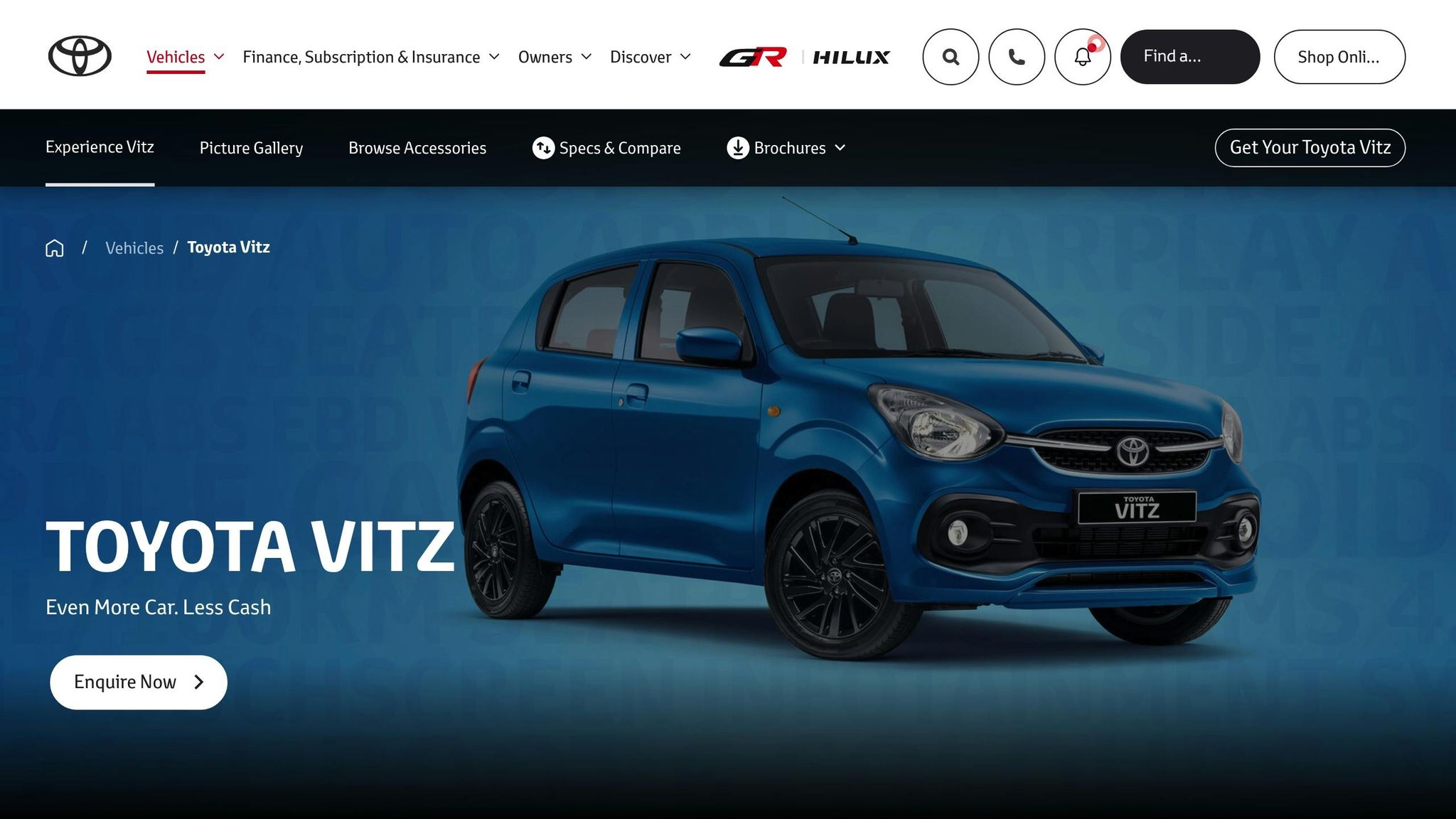
When it comes to affordable and dependable ride-hailing options, the Toyota Vitz earns its place as a reliable partner for drivers in Kenya. This compact hatchback is built for efficiency, delivering a fuel economy of 18–22 km/L (42.3–51.8 mpg), which translates to an estimated range of about 600 km (373 miles) on a full tank. For Bolt drivers, the Vitz qualifies for the "Economy" category, provided it’s a 2014 model or newer. Its compact design is perfect for weaving through Nairobi’s notoriously congested streets.
Fuel Efficiency
With a fuel economy of 18–22 km/L, the Vitz strikes a balance between performance and practicality, making it a solid choice for daily ride-hailing operations. While it doesn’t quite match the efficiency of hybrids, it offers a cost-effective alternative without the higher upfront investment.
Purchase Price and Maintenance Costs
The Toyota Vitz is available in a variety of price ranges, depending on the model year and condition.
- Older models (2008–2012): Ksh 550,000–800,000 ($4,250–$6,180)
- Mid-range models (2013–2016): Ksh 850,000–1.2 million ($6,570–$9,270)
- Newer models (2017–2021): Ksh 1.3–2 million ($10,040–$15,450)
On average, the market range for the Vitz falls between Ksh 700,000–1.7 million ($5,410–$13,130). Routine maintenance costs are manageable, averaging between Ksh 5,000 and 8,000 ($39–$62) per session. Spare parts are easy to find and reasonably priced, and the Vitz tends to retain its resale value better than competitors like the Nissan March.
Passenger Comfort
The Toyota Vitz is designed with practicality in mind, offering enough space for short city commutes. The front-row legroom is adequate for most drivers, though taller individuals might find it a bit tight. The second-row seating is sufficient for typical urban trips, making it a comfortable and efficient choice for ride-hailing services.
Next, we’ll take a closer look at electric vehicles to see how they measure up in terms of efficiency and cost-effectiveness.
6. Electric Vehicles (BYD Seagull, Henrey Minicar, BAW Pony)
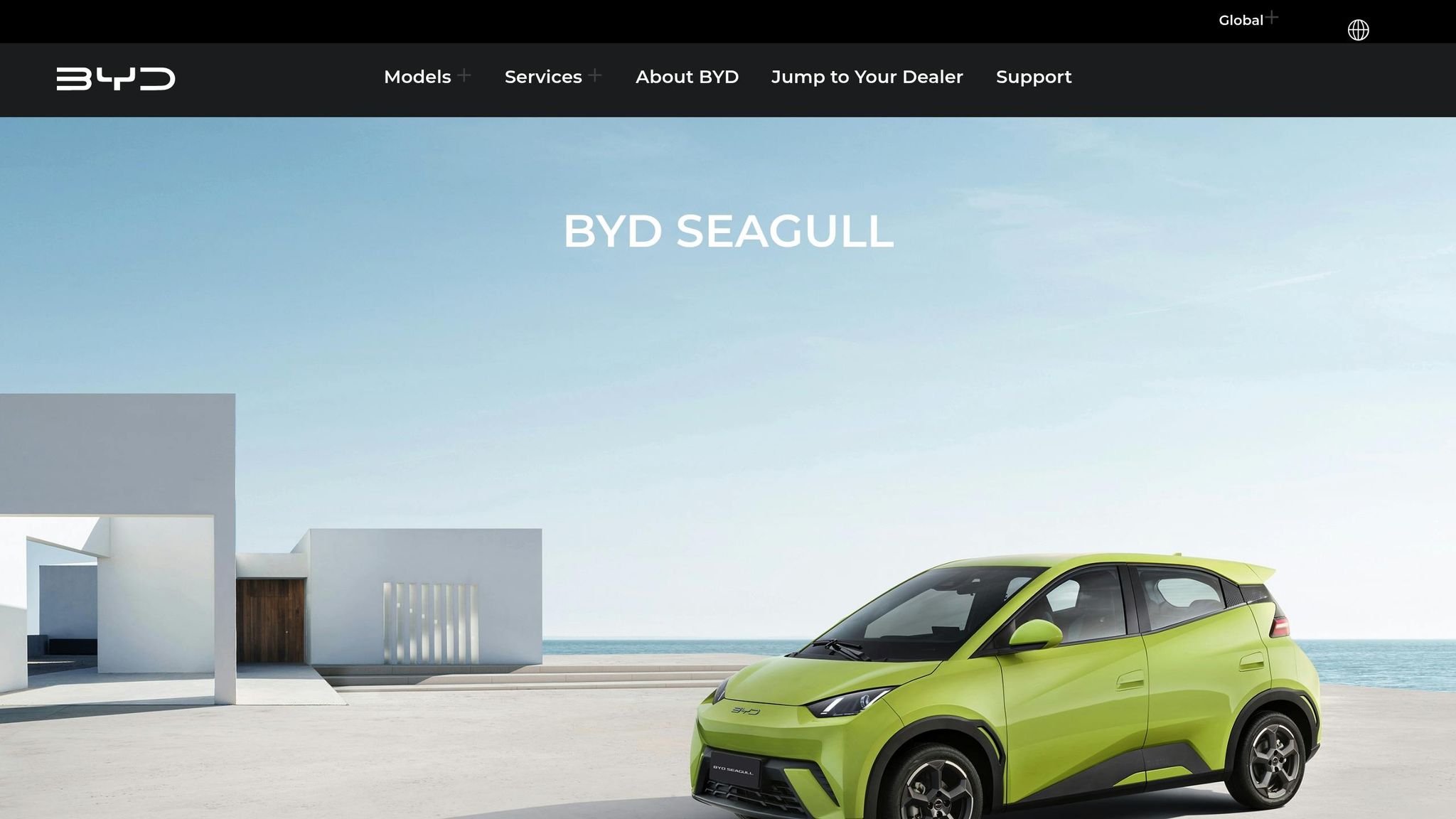
After exploring traditional models, let’s shift gears and look at how electric vehicles (EVs) are changing the ride-hailing industry in Kenya. EVs are steadily gaining traction, with the BYD Seagull leading the way. Officially introduced to Africa via South Africa on September 16, 2025, the Seagull – also branded as the Dolphin Surf – has earned a five-star Euro NCAP safety rating, scoring 82% for adult occupant protection and 86% for child safety in 2025. Meanwhile, models like the Henrey Minicar and BAW Pony are newer to the market, and their spare parts are not yet widely available locally. Notably, BYD received an impressive 10,000 orders for the Seagull within 24 hours of its launch and sold 200,000 units within seven months.
Energy Efficiency and Cost Savings
The BYD Seagull comes with two battery options: a 30.08 kWh pack offering a range of 305 km (190 miles) and a 38.88 kWh pack delivering up to 405 km (252 miles) under CLTC testing standards. For ride-hailing drivers who typically cover 150–200 km (93–124 miles) daily, either option provides more than enough range. Plus, operating an EV in Kenya can cut energy costs by 30–50% compared to fueling a similar petrol-powered car.
Purchase Price and Maintenance Costs
Priced below $12,000 at its initial launch in China, the BYD Seagull offers a competitive alternative to popular internal combustion engine models like the Toyota Aqua and Honda Fit Hybrid, which are priced between Ksh 700,000 and Ksh 1.8 million in Kenya. EVs also tend to have lower maintenance demands since they don’t require oil changes, spark plug replacements, or exhaust system repairs. For instance, BYD resolved a reversing camera issue in the Seagull through an over-the-air update, eliminating the need for physical repairs.
Passenger Comfort
Designed with a 4-seat, 5-door layout, the BYD Seagull maximizes interior space. It features BYD’s "Blade Battery" (Lithium Iron Phosphate), which is thinner to enhance passenger room. Key ride-hailing features like spacious rear legroom, smooth suspension, effective air conditioning, and a dependable infotainment system make these compact EVs appealing for drivers and passengers alike. Positioned in the "Economy" and "Lite" segments, these vehicles also offer a quieter ride, adding to the overall comfort.
Infrastructure Considerations
Kenya’s EV infrastructure is growing rapidly. The number of public charging stations jumped from 67 in 2023 to over 200 by early 2025, with a national target of 10,000 by 2030. For ride-hailing drivers, choosing models that support DC Fast Charging is crucial, as it can add over 100 km (62 miles) of range in just 20–30 minutes. Additionally, ensuring the battery’s State of Health (SOH) remains at 85% or higher is essential for maintaining performance during long shifts. As of May 2025, Kenya had 9,047 registered EVs – a 150% year-on-year increase – and these vehicles now feature distinctive green number plates issued by the NTSA. With expanding infrastructure and technological advancements, EVs are becoming an increasingly attractive option for ride-hailing in Kenya, setting the stage for a closer look at their overall benefits and challenges.
Advantages and Disadvantages
When deciding on a ride-hailing car, it often comes down to balancing costs – like the initial purchase price, fuel expenses, and maintenance – against passenger comfort. The table below outlines how popular models perform in these areas, making it easier to weigh the options based on your budget and driving habits.
| Car Model | Fuel Cost per 100km* | Purchase Price (KSh) | Maintenance Costs | Passenger Comfort Rating |
|---|---|---|---|---|
| Toyota Corolla | ~3.03 L (~KSh 390) | 1.5M – 2.5M | Moderate; parts widely available | Excellent; qualifies for Bolt’s "Comfort" tier |
| Nissan Note | ~2.69 L (~KSh 350) | 800K – 1.5M | Low; extensive local support | Very Good; surprisingly roomy |
| Honda Fit | ~2.69 L (~KSh 350) | 700K – 1.8M | Low to Moderate; hybrid components | Excellent; super spacious interior |
| Mazda Demio | ~4.00–4.76 L (~KSh 520–620) | 650K – 1.5M | Low; strong local availability | Good; agile handling in city traffic |
| Toyota Vitz | ~3.77 L (~KSh 490) | 700K – 1.7M | Very Low; cheapest to maintain | Good; front legroom can be tight for tall drivers |
*Fuel costs based on KSh 130 per liter (January 2026 average).
Breaking Down Key Trade-Offs
Hybrids
Hybrids, such as the Honda Fit, offer fuel costs around KSh 350 per 100 km, making them an attractive option for full-time drivers. While the initial purchase price can go up to KSh 1.8M, the long-term savings on fuel often justify the investment.
Standard Hatchbacks
If you’re looking for affordability, models like the Toyota Vitz and Mazda Demio provide lower entry prices. The Vitz stands out for its minimal maintenance costs, thanks to the wide availability of spare parts. However, its higher fuel consumption could cut into your profits during slower periods.
Electric Vehicles
Electric vehicles are gaining ground, offering reduced maintenance and lower energy costs. With Kenya’s charging infrastructure projected to exceed 200 stations by early 2025, this option is becoming more practical. Drivers who can charge their vehicles at home overnight stand to save even more.
Passenger Comfort
For drivers aiming to boost ratings and earnings, comfort matters. Models like the Toyota Corolla and Honda Fit excel in this area, with the Corolla qualifying for Bolt’s premium "Comfort" tier, which allows for higher fares. Keep in mind, though, that using air conditioning can reduce fuel efficiency by about 1.5 km/L.
Conclusion
Your choice of vehicle should align with your driving habits and the service category you plan to operate in. For those just starting out and watching their budget, cars like the Toyota Vitz or Mazda Demio are excellent options. These models are affordable, easy to maintain, and perfect for entry-level ride-hailing services.
For full-time drivers covering long distances – 150 to 200 km daily – hybrid options like the Honda Fit Hybrid or Toyota Aqua are worth considering. With fuel efficiency ratings of 35–37 km/L, these vehicles may have a higher upfront cost, but the savings on fuel over time can be substantial.
If you’re targeting premium ride categories like Bolt Comfort, the Toyota Corolla (2022 or newer) is a solid choice. Its added comfort can lead to higher fares and better passenger ratings, making it a smart investment for drivers aiming to stand out.
It’s also important to keep compliance in mind. Make sure your vehicle meets the platform’s requirements. For example, Bolt Economy requires 5-door hatchbacks from 2014 or later, while Bolt XL demands larger vehicles with 6–11 seats, such as the Toyota Sienta. Additionally, ensure your car adheres to local regulations by securing an NTSA inspection certificate and PSV insurance.
When making your decision, think beyond the initial price tag. Factor in fuel consumption and maintenance costs over at least two years to calculate your true earnings potential. This is especially crucial given Kenya’s fuel prices and challenging road conditions. With full-time Bolt drivers in Nairobi earning around KSh 60,000 per month after a 20% commission, selecting the right vehicle is key to running a profitable ride-hailing business.
FAQs
What should I consider when choosing a car for Uber or Bolt in Kenya?
When choosing a car for Uber or Bolt in Kenya, there are a few essential factors to keep in mind to ensure both profitability and rider satisfaction. Fuel efficiency should be at the top of your list since drivers typically clock in around 90–125 miles daily. Aim for vehicles that deliver at least 35–45 mpg. If you want even better mileage, hybrids like the Toyota Aqua or Honda Fit Hybrid are excellent options.
Another critical factor is low maintenance costs and the availability of spare parts. Brands such as Toyota, Nissan, and Mazda are widely favored because they come with reliable service networks and affordable maintenance. At the same time, passenger comfort can’t be overlooked – it plays a big role in securing positive ratings. Cars like the Mazda Demio or Toyota Vitz, with their roomy and well-ventilated interiors, are great picks for ensuring a pleasant ride.
Finally, make sure the car complies with Uber and Bolt’s requirements. This includes checking for age limits, necessary safety features, and ensuring the vehicle has a four-door design. By focusing on fuel economy, maintenance costs, comfort, and platform compliance, you’ll be well on your way to selecting a car that boosts earnings while handling Kenya’s varied road conditions seamlessly.
Are electric vehicles more cost-effective and efficient than traditional cars for ride-hailing in Kenya?
Electric vehicles (EVs) are gaining traction among Uber and Bolt drivers in Kenya, and for good reason. Although the initial purchase price of an EV is typically higher than that of a traditional gas-powered car, the long-term savings on fuel and maintenance make them an appealing choice. Electricity costs less per mile compared to gasoline, and with fewer moving parts, EVs require less routine maintenance, cutting down on servicing expenses.
When it comes to efficiency, EVs stand out. They convert more of their battery energy into motion than internal combustion engines, which means better mileage and a smoother, quieter ride. This not only enhances the driving experience but also boosts passenger comfort – something that could lead to higher ratings. That said, traditional cars continue to dominate due to their lower upfront costs and the convenience of Kenya’s well-established network of fueling stations.
Deciding between an EV and a gas-powered car boils down to what matters most to you. If you’re ready to invest more upfront and can plan around charging stops, EVs offer substantial savings over time. And as Kenya builds out its charging infrastructure and EV prices become more accessible, these vehicles are set to become an even smarter choice for ride-hailing drivers.
What is the best car for ride-hailing in Kenya that balances affordability, fuel efficiency, and passenger comfort?
The Honda Fit Hybrid stands out as a smart option for ride-hailing in Kenya, combining affordability, fuel efficiency, and passenger comfort. With a price range of KES 700,000–1,800,000, it’s a cost-effective investment for drivers. Plus, its hybrid engine delivers an impressive fuel economy of about 37 km per liter (87 mpg), helping to keep fuel expenses in check.
One of its standout features is the Magic Seat design, which offers a versatile and roomy interior. This clever setup allows the Honda Fit Hybrid to comfortably carry three passengers along with their luggage, making it a strong choice for Uber and Bolt drivers aiming to provide a comfortable experience while minimizing operating costs.
Related Blog Posts
- Car prices in Nairobi 2025
- Top 5 Reliable Cars for Uber & Bolt Drivers in Kenya
- Why Car Prices in Kenya Are Changing in 2025
- Electric Car Prices in Kenya: What You Can Get in 2025