Kenya’s roads present unique challenges, from smooth city streets to rugged rural terrain. Choosing the right engine is critical for durability, cost-effectiveness, and long-term reliability. Here’s what you need to know:
- Top Picks: Engines from Toyota, Honda, Nissan, Mazda, and Subaru dominate due to their reliability and availability of spare parts.
- Toyota Leads: Known for longevity, Toyota engines (e.g., 2.4L diesel in Hilux) often exceed 20 years or 248,000 miles with proper care.
- Diesel vs. Petrol: Diesel engines excel in torque, fuel efficiency, and long-distance performance, while petrol engines are better for urban driving and offer smoother acceleration.
- Maintenance Tips: Regular oil changes (every 5,000–7,500 km), air filter checks, and sensor cleaning are essential to handle Kenya’s dusty, rough roads.
Quick Comparison:
| Brand | Strengths | Maintenance Costs (Annual) | Best Use |
|---|---|---|---|
| Toyota | Longevity, spare parts availability | $370–$740 | City commutes, off-road tasks |
| Honda | Fuel efficiency, resale value | Higher than Toyota | Urban driving |
| Nissan | Affordable, reliable | Moderate | Family use, countryside trips |
| Mazda | Fuel-efficient, lower costs | $296–$592 | Urban driving |
| Subaru | Rugged, AWD for rough terrain | $592–$962 | Rural/off-road enthusiasts |
Key Takeaway: Choose engines based on your driving needs and budget. Prioritize regular maintenance to ensure long-term performance.
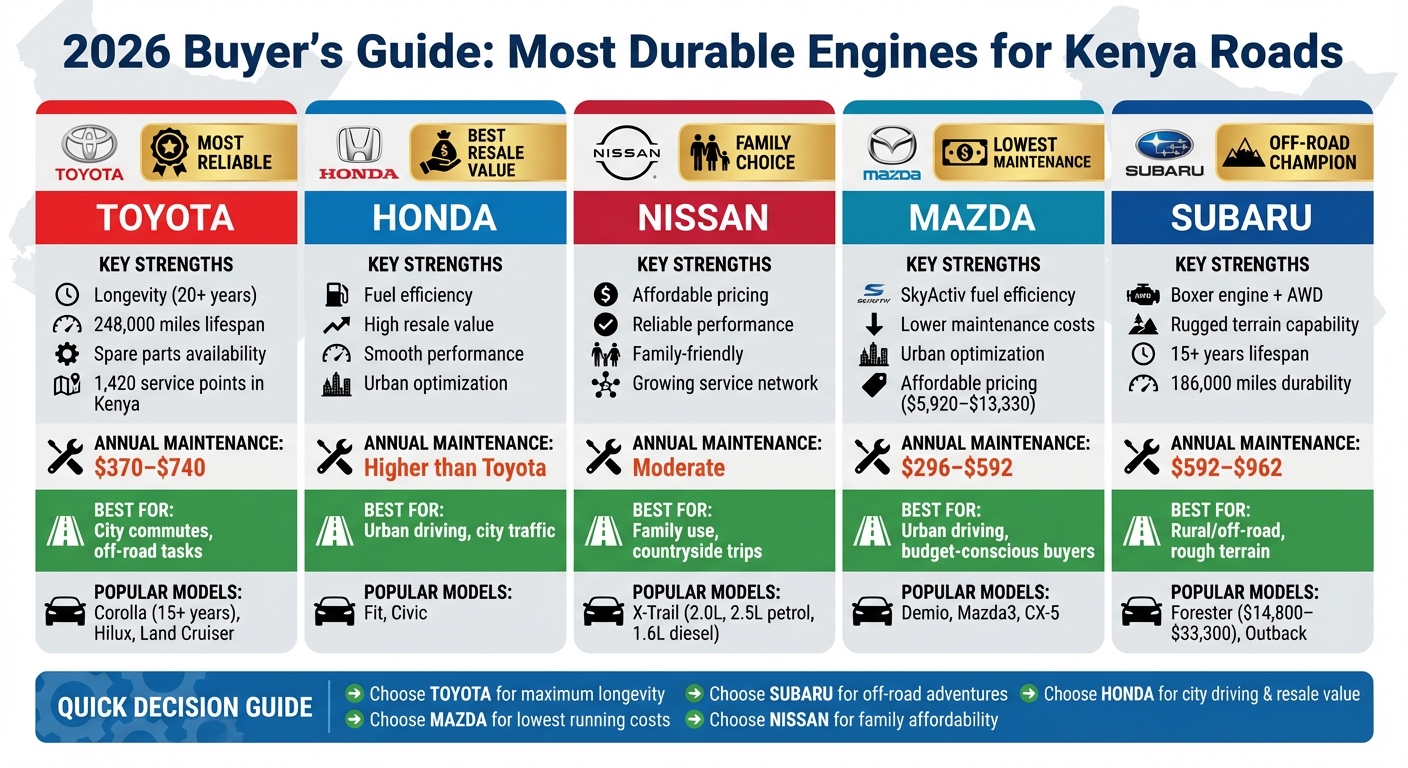
Top 5 Most Durable Engine Brands for Kenya Roads Comparison 2026
The Truth About Mazda CX-5 Diesel Reliability in Kenya. Still Too Early to Tell!

Most Durable Engines for Kenya Roads
Japanese automakers lead the way in engine reliability for Kenya, thanks to their ability to handle the country’s diverse and often tough driving conditions. From Nairobi’s stop-and-go traffic to the rugged gravel roads of rural areas, these engines are designed to endure dust, extreme heat, high altitudes, and inconsistent fuel quality.
One key factor behind their popularity is the availability of spare parts. Local supply chains ensure that parts are easy to find, which keeps maintenance straightforward. For instance, annual maintenance costs range from about $370 to $740 for a Toyota Corolla, while maintaining a Subaru Forester can cost between $590 and $960. Choosing the right engine isn’t just about performance – it’s also a smart financial decision for the long haul.
Here’s a closer look at how top Japanese brands design engines to suit Kenya’s unique driving conditions.
Toyota Engines

Toyota engines are practically synonymous with durability in Kenya. The 1.5L, 1.8L, and 2.0L petrol engines in the Corolla models (Axio, Fielder, Altis) are famous for their simplicity, ease of maintenance, and long lifespan – often exceeding 15 years or about 186,000 miles with proper care. These engines are perfect for city commutes and occasional road trips.
For heavier tasks, Toyota’s diesel engines shine. The 2026 Hilux offers two diesel options: a 2.4L engine focused on fuel efficiency for business use and a 2.8L turbo diesel for towing and off-road adventures. With proper care, these engines can last over 20 years or approximately 248,000 miles.
The Land Cruiser lineup is built for extreme conditions. The LC79 comes with either a 4.0L V6 petrol or a 4.2L diesel engine, perfect for navigating rocky trails and desert landscapes. Meanwhile, the Land Cruiser 300 offers a choice between a 3.3L V6 diesel engine delivering 306 HP and 516 lb-ft of torque or a 3.5L twin-turbo V6 petrol engine with 415 HP and 479 lb-ft of torque.
Toyota also stands out for its extensive support network, with around 1,420 service points across Kenya. Even the latest models benefit from this widespread technical support, making maintenance straightforward and accessible.
Honda Engines

Honda engines are known for blending performance with durability, making them a solid choice for Kenya’s varied driving conditions. The 1.3L and 1.5L petrol engines in models like the Fit and Civic deliver smooth handling and excellent fuel economy, whether navigating city traffic or tackling rougher roads.
Fuel efficiency is a major advantage for Honda, especially for Nairobi commuters dealing with long traffic jams. While maintenance costs can be slightly higher – due to a smaller pool of specialized mechanics and pricier parts – the high resale value of Honda vehicles helps offset these expenses. The Civic, in particular, has earned a strong reputation for reliability and style in Kenya.
Nissan Engines

Nissan offers a balance of affordability and durability, making it a popular choice for families. The X-Trail’s engine options include 2.0L and 2.5L petrol variants as well as a 1.6L diesel option. These engines provide dependable performance for both city driving and occasional trips into the countryside. With improved parts availability and a growing network of service centers, Nissan is an attractive option for buyers who want reliable Japanese engineering without breaking the bank.
Mazda Engines

Mazda’s SkyActiv technology prioritizes fuel efficiency while maintaining durability. Engines like the 1.3L and 1.5L found in the Demio and Mazda3 are well-suited for urban driving. In larger models like the CX-5, Mazda applies the same efficiency-focused design to a crossover platform.
Mazda vehicles generally have lower maintenance costs compared to some competitors. Annual servicing typically ranges from $296 to $592, and the Demio’s purchase price varies from about $5,920 to $13,330, depending on the model year and trim. While Mazda engines are reliable, they may not last as long as those from Toyota or Subaru, which could be a consideration for buyers looking for extended ownership.
Subaru Engines

Subaru’s Boxer engines, paired with Symmetrical All-Wheel Drive, are built for challenging conditions. The 2.0L and 2.5L petrol engines, including turbocharged versions found in models like the Forester and Outback, are designed for reliability and safety across diverse terrains. These engines excel on rough roads, making them a favorite for families and outdoor enthusiasts.
Subaru engines are built to last, often running for over 15 years or around 186,000 miles with proper maintenance. Their advanced AWD system enhances stability on muddy trails and rocky paths. However, this technology comes with higher maintenance costs, with annual servicing ranging from $592 to $962. Additional expenses, such as timing belt replacements, should also be factored in. The Forester’s purchase price typically falls between $14,800 and $33,300, depending on the trim level. This combination of durability and capability makes Subaru a strong contender for Kenya’s demanding roads.
Diesel vs. Petrol Engines for Kenya
Deciding between a diesel and petrol engine largely depends on your driving habits and the environment you’ll be navigating. Each engine type has distinct strengths that cater to Kenya’s varied terrain and driving conditions. Below, we break down the advantages of each to help you make an informed choice.
Benefits of Diesel Engines
Diesel engines are known for their impressive torque, which gives them strong pulling power. Take the Isuzu D-Max 3.0L Turbo Diesel, for instance – it generates 450 Nm of torque between 1,600 and 2,600 rpm, making it a great choice for tasks like transporting construction materials in Nairobi or farm equipment in Nakuru.
Fuel efficiency is another area where diesel shines. The 2024 Toyota Hilux with a 2.4L diesel engine offers an average of 14.3 km/l, compared to 10.2 km/l for the 2.7L petrol version. As of December 2023, diesel fuel was slightly more affordable at Ksh 201.47 per liter versus petrol at Ksh 212.36 per liter. For those covering long distances or working in commercial transport, these savings can quickly add up.
Diesel engines are built for durability, often featuring sturdy components designed to handle higher compression levels. With routine maintenance – like replacing fuel filters every 20,000–30,000 km and cleaning the EGR system every 60,000–100,000 km – a well-maintained diesel engine can surpass 400,000 km without major repairs. This reliability makes diesel vehicles ideal for rural areas where roads are rough and loads are heavy.
Benefits of Petrol Engines
Petrol engines, on the other hand, excel in urban settings. They are quieter, start reliably, and accelerate smoothly – qualities that make them perfect for Nairobi’s stop-and-go traffic. Smaller petrol cars often achieve excellent fuel economy, ranging from 18 to 22 km per liter in typical city driving conditions.
Another advantage of petrol engines is their lower purchase price and simpler maintenance. For example, oil changes for petrol vehicles typically cost between Ksh 3,000 and Ksh 8,000. Additionally, cars with engine sizes between 1,300cc and 2,000cc tend to retain their resale value well in Kenya. For families in the suburbs or city commuters who don’t need heavy-duty performance, petrol engines offer a practical and budget-friendly option.
Diesel vs. Petrol Comparison Table
Here’s a quick comparison to highlight the key differences between diesel and petrol engines:
| Feature | Diesel Engines | Petrol Engines |
|---|---|---|
| Initial Cost | Higher purchase price | Lower purchase price |
| Fuel Price (Dec 2023) | Ksh 201.47/L | Ksh 212.36/L |
| Fuel Efficiency | 12.0–14.3 km/l (Hilux) | 10.2 km/l (Hilux 2.7L) |
| Torque | High (450 Nm in D-Max) | Lower |
| Maintenance | More expensive, specialized care | Cheaper, simpler servicing |
| Durability | 400,000+ km with proper care | Durable, but less suited for heavy loads |
| Best Use | Long-distance, towing, rural/off-road | Urban commuting, short trips |
| Acceleration (Hilux) | 10.5 seconds (2.8L) | 8.0 seconds (4.0L) |
| Noise Level | Louder operation | Quieter, smoother |
Each engine type has its place, depending on your needs. Whether you prioritize fuel savings, durability, or ease of maintenance, understanding these differences can guide you to the right choice.
sbb-itb-e5ed0ed
Engine Maintenance Tips for Longevity
Kenya’s rugged roads demand extra attention to engine maintenance, going beyond standard manufacturer recommendations. Regular oil changes every 5,000 to 7,500 kilometers are a must to prevent wear on critical parts like cylinder walls and piston rings. While an oil change typically costs about KSh 5,000, skipping this routine task could lead to catastrophic engine failure, with repair costs soaring past KSh 200,000.
Regular Servicing and Oil Changes
The service intervals in your owner’s manual are based on ideal driving conditions – something Kenya’s roads rarely offer. With over 157,596 kilometers of unpaved roads as of 2023, engines are constantly exposed to abrasive dust. To combat this, aim to change your oil every 5,000 to 7,500 kilometers instead of the standard 10,000 to 15,000 kilometers. Be sure to use oil that matches your engine’s specifications, as lower-quality oils tend to degrade faster under Kenya’s heat and dusty conditions. During each oil change, take a moment to check the used oil for signs of trouble, such as grit or metal particles, which could indicate excessive wear.
But oil changes alone aren’t enough. Protecting your engine from dust and heat is equally important.
Handling Local Conditions
Air filters are your engine’s first shield against Kenya’s pervasive dust, but they clog up much faster here than in cleaner environments. If you’re driving on murram roads, inspect the air filter every 5,000 kilometers, and every 10,000 kilometers in urban areas. A clogged air filter can sap up to 25% of your engine’s power and increase fuel consumption by 14%. Opt for high-quality paper filters that trap 98–99% of dust particles, rather than aftermarket "high-flow" filters, which only capture about 89%.
Dust doesn’t just stop at filters – it can also interfere with sensors. Mass Airflow Sensors (MAF) are particularly sensitive, with dust buildup potentially reducing their output by as much as 46.7%. Many Toyota service centers in Kenya now include cleaning MAF and oxygen sensors as part of regular maintenance. Additionally, check your coolant levels monthly, especially before long trips, as overheating remains a leading cause of engine failure in Kenya’s climate. To minimize dust intake, maintain a safe distance from other vehicles and avoid aggressive acceleration.
Common Engine Problems and Prevention
Taking care of your engine and adjusting for local conditions can help you avoid common failures. Overheating is one of the most frequent issues, often caused by low coolant levels, leaks, or mud trapping heat on engine surfaces. During the rainy season, make it a habit to inspect your engine bay for mud after off-road trips, as it can cause corrosion and disrupt electrical systems. Fuel system problems are another common headache, especially when dust clogs injector nozzles, leading to rough idling and power loss. Water contamination during wet seasons can also trigger rapid rust in diesel fuel systems.
Regular maintenance can prevent other issues, too. Clean your battery terminals monthly to avoid corrosion caused by fluctuating temperatures. Rotate and balance your tires every 8,000 to 10,000 kilometers to handle uneven roads better, and inspect suspension components regularly – potholes can damage shocks and put extra strain on the powertrain. For drivers in Arid and Semi-Arid Lands (ASALs), installing a snorkel or oil-bath pre-cleaner can help by raising the air intake above heavy dust clouds.
| Task | Standard Interval | Kenya Interval (Dusty/Rough Roads) |
|---|---|---|
| Engine Oil Change | 10,000 – 15,000 km | 5,000 – 7,500 km |
| Air Filter Inspection | 12,000 – 15,000 km | 5,000 km (murram) / 10,000 km (urban) |
| Tire Rotation | 10,000 – 12,000 km | 8,000 – 10,000 km |
| MAF Sensor Cleaning | Not specified | Every major service |
Conclusion
Choose your engine based on how you plan to use it. Engines from Toyota and Isuzu are known for their longevity, often lasting over 20 years or more than 400,000 kilometers – provided they’re well-maintained. For city driving, the Toyota Corolla’s 1.5L petrol engine is a solid choice, capable of running for over 15 years with regular upkeep. But remember, this kind of durability only happens with proper care.
Keeping your engine in top shape requires commitment to maintenance. Routine oil changes and regular inspections, including checking components like air filters, are crucial. This is particularly important given Kenya’s dusty roads and unpredictable driving conditions.
In addition to maintenance, smart financial planning is key. Set aside about 10% of the vehicle’s purchase price for unexpected repairs within the first six months. Also, ensure you verify the engine and chassis numbers through the NTSA TIMS portal before sealing the deal. Don’t forget, NTSA transfer fees vary depending on engine size, ranging from KES 1,660 for engines under 1,000cc to KES 5,915 for engines over 3,000cc.
Whether navigating rural roads or city traffic, a reliable engine paired with consistent maintenance can handle Kenya’s demanding conditions. With disciplined care and thoughtful budgeting, your engine will be ready to meet the challenges ahead.
FAQs
Why are Toyota engines considered reliable for Kenya’s roads?
Toyota engines have built a reputation for reliability and toughness, making them a perfect match for Kenya’s demanding road conditions. Their sturdy construction and simple yet effective designs allow them to handle heat, dust, and rough terrain without compromising performance. Take the 1KD-FTV 3.0-liter turbodiesel engine, for instance. With its advanced fuel injection system and turbocharger, it delivers impressive torque while minimizing wear – provided it gets regular upkeep. Another standout is the 2TR-FE 2.7-liter engine, commonly found in models like the Hilux, which has a history of easily surpassing 250,000 miles with proper maintenance.
Toyota’s dedication to rigorous quality control and thorough testing ensures their engines can thrive in even the harshest environments. Plus, the easy availability of genuine Toyota parts throughout East Africa makes servicing straightforward and cost-effective, helping these engines stay dependable for years.
What are the maintenance cost differences between diesel and petrol engines in Kenya?
Diesel engines often come with steeper maintenance costs compared to petrol engines in Kenya. Built for endurance and suited for long hauls or heavy loads, diesel engines feature intricate components like fuel injection systems, turbochargers, and emission controls. These parts not only cost more but also require specialized servicing, which adds to the expense. On the other hand, petrol engines are simpler in design, making their maintenance less costly and easier to manage – particularly for urban driving.
In Kenya, routine car maintenance generally ranges from $135 to $405 annually. Diesel vehicles usually sit at the higher end of this spectrum – or sometimes even go beyond it – because of their more demanding service requirements. Petrol vehicles, in contrast, tend to stick to the lower end, offering a more economical option for day-to-day use.
What maintenance tips can help engines last longer on Kenya’s rough roads?
Engines tackling Kenya’s rugged, dusty roads require a bit of extra attention to stay dependable. One of the most important steps? Regular oil changes. Choose a high-quality oil with the proper viscosity for hot and dusty conditions – something like 10W-40 or synthetic blends works well. Stick to shorter intervals, around every 3,000 to 4,500 miles, to prevent contaminants from causing damage and to ensure the oil remains effective under tough conditions.
Your air filter also deserves extra care. Dusty roads can clog it much faster than usual, so inspect it every 1,200 miles and aim to replace it at least every 7,500 miles – or sooner if it looks dirty. Monthly checks of your coolant levels are equally important. Flushing the cooling system as recommended in your service schedule helps avoid overheating, especially in Kenya’s high temperatures.
After off-road trips, take a moment to inspect the engine bay. Clean off any visible dust buildup, particularly around key areas like the intake and spark plugs. Always stick with genuine replacement parts, and don’t ignore unusual noises or signs like low oil pressure – they could hint at bigger problems down the road. By following these steps, you’ll help your engine handle the challenges of rough terrain and keep it running strong for years to come.
Related Blog Posts
- Best used cars to buy in Kenya
- Diesel or Petrol: What’s best in Kenya
- Best Cars for Kenyan Roads: Tough, Reliable, and Affordable
- Most reliable car brands in Kenya: What to choose in 2025