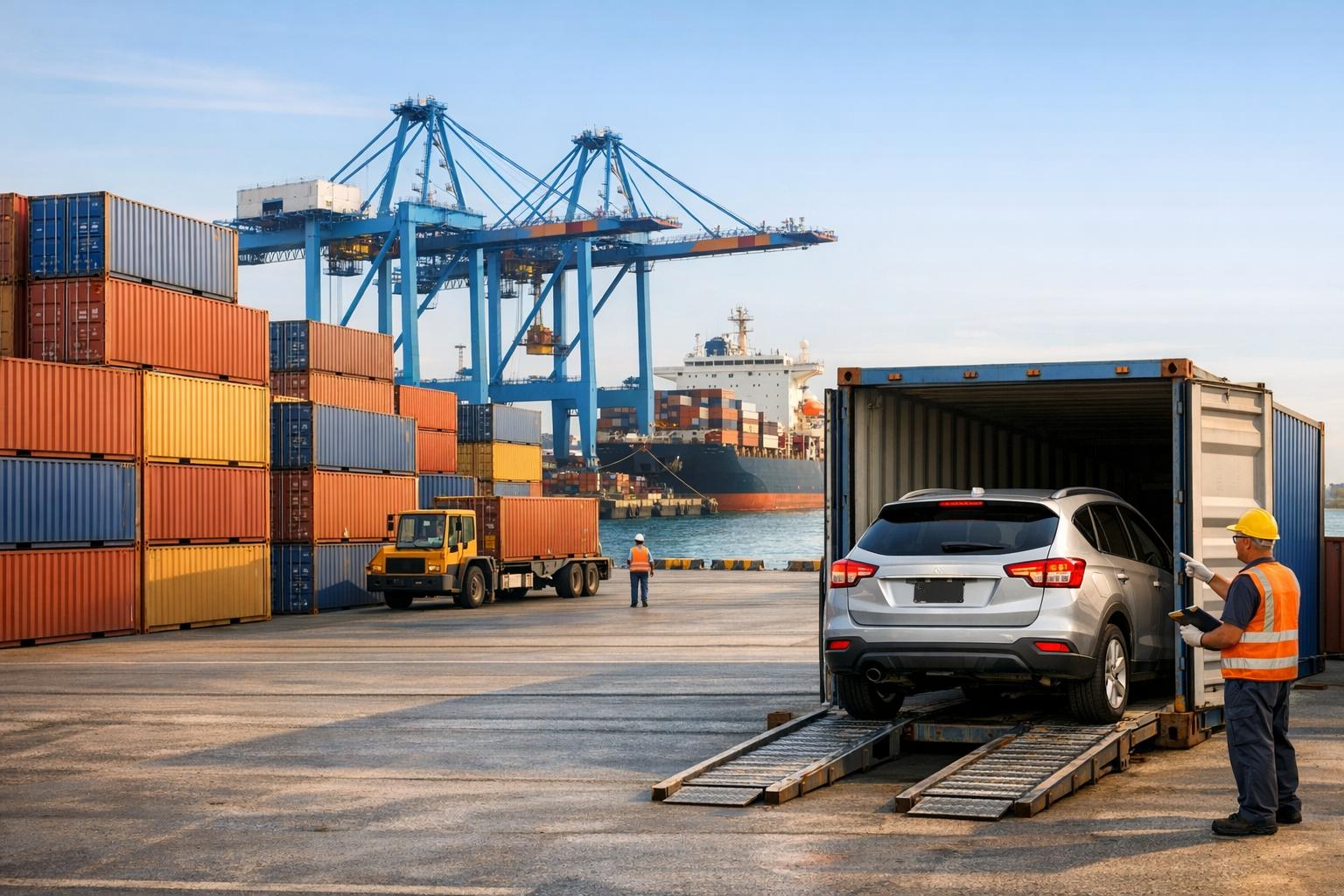
Importing a car into Kenya through Mombasa Port can save you money but requires following specific steps and rules. Here’s what you need to know:
- Eligibility: Vehicles must be right-hand drive (RHD) and no older than 8 years. For 2025, only cars from 2018 or later qualify.
- Pre-shipment Inspection: A KEBS-approved agent must inspect the car before shipping. Missing this step can result in a 20% penalty.
- Taxes and Duties: Expect to pay Import Duty (35%), Excise Duty (20-35%), VAT (16%), Import Declaration Fee (3.5%), and Railway Development Levy (2%). Electric and hybrid vehicles are VAT-exempt in 2025.
- Documents Required: Essential papers include the Bill of Lading, Commercial Invoice, Canceled Logbook, Import Declaration Form (IDF), KRA PIN Certificate, and Certificate of Roadworthiness.
- Process Timeline: Shipping takes 4-6 weeks, while customs clearance and registration typically require 7-14 working days.
Avoid common mistakes like importing left-hand drive vehicles, skipping inspections, or under-declaring the vehicle’s value. Work with licensed agents and ensure all documents are original to prevent delays. By planning ahead and adhering to regulations, you can enjoy a smooth importation process.

Car Import Process Kenya: 8 Steps from Selection to Registration
FROM JAPAN TO KENYA: I IMPORTED MY CAR AND SAVED A LOT OF MONEY
Required Regulations and Documents
This section outlines the key documentation and inspection requirements for importing vehicles into Kenya, building on the import regulations mentioned earlier.
Main Import Rules
To meet Kenyan import standards, the vehicle must be less than 8 years old from the date of first registration (for instance, in 2025, the vehicle should be from 2018 or later). Additionally, it must be a right-hand drive (RHD) vehicle, as per local road regulations. Left-hand drive vehicles are generally prohibited, with exceptions granted only for specialized vehicles like ambulances, fire trucks, or government construction vehicles. Ensuring compliance with these rules is the first step in the import process.
Pre-Shipment Inspection Requirements
Before shipping the vehicle, it must undergo a roadworthiness inspection by an agent approved by the Kenya Bureau of Standards (KEBS), such as Quality Inspection Services Japan (QISJ) or AA Japan. This inspection ensures the vehicle meets safety and environmental standards as outlined in KS1515:2000. Upon passing, a Certificate of Roadworthiness is issued, which is essential for customs clearance at Mombasa Port. Without this certificate, you may face penalties.
When negotiating with exporters, confirm that the terms of purchase include inspection by a KEBS-approved agent to avoid complications later.
Documents You Must Provide
To clear customs, you’ll need to prepare and submit original documents – scanned copies are not accepted. These include:
- Original Bill of Lading
- Commercial Invoice
- Canceled Logbook (with an English translation, if necessary)
Additionally, you must provide the Import Declaration Form (IDF), which should be applied for before the vehicle arrives, your KRA PIN Certificate for tax processing, and the Certificate of Roadworthiness from the pre-shipment inspection.
To streamline the process, hire a clearing agent licensed by the Kenya Revenue Authority (KRA). Lastly, ensure your vehicle exporter is a member of reputable organizations, such as the Japanese Used Motor Vehicle Exporters Association (JUMVEA), to guarantee the authenticity of the documents.
Step-by-Step Import Process
Selecting Your Vehicle
To import a vehicle into Kenya, it must be right-hand drive (RHD) and adhere to the country’s 8-year age limit. For instance, in 2025, only vehicles manufactured in 2018 or later will qualify. Popular choices for importers include the Toyota Harrier, Honda Fit, Subaru Forester, and Mazda. These models are favored for their dependability and the easy availability of spare parts locally.
Before committing to a purchase, use tools like CarVX to verify the vehicle’s auction history and mileage. This ensures the details align with the exporter’s claims. Additionally, confirm that the exporter is a member of the Japanese Used Motor Vehicle Exporters Association (JUMVEA). When negotiating Cost and Freight (C&F) terms, make sure the pre-shipment inspection fee is included, and verify that the inspection is conducted by a Kenya Bureau of Standards (KEBS)-approved agency.
Once you’ve selected your vehicle, you can proceed to arrange shipping.
Shipping and Pre-Arrival Steps
After paying the Cost, Insurance, and Freight (CIF) charges – typically split into a 50% deposit and a final payment – the exporter will arrange shipment to the port of Mombasa. Shipping times vary based on the origin: about 45 days from Japan or the UK, and up to 70 days from Australia. You’ll receive a draft Bill of Lading to confirm consignee details, which allows you to track your shipment on the Kenya Ports Authority (KPA) 14-day shipping list.
Before the ship docks, you’ll need to nominate a Container Freight Station (CFS) in Mombasa where your vehicle will be unloaded. Opt for a CFS offering a 15-day free storage period to avoid additional storage charges. It’s also essential to hire a KRA-licensed clearing agent and list them as the notify party on the Bill of Lading. This ensures they receive timely notifications about your vehicle’s arrival. Once the exporter receives full payment, they’ll send the original documents via DHL.
With these steps complete, you’ll be ready to move on to customs clearance and vehicle collection.
Customs Clearance and Getting Your Vehicle
When your vehicle arrives, your clearing agent will submit a customs entry through the Simba or iCMS systems once the manifest is available. You’ll then receive a KRA e-slip to pay duties and taxes, which can be settled via bank deposit or mobile money. The vehicle will undergo several verification checks, including KEBS quality inspection, clearance from the Radiation Protection Board (RPB), and Interpol/DCI verification to ensure it isn’t stolen. The customs process usually takes 7 to 14 working days.
Once the vehicle is cleared, you’ll need to register it through the NTSA eCitizen/TIMS portal to get your Kenyan logbook and license plates. This process costs roughly KSh 3,000. After addressing any outstanding port storage or CFS fees, you’ll receive a gate pass to collect your vehicle. To simplify things, consider setting up your NTSA account in advance.
sbb-itb-e5ed0ed
Import Costs and Tax Breakdown
What Is CIF Value?
CIF, which stands for Cost, Insurance, and Freight, represents the base value of your vehicle for tax purposes. This includes the purchase price, transit insurance, and shipping costs to Mombasa. However, the Kenya Revenue Authority (KRA) doesn’t always rely solely on your purchase price. Instead, they compare it to the Current Retail Selling Price (CRSP) – a standard benchmark value assigned to each vehicle model. Whichever value is higher becomes the taxable "Customs Value." From there, KRA applies a depreciation rate based on the vehicle’s age. For instance, under current rules, a 2018 model imported in 2025 qualifies for a 65% depreciation rate, while a 2019 model qualifies for a 60% rate.
Taxes and Duties Explained
Here’s how taxes and duties are calculated:
- Import Duty: This is 25% of the Customs Value.
- Excise Duty: Calculated on the combined total of Customs Value and Import Duty. The rate depends on the engine size and fuel type:
- 20% for engines under 1,500cc
- 25% for engines over 1,500cc
- 35% for petrol engines above 3,000cc or diesel engines over 2,500cc
- Electric vehicles benefit from a reduced rate of 10%.
- VAT: Charged at 16% on the total of Customs Value, Import Duty, and Excise Duty.
- Railway Development Levy (RDL): 2% of the Customs Value.
- Import Declaration Fee (IDF): 3.5% of the Customs Value.
In addition, standard registration costs are around KSh 13,000, and clearing agent fees are approximately KSh 15,000.
Example Cost Calculation
Let’s break this down with two examples:
- 2018 Toyota Harrier (2,000cc petrol)
- CRSP: KSh 5,506,050
- Depreciated Customs Value (65%): KSh 886,031
- Import Duty (25%): KSh 221,508
- Excise Duty (25%): KSh 276,885
- VAT (16%): KSh 221,508
- RDL: KSh 17,721
- IDF: KSh 22,151
- Registration Fee: ~KSh 13,000
- Total Duty: ~KSh 772,773.
- 2019 Toyota Land Cruiser Prado (2,800cc diesel)
- CRSP: KSh 9,100,000
- Depreciated Customs Value (60%): KSh 1,544,828
- Import Duty (25%): KSh 386,207
- Excise Duty (35%): KSh 675,862
- VAT (16%): KSh 417,103
- RDL: KSh 30,897
- IDF: KSh 54,069
- Registration Fee: ~KSh 13,000
- Total Duty: ~KSh 1,576,138.
| Vehicle Model | Customs Value | Import Duty | Excise Duty | VAT | RDL + IDF | Total Duty |
|---|---|---|---|---|---|---|
| 2018 Toyota Harrier (2000cc) | KSh 886,031 | KSh 221,508 | KSh 276,885 | KSh 221,508 | KSh 39,872 | KSh 772,773 |
| 2019 Toyota Land Cruiser Prado (2800cc) | KSh 1,544,828 | KSh 386,207 | KSh 675,862 | KSh 417,103 | KSh 84,966 | KSh 1,576,138 |
It’s crucial to ensure accurate tax payments, as underpaying can result in KRA penalties of up to 20% of the vehicle’s value. Always verify the CRSP for your specific car model before proceeding with the import process.
Tips and Mistakes to Avoid
Expected Timelines
When importing a car, timing is everything. Shipping from Japan typically takes about 4–6 weeks, while shipments from the UK or UAE usually arrive in 3–5 weeks. Once your car reaches Mombasa Port, the process moves to customs clearance and inspection. Here’s a general breakdown of what to expect:
- Arrival and customs clearance: 2–5 working days.
- Physical inspection and release: Another 3–5 working days.
- Final clearance and pickup: 1–3 working days.
- Customs clearance process: Around 7–14 working days.
- Number plate registration: After registration, plates arrive in 7–14 days.
To avoid unexpected costs like demurrage charges, it’s wise to budget extra time for any delays.
Common Mistakes to Avoid
Even with clear timelines, some missteps can derail the process. Here are the most frequent mistakes people make:
- Importing a left-hand drive (LHD) vehicle: In Kenya, LHD vehicles cannot be registered unless they’re for specialized government or emergency use.
- Violating the 8-year age limit: For instance, in 2025, only vehicles from 2018 or newer meet the requirement.
- Skipping pre-shipment inspection: Failing to get a KEBS-approved inspection (e.g., by QISJ or AA Japan) can result in hefty penalties.
- Under-declaring the vehicle’s value: Trying to reduce taxes this way can backfire, with Kenya Revenue Authority (KRA) imposing fines of up to 20% of the car’s total value.
- Using unlicensed agents: This often leads to scams and financial losses.
- Relying on scanned documents: Original documents like the Bill of Lading and Export Certificate are essential. Missing these can cause delays of up to a month at the port.
Avoiding these mistakes can save you from unnecessary stress and expenses.
Best Practices for Safe Importing
To streamline the process and ensure everything goes smoothly, follow these best practices:
- Verify your exporter: Make sure they are a member of the Japan Used Motor Vehicle Exporters Association (JUMVEA) and ask for references from at least three past customers.
- Work with licensed agents: Only use KRA-approved agents and pay taxes directly through the official e-slip system to avoid scams.
- Choose the right Container Freight Station (CFS): Opt for one that offers a generous free storage period (typically 15 days) to give yourself a buffer during the clearing process.
- Set aside a contingency budget: Be prepared for miscellaneous fees, such as radiation charges (~KSh 1,000) and delivery order fees (~KSh 10,000).
- Set up your NTSA account early: This can help avoid delays in the registration process.
- Verify auction history: Services like CarVX are great for checking the auction history of Japanese vehicles. Ensuring the mileage matches the auction sheet can help you avoid cars with hidden damage, a problem that affects roughly 30% of imported vehicles.
Conclusion
This guide has outlined the steps to ensure a hassle-free car importation process through Mombasa Port. To begin, make sure your vehicle meets the Right-Hand Drive (RHD) and 8-year age limit regulations.
Work only with licensed professionals to avoid unnecessary delays and potential scams. Confirm that your exporter is registered with the Japanese Used Motor Vehicle Exporters Association (JUMVEA) and that your clearing agent holds a valid license from the Kenya Revenue Authority (KRA). Be cautious with brokers – unlicensed operators are often linked to import-related fraud.
Before your car arrives, secure original documents like the Bill of Lading, Export Certificate, and Pre-Shipment Inspection Certificate. Depending on scanned copies can lead to delays of up to a month or more at the port. The complete process, from shipping to registration, usually takes 7–14 working days . Budgeting is critical, as import costs can vary widely.
Taxes and duties on imported vehicles typically range between 45% and 65% of the car’s value. Use the KRA Vehicle Duty Calculator to estimate these costs accurately, and always pay duties through official e-slip channels to avoid fraud. If you’re considering an electric or hybrid vehicle, keep in mind the VAT exemptions available in 2025, which could save you over KSh 300,000. Careful planning and adherence to these guidelines will make the process smoother and more cost-effective.
FAQs
What happens if you miss the pre-shipment inspection when importing a car to Kenya?
If you fail to complete the necessary pre-shipment inspection when importing a car to Kenya, you could encounter serious problems and hefty penalties. While the exact fines for skipping this inspection aren’t clearly outlined, general customs violations within the East African Community can lead to penalties of up to $5,000. Beyond the financial hit, your vehicle might be refused entry at the port or subjected to extra inspections and delays, which can pile on additional costs.
To steer clear of these headaches, make sure your car undergoes the required pre-shipment inspection and fully adheres to Kenyan import regulations before shipping.
How can I find a trustworthy car importer for Kenya?
To make sure your car importer is trustworthy and follows Kenyan regulations, here are some important steps to take:
- Verify trade affiliations: Look for an importer who is a member of a respected organization like the Japanese Used Motor Vehicle Exporters Association (JUMVEA). Membership often indicates adherence to industry rules and practices.
- Review their history: Check for recent customer feedback, either through references or online reviews. A solid track record of successful car shipments to Kenya is a strong indicator of reliability.
- Insist on pre-shipment inspections: Confirm that the vehicle is inspected by a KEBS-approved agent, such as QISJ or AA Japan. Always request a copy of the inspection certificate as proof.
- Ensure original documentation: Accept only original shipping documents, including the Bill of Lading, an export certificate translated into English, and the inspection certificate. Be cautious of scanned copies, as they can be unreliable.
- Choose secure payment options: Set clear payment terms, such as a 50% deposit made through a secure method like Telegraphic Transfer (TT). Avoid cash payments or any untraceable transactions.
By following these steps, you can minimize risks and ensure you’re working with a dependable car importer.
What mistakes should I avoid when importing a car through Mombasa Port?
When bringing a car into Kenya through Mombasa Port, several common mistakes can derail the process, often due to inadequate preparation or missing documentation. One major pitfall is failing to confirm the vehicle’s eligibility. Kenya enforces strict rules, such as an eight-year age limit for used cars and a requirement for right-hand-drive vehicles. Overlooking these regulations can lead to customs delays or outright rejection of the vehicle.
Another critical step is choosing trustworthy exporters. Always verify that the exporter is affiliated with reputable organizations to minimize the risk of fraud or receiving a vehicle that doesn’t meet Kenyan standards.
A frequent misstep is neglecting the importance of hiring a licensed clearing agent. Attempting to handle customs declarations on your own can lead to costly errors, like incorrect duty calculations or incomplete paperwork. These mistakes can result in penalties or prolonged delays. Additionally, make sure you have all the original documents on hand, such as the Bill of Lading and pre-shipment inspection reports, as customs will not accept scanned copies.
Lastly, many importers fail to account for taxes, fees, and storage costs. Beyond import duties, you’ll need to budget for other expenses, and remember that container freight stations typically offer a 15-day free storage period. Proper planning and thorough checks can help you avoid unnecessary costs, delays, and headaches.
Related Blog Posts
- FAQ: Importing Used Cars to Kenya in 2025
- Importing a car to Kenya: costs & taxes
- Import a Car from Japan to Kenya: Costs, Duties, and How to Avoid Scams
- Car import duties in Kenya: Full guide to KRA fees and clearance