In 2026, deciding between Japanese imports and local used cars in Kenya comes down to cost, condition, and convenience. New regulations now only allow the import of vehicles registered from January 1, 2019, onward, making imports more expensive and limiting options. Local used cars, on the other hand, avoid import duties and are immediately available but often come with higher mileage and wear from Kenyan roads.
Key Takeaways:
- Japanese Imports: Higher upfront costs, better condition, lower mileage, advanced features, but longer wait times and complex import processes.
- Local Used Cars: Cheaper upfront, readily available, suited for Kenyan roads, but higher mileage and potential hidden issues.
Quick Comparison:
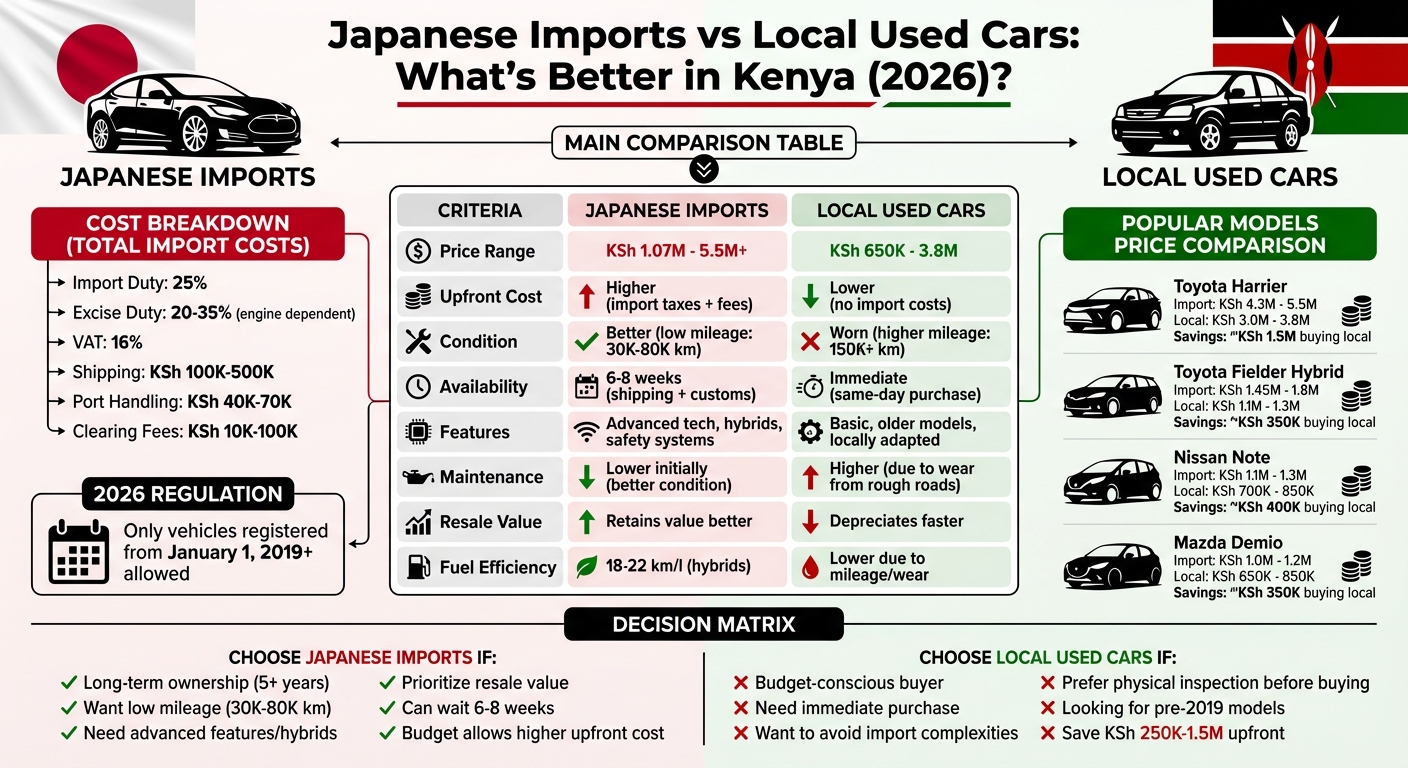
| Criteria | Japanese Imports | Local Used Cars |
|---|---|---|
| Price | Higher (import taxes, fees) | Lower (no import costs) |
| Condition | Better (low mileage) | Worn (higher mileage) |
| Availability | 6–8 weeks (shipping) | Immediate purchase |
| Features | Advanced tech, hybrids | Basic, older models |
| Maintenance | Lower initially | Higher due to wear |
| Resale Value | Retains value better | Depreciates faster |
If you’re looking for long-term reliability and modern features, imports are worth the investment. For budget-friendly and immediate needs, local used cars are a practical choice.
Japanese Imports vs Local Used Cars in Kenya 2026: Complete Comparison Guide
TOP TEN CARS THAT SAVE YOU MONEY WHEN YOU IMPORT DIRECTLY FROM JAPAN
Japanese Imported Cars Explained
Japanese imported cars are vehicles sourced directly from Japan, often through online auctions or authorized exporters, and then shipped to Kenya. Unlike locally used cars that have already been driven on Kenyan roads, these imports come with detailed maintenance records. Auction sheets document the car’s condition, mileage, and accident history, providing buyers with a clear picture of what they’re purchasing. These records also note any scratches, dents, or mechanical issues, offering a level of transparency that many buyers find reassuring.
One of the main reasons Kenyan buyers favor Japanese imports is their generally lower mileage and better maintenance compared to local options. Thanks to Japan’s stringent inspection standards, these cars often arrive in excellent condition. Additionally, importing vehicles from Japan gives buyers access to a broader range of models, colors, trims, and advanced features, such as hybrid technology, which may not be available through local dealerships.
However, the import process isn’t without its challenges. Shipping a vehicle from Japan to Mombasa usually takes 41 days to 8 weeks. On top of that, Kenya’s import tax structure can be complex, with costs including a 25% import duty, 20–35% excise duty (depending on engine size), 16% VAT, and other fees. Hybrid and electric vehicles enjoy reduced excise duty rates of 10–20%, which can make them more appealing. These factors make importing a car more complicated than simply buying one locally.
New regulations by the Kenya Bureau of Standards (KEBS) add another layer of complexity. Imported vehicles must now be first registered on or after January 1, 2019, effectively banning older models like the 2018 Toyota Harrier. Additionally, buyers must secure a Certificate of Roadworthiness, which comes with a KSh 12,000 fee.
Benefits of Japanese Imports
Japanese imports offer several advantages, even if their upfront costs are higher. For starters, these vehicles often have significantly lower mileage – typically between 30,000 and 60,000 kilometers – compared to local cars, which may have racked up 150,000 kilometers or more. This translates to fewer mechanical problems and a longer lifespan.
Another key advantage is the availability of modern features. Many imported cars come equipped with advanced safety systems like Anti-lock Braking Systems (ABS), high-end infotainment systems, navigation options, and driver-assistance technologies. Hybrid models, such as the Toyota Fielder Hybrid, stand out for their impressive fuel efficiency (18–22 km/l) and reduced excise duties.
The reliability of these vehicles is well-documented, with popular models like the Toyota Vitz (landed cost around KSh 1.07 million), Toyota Harrier (KSh 3.64 million to KSh 4.3 million), and Toyota Prado (approximately KSh 4.7 million) being prime examples.
Drawbacks of Japanese Imports
While Japanese imports have their perks, they also come with notable drawbacks. Import duties can significantly increase the total cost of a vehicle. For instance, a 2018 Toyota Harrier with a CIF value of KSh 2.5 million in Japan could end up costing around KSh 4,328,218 after adding a 25% import duty, 25% excise duty (for engines above 1,500cc), 16% VAT, and other fees.
Shipping delays are another issue, with delivery times ranging from 6 to 8 weeks. Additionally, buyers need to hire a licensed clearing agent to handle port documentation, which can lead to added expenses. If there are delays, demurrage fees and port handling charges – ranging from KSh 40,000 to KSh 70,000 – can quickly pile up.
The table below highlights the cost differences and features of some popular Japanese imports compared to their local equivalents.
Cost Comparison Table
| Model | Estimated Import Cost (Landed) | Typical Mileage | Key Features | Local Equivalent Price |
|---|---|---|---|---|
| Toyota Vitz | KSh 1.07M+ | 30,000–50,000 km | High fuel efficiency (18–22 km/l); 1,000–1,300cc engine; compact for city driving | KSh 800K–950K |
| Toyota Harrier | KSh 3.6M–4.3M | 40,000–70,000 km | Luxury SUV; hybrid options; advanced safety tech; premium trims | KSh 2.8M–3.2M |
| Toyota Prado | KSh 4.7M+ | 50,000–80,000 km | 4WD capability; high ground clearance; strong resale value | KSh 3.5M–4.2M |
| Toyota Fielder Hybrid | KSh 1.44M | 35,000–55,000 km | Excellent fuel economy; lower excise duty (10–20%); versatile for family or commercial use | KSh 1.1M–1.3M |
Local Used Cars Explained
Local used cars are pre-owned vehicles that have been registered and driven within Kenya, bypassing the costs and complexities of shipping and customs fees. These cars are sold through various channels and are not subject to the strict age restrictions imposed on imported vehicles. For instance, as of 2026, only cars first registered on or after January 1, 2019, can be imported into Kenya. However, there are no such limitations for buying or selling locally used cars.
The market for locally used cars has seen notable growth. Many buyers are opting for these vehicles to avoid the rising costs associated with imports. Factors like the revised CRSP (Current Retail Selling Price) list, which increases import taxes starting in July 2025, and the weakening Kenyan shilling have made foreign purchases less appealing. This trend has particularly attracted first-time buyers and those shopping on a budget.
"Locally used vehicles are becoming an attractive alternative to imported units… you can find a clean, well-maintained unit for far less than an imported equivalent." – James Mwangi, Tips Contributor, Automag Kenya
Another reason for the growing interest in local used cars is their suitability for Kenya’s driving conditions. Many of these vehicles already feature modifications like enhanced ground clearance or tires designed for tropical climates, making them better equipped for local roads. In contrast, imports often arrive with features tailored to colder climates, which may not perform as well in Kenya. Additionally, transferring ownership of a local vehicle is straightforward, with NTSA transfer fees ranging from KSh 1,660 for smaller engines (up to 1,000cc) to KSh 5,915 for larger engines (above 3,000cc).
That said, buyers should be aware of the higher mileage often associated with locally used cars. For example, a 2015 Suzuki Wagon R sold locally had 321,000 km on the odometer, compared to a 2018 imported model with just 121,000 km. Kenya’s challenging road conditions – marked by potholes and rough terrain – also contribute to faster wear and tear on key components like suspension systems, tires, and brakes.
Benefits of Local Used Cars
Local used cars come with several advantages, particularly for buyers navigating Kenya’s unique road and market conditions. One major benefit is their immediate availability. Unlike imported cars, which can take 41 days to 8 weeks to arrive and clear customs, local cars offer same-day convenience. You can inspect, test drive, and purchase a car, driving it home on the same day without worrying about shipping delays or added costs.
Another key advantage is the ability to physically inspect and test drive the vehicle before making a purchase. This hands-on approach ensures you can assess the car’s condition, identify any mechanical issues, and even consult a trusted mechanic for a professional opinion [6,3]. You can test the brakes on different road surfaces, listen for unusual engine noises, and get a clear picture of the car’s overall performance [17,18].
Local used cars also save buyers from the hassle of customs paperwork. There’s no need to navigate complex import duties, VAT, or port clearance procedures. Instead, the transfer process is handled through the NTSA TIMS portal, making it more straightforward. Financing can also be simpler, as many Kenyan banks are more willing to provide loans for vehicles already in the country, avoiding the need for specialized import financing. Additionally, since these vehicles have already experienced the steepest depreciation – about 55% in the first three years – they tend to be a more stable option for short-term ownership.
Drawbacks of Local Used Cars
Despite their advantages, locally used cars come with some challenges. High mileage and wear due to Kenya’s rough road conditions are common. Potholes, uneven surfaces, and poor infrastructure take a toll on suspension systems, tires, and brakes, leading to faster deterioration. Another concern is odometer fraud and hidden mechanical issues. Unlike Japanese imports, which often include detailed auction sheets, local vehicles may have altered odometers or undisclosed accident histories. To avoid these pitfalls, buyers should verify a car’s details – such as ownership history, tax compliance, and mileage – using the NTSA TIMS portal or SMS service.
Legal issues can also arise with local used cars. Some vehicles may have unresolved loans, such as "logbook loans", which can lead to ownership disputes. It’s essential to ensure the seller’s name matches the ID on the logbook and to confirm there are no outstanding financial obligations.
Insurance is another consideration. Many Kenyan insurers are hesitant to offer comprehensive coverage for older vehicles, particularly those over 10–12 years old or valued at less than KSh 600,000.
sbb-itb-e5ed0ed
Japanese Imports vs Local Used Cars: Side-by-Side Comparison
Let’s stack Japanese imports against locally used cars on the factors that matter most to Kenyan buyers in 2026.
Price and Affordability
The 2026 regulations have made importing cars more expensive, with costs piling up from shipping (KSh 100,000–500,000), port handling (KSh 40,000–70,000), clearing fees (KSh 10,000–100,000), and taxes that range between 45% and 65% of the car’s value. These taxes include Import Duty (25%), Excise Duty (20–35%, depending on engine size), VAT (16%), and other levies[3, 10].
Local used cars avoid these import-related costs. Buyers only pay the sticker price and a small NTSA transfer fee. The 2026 rule – restricting imports to vehicles registered from January 1, 2019, onward – has further inflated import prices. This makes pre-2019 locally available models a more budget-friendly choice, potentially saving buyers over KSh 250,000.
| Model | Japanese Import (2019+ Models) | Locally Used (Varies by Year) |
|---|---|---|
| Toyota Harrier | KSh 4,300,000 – 5,500,000 | KSh 3,000,000 – 3,800,000 |
| Toyota Fielder Hybrid | KSh 1,450,000 – 1,800,000 | KSh 1,100,000 – 1,300,000 |
| Toyota Axio | KSh 1,500,000+ | KSh 950,000 – 1,200,000 |
| Nissan Note | KSh 1,100,000 – 1,300,000 | KSh 700,000 – 850,000 |
| Mazda Demio | KSh 1,000,000 – 1,200,000 | KSh 650,000 – 850,000 |
These price differences naturally lead us to consider maintenance costs and parts availability.
Maintenance Costs and Parts Availability
Japanese imports often come with lower mileage and well-documented service records. Meanwhile, locally used cars have already been tested on Kenyan roads, sometimes featuring modifications like raised ground clearance to handle rough conditions. However, Kenya’s challenging roads can speed up wear and tear on key components like suspension, brakes, and engines, which may result in higher repair bills over time.
For brands like Toyota, Nissan, and Mazda, spare parts are widely accessible and relatively affordable[17, 20]. Toyota stands out for its extensive parts availability in local shops.
"A car driven on Kenyan roads is likely to have undergone more wear and tear than a foreign-used car that’s driven on typically better maintained roads abroad." – Charity Nyawira, Finance Writer
This brings us to how these cars handle fuel efficiency and road performance.
Fuel Efficiency and Road Performance
Japanese imports, especially hybrids like the Toyota Fielder, Harrier, and Honda Freed, are known for their fuel efficiency thanks to modern engine technology. They also benefit from lower excise duty rates (10–20%) designed to encourage eco-friendly vehicles. However, some imports arrive with winter tires that aren’t suited for Kenyan roads, requiring an early replacement. Additionally, their factory-standard ground clearance may be inadequate for Kenya’s rough roads, often necessitating aftermarket adjustments.
On the other hand, locally used cars are already equipped with tires and suspension systems tailored to Kenyan conditions. While their fuel efficiency might have dipped due to higher mileage and wear, they’re ready to handle local terrain without additional modifications.
Resale Value
Resale value is another area where these two options differ. Japanese imports tend to retain their value better, thanks to their lower mileage and better overall condition. Models like the Toyota Vitz and Toyota Corolla are especially valued for their reliability and strong resale performance[17, 8].
Locally used cars, while cheaper upfront, generally depreciate faster. High-end imports like BMW or Audi see even steeper value drops, as their maintenance costs rise with mileage.
| Model | Resale Value Retention | Primary Reason |
|---|---|---|
| Toyota Vitz | High | Popular model with widely available parts[17, 8] |
| Toyota Corolla | High | Reliable and easy to maintain |
| Mazda Demio | Moderate-High | Stylish with good fuel economy |
| Honda Fit | Moderate | Spacious but parts can be pricier |
| High-end (BMW/Audi) | Lower | High maintenance costs with mileage |
Which Option Is Better in 2026?
When deciding in 2026, your choice will come down to your budget, timeline, and what you value most in a car.
Japanese imports are ideal for long-term ownership. If you’re planning to keep the car for more than five years, these vehicles are worth the higher upfront cost. With a solid maintenance history, minimal wear-and-tear, and higher auction grades (often Grade 4 or 4.5), they offer better reliability over time. Plus, they typically retain more resale value. They’re a great pick if you’re after premium trims, advanced safety features, or better fuel efficiency – features that may not be as accessible locally. Just remember to set aside an extra 10% for minor fixes, registration, or any necessary modifications.
Locally used cars are the go-to for budget-conscious buyers. If you need a car quickly and want to avoid extra costs like import duties, port charges, and clearing fees, this is the way to go.
"If you’re on a budget or want to avoid unpredictable costs at the port, a locally used car may offer better value in 2025." – James Mwangi, Tips Contributor, Automag Kenya
These cars are ready for immediate inspection and purchase, already suited to Kenyan roads, making them a practical and economical choice.
FAQs
What makes Japanese imports a better option than local used cars in Kenya?
Japanese-imported cars come with several perks that make them a popular choice in Kenya. One standout benefit is their excellent condition upon arrival. Thanks to Japan’s strict auction standards and thorough inspections, these vehicles often have lower mileage and are well-maintained. They also tend to feature modern amenities, such as advanced safety systems and enhanced comfort – features that are harder to find in older, locally used models.
Another major plus is their reliability and fuel efficiency. These cars are built to last and often demand less maintenance over time. Plus, their high-quality construction helps them maintain strong resale value, making them a smart investment. Buyers also gain access to a broader range of makes and trims, including newer or rare models that aren’t readily available in the local market. Even with import fees, these benefits make Japanese imports an attractive and practical choice for many.
How will the 2026 import rules impact the cost and availability of Japanese cars in Kenya?
Starting January 1, 2026, the Kenya Bureau of Standards (KEBS) will introduce new regulations impacting the importation of used vehicles, including popular Japanese models. While the eight-year age limit remains unchanged – allowing only cars first registered in 2018 or later – new compliance measures will tighten the process. Every shipment will now require stricter checks and mandatory Certificates of Conformity, making it harder to import older, budget-friendly options like Toyota Corollas or Nissan Almeras. This change is expected to significantly reduce the availability of affordable Japanese cars.
Adding to the challenge, import taxes and fees are notably high. Buyers must navigate duties of up to 35% of the car’s CIF (Cost, Insurance, and Freight) value, excise taxes ranging from 20–25% based on engine size, a 16% value-added tax, and additional levies for railway development and import declarations. When combined, these charges often surpass 200% of the car’s CIF value. For Kenyan buyers, the result is clear: fewer affordable choices and steeper costs for imported vehicles in 2026.
What factors should buyers consider when choosing between Japanese imports and locally used cars in Kenya?
When choosing between Japanese imports and locally used cars, it’s essential to consider factors like upfront costs, resale potential, maintenance requirements, and how well the car suits Kenyan roads.
Japanese imports often stand out for their lower mileage, advanced features, and slower depreciation rates, which can make them a worthwhile long-term choice. However, they come with higher initial expenses due to import duties, shipping charges, and the risk of hidden issues like undisclosed accident damage.
On the other hand, locally used cars are generally more budget-friendly and offer the advantage of in-person inspection before purchase. That said, they often have higher mileage, more wear and tear, and less reliable service records, which can lead to quicker depreciation and higher maintenance bills. While spare parts are available for both options, Japanese imports in better condition typically demand fewer repairs.
To make the best decision, buyers should factor in their budget, how long they plan to keep the car, and Kenya’s changing tax regulations to find the option that delivers the most value over time.
Related Blog Posts
- Car prices in Nairobi 2025
- Car Prices in Kenya in 2025: Full Market Guide
- Why Car Prices in Kenya Are Changing in 2025
- New vs Used Cars in Kenya: What You’ll Pay in 2025