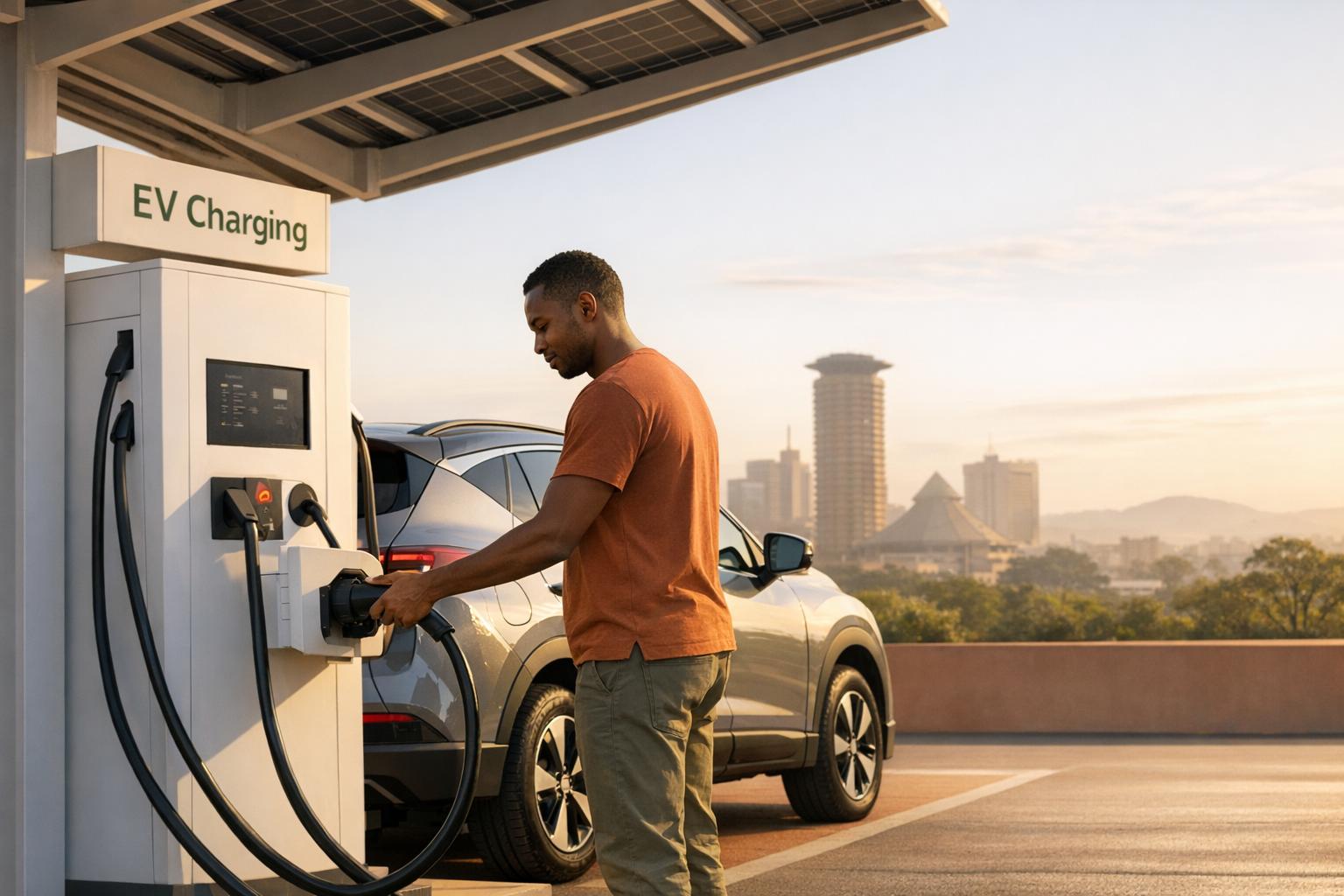
Electric vehicles (EVs) are becoming more popular in Kenya, with registered EV numbers growing from 2,694 in 2023 to 9,047 by May 2025. This surge is driven by government tax breaks, expanding charging networks, and lower running costs compared to gas-powered cars. Here’s what you need to know:
- Tax Benefits: Zero import duty, VAT exemptions, and lower excise duties make EVs more affordable than traditional cars.
- Charging Infrastructure: Over 200 public charging stations as of early 2025, with plans for 10,000 by 2030. Home chargers cost $375–$1,125 to install.
- Cost Savings: Charging is 30–50% cheaper than refueling with petrol. Maintenance costs are also lower due to fewer moving parts.
- Available Models: Budget options include used Nissan Leafs ($8,000–$11,300) and Renault Zoes ($12,000–$14,700). High-end models like the Hyundai Kona ($25,000–$30,000) offer longer ranges.
Whether you’re looking for affordability or premium features, Kenya’s growing EV market offers options to suit different budgets and needs.
Training Africa’s EV Technicians: How Kenya is Preparing For E-Mobility Future
Electric Vehicle Models Available in Kenya
To make an informed decision about electric vehicles (EVs) in Kenya, it’s important to know what models are available. The Kenyan EV market is essentially split into two groups: affordable second-hand imports – mainly from Japan and the UK – and newer premium models from Chinese and international brands. Most EVs in Kenya are equipped with the CCS2 port, which supports both AC and DC charging. However, real-world driving conditions in Kenya, such as Nairobi’s traffic, hilly terrain, and frequent air conditioning use, can reduce the range by 15–20% compared to official WLTP estimates.
If you’re considering a second-hand EV, it’s crucial to check the battery’s State of Health (SOH). Ideally, aim for an SOH of 85% or higher to ensure good performance. Below is a breakdown of available EV models, categorized by price and performance.
Budget-Friendly EVs
For those shopping on a budget, used Nissan Leafs are a popular choice, typically priced between KSh 1.2M and 1.7M. These compact cars offer a practical range of 150–270 km (93–168 miles), making them ideal for daily commutes within cities like Nairobi or Mombasa. Another affordable option is the Renault Zoe, which costs around KSh 1.8M–2.2M and provides a slightly better range of 250–300 km (155–186 miles) along with a more modern interior.
Chinese micro-EVs are also entering the Kenyan market. The Wuling Mini EV, designed as a budget-friendly city car, is expected to launch soon, though pricing has not yet been confirmed. On the lower end of the price spectrum, the Toyota C+Walk T, a micro-EV optimized for short neighborhood trips, starts at just KSh 544,402.
High-End and Long-Range EVs
For buyers with more flexibility in their budget, there are models offering greater range and advanced features. The BYD Dolphin, priced between KSh 2.5M and 4.0M, delivers a range of 300–400 km (186–249 miles) and comes with a sleek, modern design. Another solid option is the MG ZS EV, which costs between KSh 2.9M and 3.5M, although its range is not explicitly stated.
Stepping up to long-range EVs, the Hyundai Kona Electric offers over 450 km (280 miles) of range and is priced at KSh 3.5M–4.2M. For those seeking luxury, the Aion LX Plus stands out with an incredible range of 1,000 km (621 miles), though its pricing is not yet available. The Tesla Model 3, another premium option, is available in Kenya but comes with a hefty price tag of over KSh 10M. High-end models like these are packed with premium features, including advanced driver-assistance systems, larger touchscreens, and faster charging capabilities. These differences in range and technology can significantly affect long-term value, a topic that will be discussed further in the cost of ownership section.
| Model | Category | Est. Price (KSh) | Approx. Range (km) |
|---|---|---|---|
| Nissan Leaf (Used) | Budget/City | 1.2M – 1.7M | 150 – 270 |
| Renault Zoe (Used) | Budget/City | 1.8M – 2.2M | 250 – 300 |
| BYD Dolphin | Mid-Range | 2.5M – 4.0M | 300 – 400 |
| MG ZS EV | Mid-Range | 2.9M – 3.5M | Range not specified |
| Hyundai Kona Electric | Long-Range | 3.5M – 4.2M | 450+ |
| Aion LX Plus | High-End | Range not specified | 1,000 |
Charging Infrastructure and Power Supply
Kenya’s public charging network has seen impressive growth, expanding from 67 stations in 2023 to over 200 by early 2025. The government has set an ambitious goal of reaching 10,000 stations by 2030. In May 2025, Kenya Power (KPLC) allocated KSh 258 million ($1.9 million) to install 45 charging stations across key areas, including Nairobi, Nyeri, Kisumu, Eldoret, Nakuru, Mombasa, and Taita Taveta counties, with a 12-month completion timeline. These stations cater to both AC and DC charging needs.
The network is no longer confined to urban areas. Charging points now line major highways to Nakuru, Mombasa, and Nanyuki, meeting government guidelines that suggest stations every 25 km (15.5 miles) to ease range anxiety. Public chargers can be found in locations like shopping malls (Sarit Centre, Two Rivers, The Hub Karen), hotels such as Mövenpick, and office buildings including KCB Towers and Britam Towers. Apps like PlugShare, AEMP, and ChargeNet make it easy for drivers to locate available charging stations in real time. Together, these developments address both urban and highway charging needs, as outlined below.
Public Charging Stations in Kenya
With the expanding network, public charging stations now offer competitive and standardized pricing. EPRA-approved tariffs are set at KSh 16 per kWh during peak hours and KSh 8 per kWh off-peak. While most providers charge per kilowatt-hour, some DC fast chargers opt for per-minute pricing or flat session fees. Charging an EV is 30% to 50% cheaper than refueling a comparable gasoline vehicle. The system uses the Open Charge Point Interface (OCPI) protocol, enabling drivers to access multiple charging networks with a single account.
However, grid reliability remains a concern, especially during scheduled power outages. To mitigate this, Kenya issued its first solar-to-charging station license in 2023. Many operators are incorporating Battery Energy Storage Systems (BESS) to maintain service during outages. Additionally, smart charging technology helps by scheduling charging sessions during off-peak hours, reducing strain on the grid. For commercial vehicles and two-wheelers, battery-swapping stations are becoming more popular. Companies like BasiGo are leading the way, with 16 electric bus charging depots planned along major transport routes in Nairobi by September 2025.
Installing a Home Charging Station
For EV owners, installing a Level 2 home charger is a convenient way to ensure a full battery every morning. Installation costs typically range from KSh 50,000 to KSh 150,000 ($375–$1,125), depending on your home’s electrical setup and the charger model you choose. It’s important to hire a qualified electrician to confirm your wiring is compatible with Kenya’s 240V, 50Hz power supply. A Level 2 charger can fully charge most EVs in 4–8 hours, making it easy to take advantage of off-peak electricity rates of KSh 8 per kWh.
As of 2025, charging equipment and batteries are exempt from VAT, reducing costs for consumers. The 2024 National Building Code also requires that 5% of parking spaces in new commercial and multi-dwelling buildings be designated for EV charging. For homes that experience frequent power outages, combining solar panels with your charging setup can ensure a reliable power supply. When selecting a charger, make sure it matches your EV’s connector type – Type 2 connectors are the standard for most models.
Government Incentives and Policies for EV Buyers
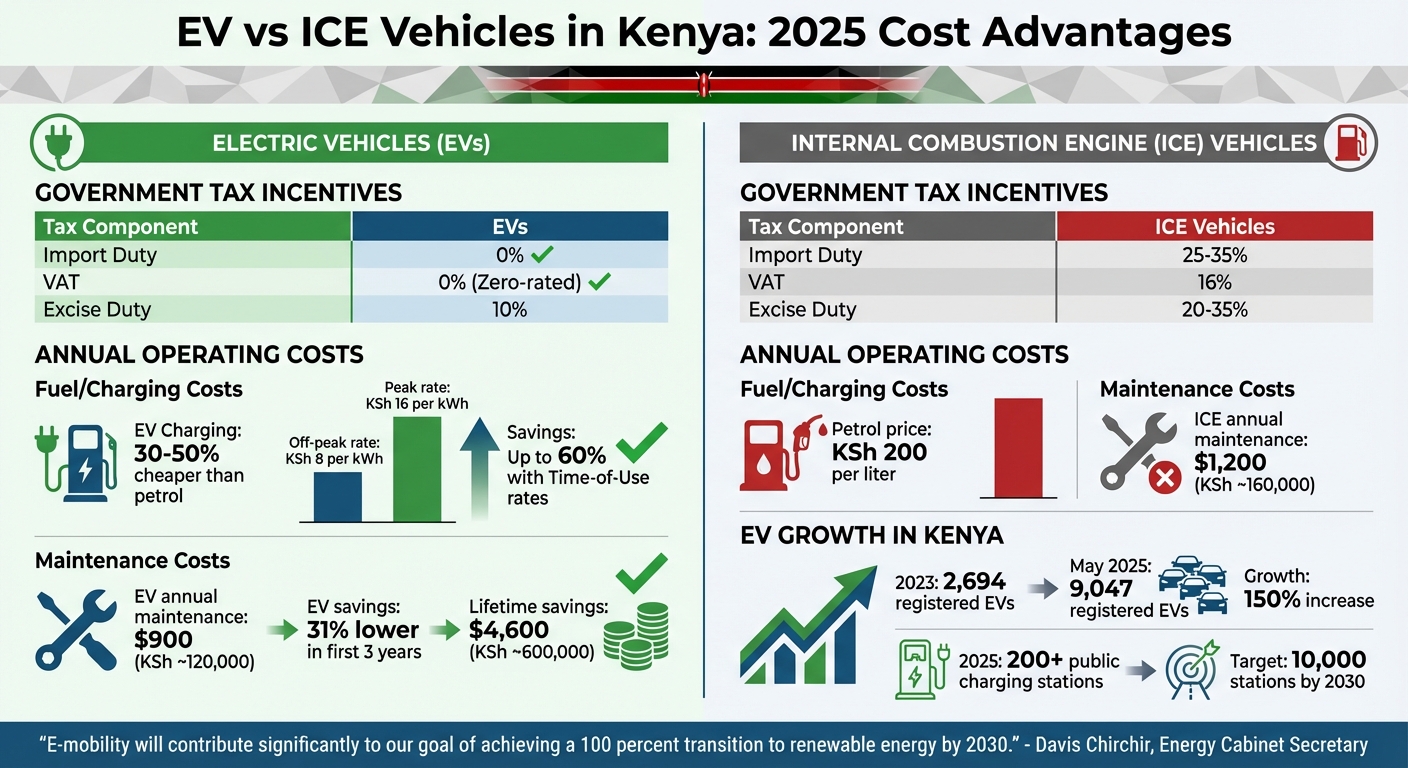
EV vs Gas Car Costs in Kenya: Tax Rates and Savings Comparison 2025
Kenya has implemented a range of tax incentives to make electric vehicles (EVs) a more attractive option compared to traditional gas-powered cars. For starters, the government has eliminated import duties on fully assembled EVs, setting the rate at 0%, whereas internal combustion engine (ICE) vehicles face a 25%–35% duty rate.
On top of that, EVs are zero-rated for VAT, meaning buyers avoid the standard 16% VAT charged on gas-powered vehicles. Excise duty for EVs is also significantly lower at 10%, compared to the 20%–35% applied to ICE vehicles.
| Tax Component | Rate for EVs | Rate for ICE Vehicles |
|---|---|---|
| Import Duty | 0% | 25%–35% |
| VAT | 0% (Zero-rated) | 16% |
| Excise Duty | 10% | 20%–35% |
These tax breaks are already making an impact. EV registrations have surged, and the groundwork is being laid for local manufacturing. Businesses are also benefiting from a reduced 15% corporate tax rate (down from 30%) for the first five years if they establish new EV assembly plants. This policy has already borne fruit, with a $150 million (KSh 19.37 billion) EV assembly plant opening in Naivasha in October 2025. The government has further bolstered the sector by allocating $102 million from a Japanese "Samurai loan" to support domestic production of EVs and spare parts.
"E-mobility will contribute significantly to our goal of achieving a 100 percent transition to renewable energy by 2030." – Davis Chirchir, Energy Cabinet Secretary
The results speak for themselves. Between 2023 and 2024, EV registrations nearly doubled, and by May 2025, Kenya had 9,047 registered electric vehicles – a staggering 150% increase from the previous year. The government is aiming for EVs to make up 5% of all annual vehicle registrations by 2025, with a long-term goal of 100% adoption by 2040. These incentives, paired with the cost savings EVs offer, are set to reshape vehicle ownership in Kenya.
sbb-itb-e5ed0ed
Cost of Ownership: EVs vs. Gas Cars
Government incentives make electric vehicles (EVs) more appealing, but the real advantage lies in their operational costs. When you look beyond the upfront price tag, EVs deliver noticeable long-term savings. Let’s break down the costs of fueling and maintenance to see why EVs come out ahead.
Electricity Costs vs. Fuel Costs
Charging an EV is significantly cheaper than filling up a gas tank – about 30–50% less, to be exact. With petrol prices in Kenya often hitting KSh 200 per liter, the savings become even more apparent. To encourage EV adoption, the Energy and Petroleum Regulatory Authority (EPRA) has introduced e-mobility tariffs: KSh 16 ($0.12) per kWh during peak hours and KSh 8 ($0.058) per kWh during off-peak times. If you charge your EV overnight using Kenya Power’s Time-of-Use rates, you could save up to 60% compared to standard electricity rates. These savings can add up quickly over the course of a year.
Lower Maintenance and Repair Costs
The financial perks of owning an EV don’t stop at fueling costs. Maintenance is another area where EVs shine. Unlike gasoline engines, which have over 2,000 moving parts, EVs operate with just about 20. This simplicity eliminates the need for routine services like oil changes, spark plug replacements, and transmission fluid checks. In fact, maintenance costs for EVs are 31% lower during the first three years of ownership.
A 2020 study revealed that maintaining an EV costs around $900 annually, compared to $1,200 for a gasoline vehicle. Over a vehicle’s lifetime, this translates to an average savings of $4,600.
"Typically, electric vehicles require less maintenance than their regular counterparts… primarily because they have fewer fluids and fewer moving parts that need checking."
- Zach Wimpey, Operations Manager, Craig and Landreth Cars
EVs also benefit from regenerative braking, which helps extend the life of brake pads. The main upkeep tasks include tire rotations, cabin air filter changes, and occasional checks on brake fluid and battery health. However, it’s worth noting that specialized repairs – like fixing infotainment screens or sensors – can be pricier in Kenya due to the limited availability of skilled technicians and diagnostic tools.
In the long run, these lower day-to-day costs make EVs a smart choice for budget-conscious drivers.
Benefits of Electric Cars in Kenya
Electric vehicles (EVs) are not just about saving money – they bring practical perks that align perfectly with Kenya’s urban needs and environmental goals. Since EVs produce zero tailpipe emissions, they significantly improve air quality in crowded cities like Nairobi, where pollution is becoming a major issue. Even better, Kenya’s electricity grid is powered predominantly by geothermal, wind, and hydro energy, making it one of the cleanest in Africa. This aligns with the government’s pledge to cut greenhouse gas emissions by 32% by 2030.
On top of the environmental perks, EVs are well-suited for Kenya’s roads. Their instant torque ensures smooth and quick acceleration, which is perfect for handling the stop-and-go traffic on busy routes like Thika Road or within Nairobi’s CBD. Features like regenerative braking extend the lifespan of brakes, while the quiet motors create a more peaceful urban environment.
"The buzz around EVs in Kenya is about more than just being eco-friendly. For most people, it comes down to the significant savings you can make."
- Younes Rabeh, African EV Market News
When picking an EV, it’s important to ensure the car can handle local conditions. Look for features like adequate ground clearance to comfortably navigate Kenya’s speed bumps and uneven roads.
Conclusion: Choosing the Right EV
Deciding on an EV in Kenya in 2025 comes down to balancing savings, convenience, and sustainability. With 9,047 registered EVs as of September 2025 and more than 200 public charging stations across the country, the infrastructure is steadily growing, making the transition smoother than ever. Beyond saving money, EVs also help improve air quality in cities, aligning with Kenya’s environmental goals.
When choosing an EV, think about your budget, driving habits, and future plans. For daily urban commutes, a used Nissan Leaf might be a practical choice. If you’re planning longer trips, consider models like the Hyundai Kona Electric, which offers DC fast-charging and the range needed for stress-free travel. Tailor your choice to your specific needs, keeping an eye on important technical details.
Here are a few critical factors to keep in mind:
- Battery health: For used EVs, look for a State of Health (SOH) above 85%.
- Charging setup: Budget KSh 50,000–KSh 150,000 for a home Level 2 charger to make the most of off-peak electricity rates at KSh 8 per kWh.
- Ground clearance: Ensure the vehicle can handle Kenya’s road conditions comfortably.
"The biggest mental shift for new EV owners? Realizing you leave home with a ‘full tank’ every morning. Public chargers aren’t for daily use; they’re for topping up on long journeys."
- EV24.africa
With zero import duty, zero VAT on fully assembled EVs, and operating costs 30–50% lower than petrol vehicles, the financial advantages are clear. Choose an EV that aligns with your lifestyle, and enjoy the benefits of cleaner, more affordable mobility.
FAQs
What should I keep in mind when buying a used electric car in Kenya?
When purchasing a used electric car in Kenya, there are a few important things to keep in mind. First, make sure the vehicle complies with local import rules. In Kenya, this means the car must be less than 8 years old, have a right-hand drive, and maintain a battery capacity of at least 80%. These standards are in place to ensure the car is reliable and fits local requirements.
You’ll also want to calculate the full cost of importing the car. This includes taxes like VAT (16%), the import declaration fee (2%), and the railway development levy (1.5%). The good news? Electric vehicles are exempt from import duty (0%), making them a budget-friendly option compared to traditional cars. Don’t forget to inspect the car’s battery health and overall condition, as the battery plays a huge role in the car’s performance and lifespan.
Another key factor is Kenya’s charging infrastructure. With over 200 charging stations, including fast chargers, the country is steadily building a network that makes owning an electric vehicle more practical. Plus, government perks like VAT exemptions and lower registration fees can help you save even more and make the transition to electric driving easier.
Is it cheaper to charge an electric car or refuel a gasoline car in Kenya?
Charging an electric vehicle (EV) in Kenya is much easier on the wallet compared to refueling a gasoline-powered car. This is largely due to Kenya’s favorable electricity rates and supportive government policies. For instance, the country’s e-mobility tariff offers reduced electricity rates, with off-peak hours priced at just KSh 8 per kilowatt-hour (kWh) and peak hours at around KSh 16 per kWh. By charging during off-peak times, EV owners can significantly cut down on costs.
Meanwhile, gasoline prices remain higher, and traditional internal combustion engines are less efficient. Add to that the government incentives for EVs – like reduced import duties, VAT exemptions, and lower registration fees – and it’s clear why owning and running an electric car in Kenya is becoming a more attractive and cost-effective choice compared to gasoline vehicles.
What incentives does the Kenyan government offer for electric vehicle buyers?
The Kenyan government has rolled out several measures to make electric vehicles (EVs) more accessible and appealing to buyers. For starters, import duties on EVs have been cut to 10%, a big drop from the usual 35%. On top of that, EVs are now exempt from excise duty, and the 16% Value Added Tax (VAT) has been eliminated, significantly reducing the overall cost of purchasing an EV.
There are additional perks too. EV owners benefit from lower registration fees, and electric motorcycles enjoy their own excise duty exemptions. To further boost EV adoption, the government has introduced a special e-mobility electricity tariff, designed to encourage the establishment of charging stations across the country. These initiatives are all about making EV ownership simpler, more affordable, and a greener choice for Kenyan drivers.
Related Blog Posts
- Guide to Electric Vehicle Charging Stations in Kenya
- Kenya considers new EV policies to support local adoption
- Electric Car Prices in Kenya: What You Can Get in 2025
- Kenya Goes Electric: Discover Trusted EV Deals on EV24.africa